













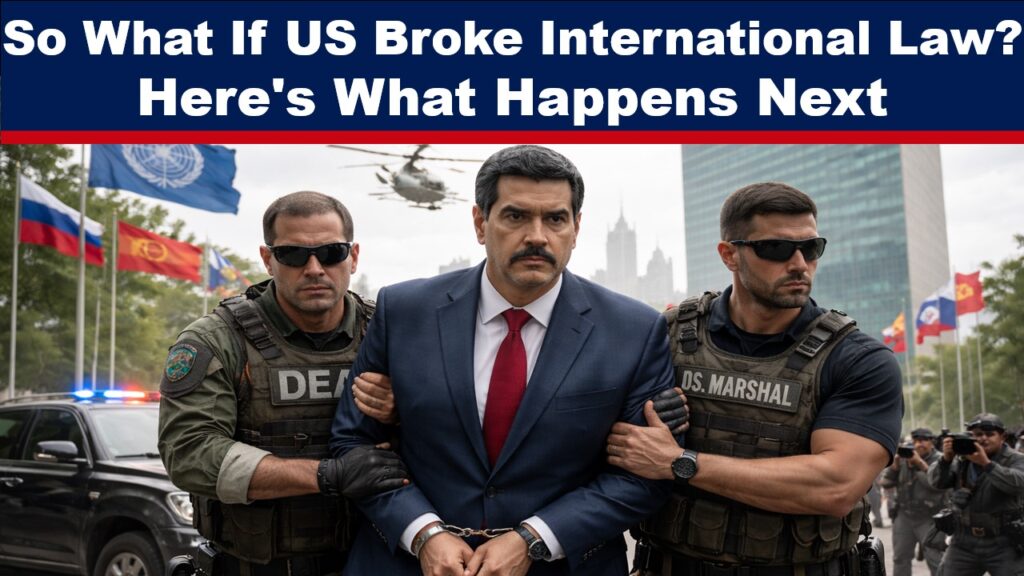
In recent days, global attention has focused on reports that Venezuelan president Nicolas Maduro has been captured by US forces and transferred out of Venezuela to face prosecution. Such an operation represents one of the most dramatic unilateral decisions taken by Washington in decades – and one that many governments and legal experts say could violate international law. As statements from Europe, Latin America, and the BRICS countries pile up, critical questions must be answered: did the US cross a legal red line, and if so, what precedent does that set for the global order?
The Maduro Capture
US forces conducted an operation on Venezuelan territory resulting in the capture of President Maduro, who has long been indicted in US courts on narcotics-related charges. The US government has labelled Maduro the head of a “narco-state” and previously placed a multimillion-dollar bounty on his arrest.
What’s now being disputed is the precise legal basis for the operation. Washington has not claimed authorisation from the United Nations Security Council, nor has it publicly asserted that Venezuela launched an armed attack against the US – the two standard justifications for the use of force under international law.
What International Law Says
At the heart of the controversy is the UN Charter – particularly Article 2(4) – which prohibits the use of force against another state’s sovereignty or political independence. But there are two widely recognised exceptions:
- UN Security Council authorisation, or
- Self-defence following an armed attack under Article 51
Most international law experts argue that criminal indictments, drug trafficking accusations, or simple “law enforcement” objectives do not qualify as self-defence according to the Charter. In addition, sitting heads of state generally have personal immunity from foreign arrest while in office, unless prosecuted by international tribunal or removed domestically. As such, analysts agree that the case here is highly problematic.
Other Countries Condemn the Operation
Several governments have publicly described the Maduro capture as a violation of international law, warning against setting a dangerous precedent.
- Spain: Prime Minister Pedro Sanchez said Spain “cannot accept the use of force against another sovereign state without international authorisation,” calling it a clear breach of the UN Charter
- Russia: The Kremlin called the operation an “illegal abduction” and accused Washington of behaving as a “global enforcer above the law”
- Brazil: President Luiz Inacio Lula da Silva warned that normalising such actions would destabilise Latin America and undermine international norms
- China: Criticised the action, calling it an abuse of power and urging Maduro’s release
The US Says It Had Its Reasons
The US appears confident it had just cause, and operated within legal framework, arguing that Maduro is not a legitimate head of state but the leader of a criminal organisation. It adds that the Venezuelan president’s indictment on narcotics and terrorism-related charges places him outside normal diplomatic protections, and that the operation was a law-enforcement and national security action, not a traditional military intervention.
These arguments are proving controversial as international law does not allow states to strip another leader of head-of-state immunity – even if they themselves consider that leader illegitimate.
Israel has spoken positively about the operation but has not explicitly endorsed the legality of it. Other leaders of anti-Maduro campaigns in Colombia and Chile have also welcomed his capture. Meanwhile, US allies such as the UK, France, Germany, Canada have either expressed concern about international law, called for clarification, or remained carefully non-committal. Ultimately, no government has expressed that they believe the operation was lawful.
This Could Change the Global Order
The implications of this situation extend far beyond one country. If the capture of a sitting president without UN approval becomes normalised, then any powerful state could justify similar actions against weaker ones. That risk is why even governments who are hostile toward Maduro have still expressed concern.
For decades, the post-1945 international order has rested on the principle that sovereignty protects even unpopular regimes from external force in order to prevent great-power chaos.
What Might Happen Next
The fallout from the Maduro capture is unlikely to result in immediate legal punishment. However, the political consequences and the precedent set here will be felt worldwide.
Venezuela’s allies – such as Russia, Brazil, China – may push for condemnations, symbolic retaliation, and UN legal motions. These carry limited enforcement powers, but could formalise opposition and harden existing anti-US blocs.
For allies of the US, relationships may be tested behind closed doors. Partners are unlikely to publicly confront the issue. Silence should not be assumed to equal comfort, however. Quietly, even friendly nations’ trust in the stability of international rules could erode.
But most importantly, the precedent risk will have the longest lasting consequence. If this action is found to have violated international law and goes unpunished, then it lowers the political cost of similar operations in future. States may feel emboldened to justify cross-border arrests simply by finding a way to label opponents as criminals or illegitimate leaders. That erosion of restraint worries governments worldwide – even if they privately welcome Maduro’s removal.
Final Thought
Whether Maduro is viewed as a criminal or tyrant is not the legal question here. While millions of Venezuelans are reported to be celebrating in the country and abroad, the real storyline is yet to play out. Depending on what happens in the short term, this case may be better remembered for what it revealed about the fragility of international law rather than who was captured in the first place.
The Expose Urgently Needs Your Help…
Can you please help to keep the lights on with The Expose’s honest, reliable, powerful and truthful journalism?
Your Government & Big Tech organisations
try to silence & shut down The Expose.
So we need your help to ensure
we can continue to bring you the
facts the mainstream refuses to.
The government does not fund us
to publish lies and propaganda on their
behalf like the Mainstream Media.
Instead, we rely solely on your support. So
please support us in our efforts to bring
you honest, reliable, investigative journalism
today. It’s secure, quick and easy.
Please choose your preferred method below to show your support.

Categories: Did You Know?, World News
Not interested.
International Law ????
BS !!!!!!
US could have just opened a door. Not sure what is behind that door! However, if Putin had gone in and grabbed Zelensky, how different would things have been? Millions have been killed and displaced. Was it necessary?. The wrong people did well out of it.
Perhaps land/behaviour disagreements between countries should be fought in special world courts(Dreaming) Who knows one day we find our selves civilised and find another way of solving our arguments that doesn’t involve the meat grinder/missiles/kidnap. Just a fanciful thought.
Alot of people are happy over Trumps actions. I certainly would dance in the streets if it happened over here and certain dictators were deservedly removed.
This is just another scam about control.
You forgot one thing. Everyone just confirms what they know about US: terrorists and oil/resources thieves/leechers.
They are a very young civilisation. Insecure.
Let’s see, world history …. tribal slaughters, village pillages, government deliberately caused mass starvations, world wars, ….. now infecting and killed massive number of people with deadly viruses and/or germs. Oh, what about injecting people to cause ……
700 Million Worldwide Will Die from CV19 Vax by 2028 – Dr. David Martin | Greg Hunter’s USAWatchdog
they forced those poor souls into ghetto,s and slums then they starved and mistreated those souls to the point were the Nazi,s offered them food cloths a shower and a new life if they get on the trains . and they did ..
UN has been controlled by globalists and communists. Do you think they can issue an just authorization on anything? It’s time for a new page in history.
i am not sure about millions of people celebrating, some of the videos of these celebrations are found to be false so watch out for the propaganda. I know some of the Venezuelans did not like Maduro, specially the ones living out of the country, but some others do like him, i personally don’t know much about him so cannot say.
But what i believe this is nothing to do with the narco-traffic but more with the Petrol, control of the richness of the county, and ultimately to take China out of it.
as per ‘anti-Maduro campaigns in Colombia and Chile have also welcomed his capture’ haha, lets see when it is they turn to be assaulted if they fell the same! watch out for the cowboys and their sheriff coming into your town