













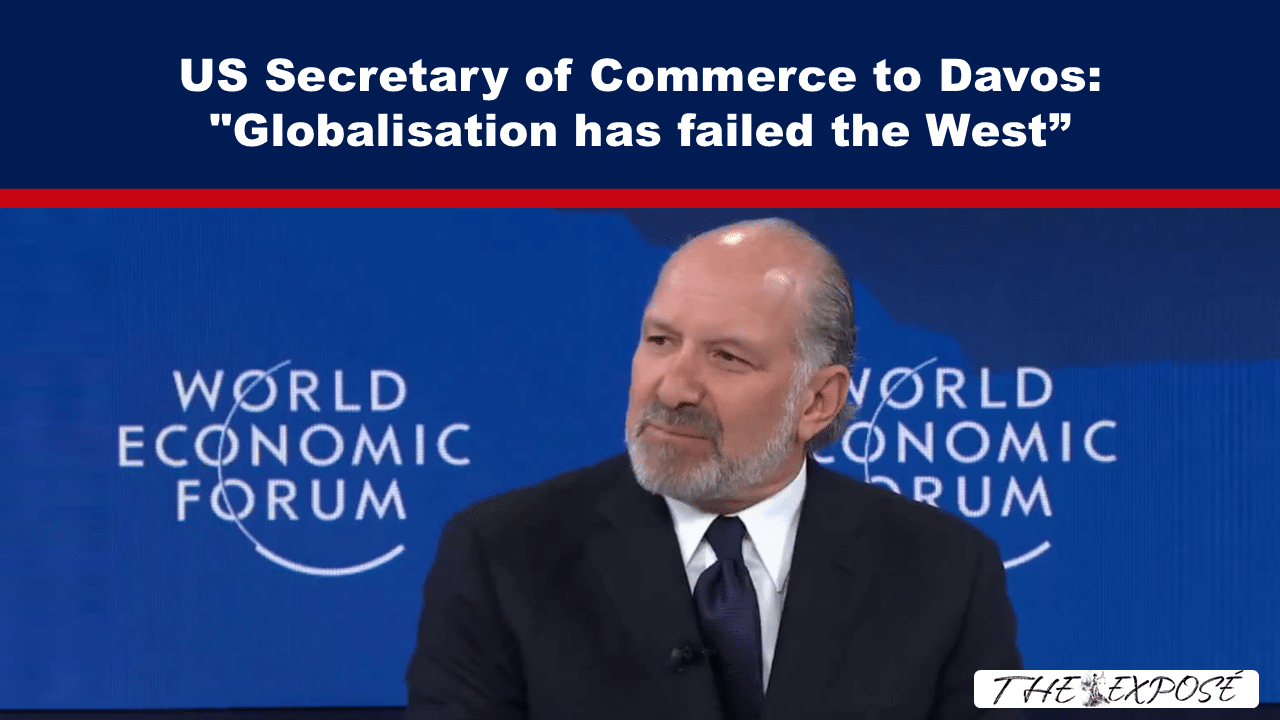
Howard Lutnick, US Secretary of Commerce, said at last week’s annual meeting of the global oligarchs and their puppets, “Globalisation has failed the West.” At the same meeting, the US launched its “Board of Peace.”
It has been known for years that the United Nations system has been under strain and on the verge of collapse, and, so they say, a “new world order” is needed to replace it.
At Davos, far from being an indication that the end of globalism is nigh, are we witnessing the birth of the United Nations’ replacement – the same globalism under a different name?
Let’s not lose touch…Your Government and Big Tech are actively trying to censor the information reported by The Exposé to serve their own needs. Subscribe to our emails now to make sure you receive the latest uncensored news in your inbox…
Lutnick delivered a series of high-profile and controversial remarks at the World Economic Forum (“WEF”) in Davos, Switzerland, during the 56th annual meeting from 19-23 January 2026.
At a closed-door dinner hosted by BlackRock CEO Larry Fink, Lutnick faced widespread heckling and jeering after delivering combative remarks sharply critical of Europe and globalist economic policies. European Central Bank President Christine Lagarde reportedly walked out during his speech, as did other senior European officials, prompting the event’s hosts to call off the dinner before dessert.
During a panel titled ‘Prosperity: Sovereign Yet Connected?’, Lutnick declared that “globalisation has failed the West and the United States of America,” arguing that decades of offshoring and far-shoring have hollowed out domestic industries, weakened national sovereignty and left American workers behind.
Some are hailing it as the US has fired a cannonball across the bow of globalism.
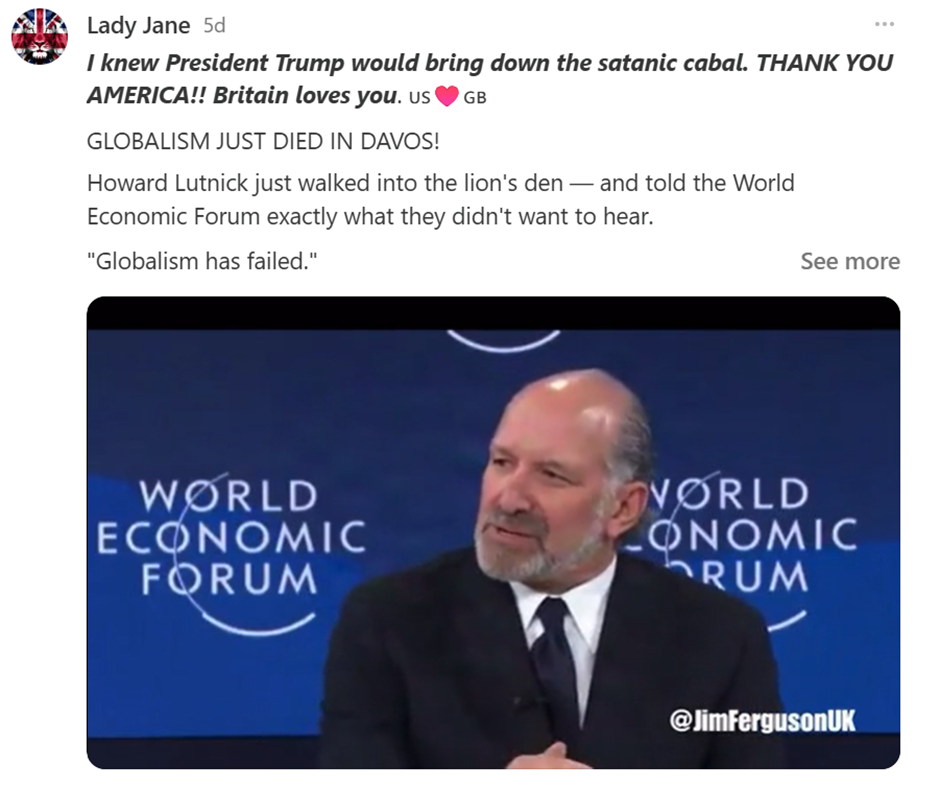
But was it? Or was it just for show? Or is it perhaps simply European oligarchs and American oligarchs vying to be at the top of the pile?
To understand what happened, we need to consider what the various terms used by Globalists mean – they are often conflated, and globalisation had already been on the way out for years. Globalism, it seems, is alive and well.
There are several terms used to describe the system that the Globalists are implementing. Whether by design or by default, these terms are easily conflated as they are similar concepts and tend to overlap.
Globalisation
Globalisation is the process of increasing interdependence and integration among countries’ economies, societies and cultures. It is driven by the free movement of goods, services, capital, people and information across borders, enabled by advances in transportation, communication technologies and trade liberalisation.
Globalisation is what the oligarchs and their puppets at the World Economic Forum have stood for. It is also the reason why the United Nations was set up.
The Rules-Based International Order (“RBIO”) or rules based order (“RBO”) serves as a framework to govern globalisation’s dynamics. The RBIO refers to the system of international laws, institutions and agreements – such as the United Nations, World Trade Organisation and international treaties – that emerged after World War II and was later rebranded from the “liberal international order” (“LIO”). It was in the 1990s that the term RBIO emerged from under the shadow of the more commonly used term LIO.
As the Parley Policy Initiative explained:
Governments across the globe recognised it in the 1910s as the Great War spanned from the trenches of Europe to the waters of the Pacific. When the shooting stopped, members of the international community sought to create a new order through the establishment of the League of Nations.
However, the League of Nations failed, and the world plunged once again into world war. While the fighting raged on, diplomats worked simultaneously to design a new international system … The product of this effort was the United Nations, and it came into being once World War II ended.
The “Rules-Based International Order,” explained, Parley Policy Initiative, 3 May 2023
The League of Nations was an intergovernmental organisation founded on 10 January 1920, following the Paris Peace Conference that ended World War I. It was formally dissolved on 18 April 1946, transferring its assets, archives and functions to the newly established United Nations, which was created in 1945. In other words, the failed League of Nations, formed as a consequence of World War I, was rebranded the United Nations on the back of World War II.
The United States is the main driver of the United Nations, both in its founding and ongoing operations. As a founding member, the US played a pivotal role in establishing the UN after World War II and shaping its structure.
The RBIO and globalisation are distinct concepts but are deeply interconnected. Globalisation has been both a driver and a beneficiary of the RBIO.
Recently, in reports about the USA’s stance on Greenland, British news reports have attempted to blame the collapse of the RBIO system (or the “world order” as many will call it) on President Donald Trump. However, the system has been under strain for some time.
In January 2025, for example, the House of Lords debated challenges to the RBIO. The lede to the ‘In Focus’ published in the lead up to the debate states, “In recent years, many commentators suggest that a growing strain has been placed upon this system [the rules-based international order] and that a new commitment to global stability and security is required.”
“Writing in 2019, Professor Malcolm Chalmers contended that there was already growing strain in the international rules relating to economic governance that have underpinned trade liberalisation. He argued that support for economic globalisation was being eroded by growing inequality and nationalism within Western states, and was also under threat from the re-emergence of competition with major non-Western powers, and with Russia and China in particular,” the Lords’ In Focus said.
If we want to cut a long story short, it sounds as if the United Nations system is under threat and a “new world order” is required to replace it. It cannot be a coincidence that in January 2026, US President Donald Trump established the “Board of Peace,” an international organisation authorised by United Nations Security Council Resolution 2803 and formally launched at the World Economic Forum meeting in Davos. The “Board of Peace” was established to oversee post-war reconstruction in Gaza and deploy a temporary peacekeeping force, though the Board’s charter does not mention Gaza directly.
The Board includes a founding Executive Board with members such as Marco Rubio (Secretary of State), Jared Kushner, Tony Blair (former UK Prime Minister), Steve Witkoff (special envoy), Ajay Banga (World Bank President), and Marc Rowan (CEO, Apollo Global Management).
Alarm bells should ring when we see the involvement of Globalist puppet Tony Blair, private companies and the World Bank, a specialised agency of the United Nations, at the top of the structure.
When the League of Nations failed, the United Nations took over. Now the United Nations is failing. Does the “Board of Peace” feel like the same agenda under a different name?
Related: Organisations that make up the UN World Government System
Internationalism
Internationalism represents a different vision of global interconnectedness from globalisation. Internationalism is a political and ethical principle emphasising cooperation, solidarity and mutual respect among nations. It prioritises peace, justice, and equity, advocating for multilateralism, respect for national sovereignty, and collective action on global challenges like climate change, poverty, and human rights.
Globalisation, in contrast, refers to the economic and cultural process of increasing interconnectedness and interdependence across the world. While it involves the exchange of goods, ideas and technology, it is often driven by unfettered capitalism, corporate interests, and the expansion of global markets.
Globalism
While used by many as interchangeable with globalisation, globalism is not the same. Globalism is an ideology or worldview that emphasises the interconnectedness of the world and advocates for cooperation, open borders and policies that prioritise global interests over national ones. It supports international collaboration in areas like trade, environmental protection, and human rights. Globalists believe that global challenges – such as climate change or pandemics – require collective action and that mutual respect and shared responsibility are essential for global stability.
In short, globalism is the belief in a connected world; globalisation is the process of becoming more connected. In other words, globalism is the ideology behind globalisation.
Sources for this article include:
- Globalisation vs. Globalism: Giving Internationalism a Bad Name, Mark Ritchie, President, Institute for Agriculture and Trade Policy, January 1996
- Globalisation Versus Internationalisation, Global Policy Forum, 1999
- Differentiating Globalism and Internationalism, Abhipedia
- Rules-based order: What’s in a name? The Interpreter, 30 June 2021
- The Rules-Based International Order: A Historical Analysis, MIT Press Direct, 1 November 2025
- US Commerce Secy Howard Lutnick heckled at Davos dinner after ECB chief Lagarde walks out over Europe criticism, Live Mint, 22 January 2026
- Lutnick: Getting booed by Al Gore ‘greatest honour’ of Davos trip, The Hill, 23 January 2026
The Expose Urgently Needs Your Help…
Can you please help to keep the lights on with The Expose’s honest, reliable, powerful and truthful journalism?
Your Government & Big Tech organisations
try to silence & shut down The Expose.
So we need your help to ensure
we can continue to bring you the
facts the mainstream refuses to.
The government does not fund us
to publish lies and propaganda on their
behalf like the Mainstream Media.
Instead, we rely solely on your support. So
please support us in our efforts to bring
you honest, reliable, investigative journalism
today. It’s secure, quick and easy.
Please choose your preferred method below to show your support.

Categories: Breaking News, World News