














Ignoring that oil and natural gas are hydrocarbons that are produced abiotically and assuming the fossil fuel account, Jerome Corsi challenges the global reserve estimates used by peak production theorists.
He does this by discussing in depth the deep-earth and deep-water reserves, which, as technology improves to extract them, the estimates of how much there is increase. The increasing, rather than decreasing, estimates challenge peak oil and peak gas assumptions.
As we read the overview below, we should bear in mind that Corsi’s book was originally published in 2012, and so the facts and figures he provides are as of that date.
Let’s not lose touch…Your Government and Big Tech are actively trying to censor the information reported by The Exposé to serve their own needs. Subscribe to our emails now to make sure you receive the latest uncensored news in your inbox…
The Great Oil Conspiracy: How the US Government Hid the Nazi Discovery of Abiotic Oil from the American People by Jerome R. Corsi, 2014 edition
Please note: The following has been summarised by an AI programme. AI programmes are prone to inaccuracies and “hallucinations.” We advise readers to refer to the original book to check the accuracy of information. A copy of the book can be downloaded HERE and you can listen to the audiobook HERE.
Chapter 4: Deep-Earth and Deep-Water Oil
Table of Contents
- Deep-water Drilling and Fossil Fuel Theories
- The Cantarell Oil Field and Meteor Impact Theories
- Pemex's Deep-water Discoveries in Mexico
- Geological Factors in Saudi Arabian Oil Formation
- Debates on Saudi Oil Reserves and Peak Production
- The Deepwater Horizon Disaster and Its Implications
- Brazil's Offshore Oil Developments and Pre-salt Discoveries
- Deep-earth Natural Gas Resources in the United States
- Technological Advancements in Ultra-deep Drilling
- Challenges and Costs of Deep-Earth Drilling
- Future Prospects and Unexplored Hydrocarbon Resources
Deep-water Drilling and Fossil Fuel Theories
The advances in deep-earth and deep-water drilling have challenged the fossil fuel theory, with this segment of the energy industry experiencing rapid growth over the last twenty years, and international companies are now planning to expand deep-water drilling in Mexican and Cuban waters beyond US control.
Despite the moratorium on deep-water exploration and production in the Gulf of Mexico after the Deepwater Horizon disaster, by early 2012, forty rigs were drilling in the Gulf, compared to only twenty-five a year earlier, with British Petroleum having five rigs drilling in the Gulf, the same number as before the disaster.
The Energy Information Administration expects oil production in the Gulf to increase from 1.3 million barrels a day to 2 million barrels a day by 2020, and without the restraints placed on Gulf drilling by the Obama administration, the oil production numbers would be dramatically higher.
Deep-water drilling typically involves offshore rigs drilling on the continental shelves around the world in water thousands of feet in depth, and the advantage of offshore drilling is that oil rigs get free passage through water before deep-earth drilling begins, allowing deeper drilling into the earth with less technical difficulty and expense.
The Cantarell Oil Field and Meteor Impact Theories
The Cantarell oil field, discovered in 1976, has been largely responsible for keeping Mexico in the top ten oil producing countries in the world, and its discovery is believed to be linked to a massive meteor that hit the earth at the end of the Cretaceous Period, approximately sixty-five million years ago, in the Yucatan near the town of Chicxulub.
Geophysicist Glen Penfield established that the meteor impact fractured the Gulf of Mexico bedrock off the Yucatan coast, creating the Cantarell oil field and opening up oil exploration opportunities throughout the Gulf, and physicists Luis Alvarez and his geologist son Walter suggested that an impact meteor hitting Earth between the Cretaceous and Tertiary Periods caused the extinction of the dinosaurs.
The Chicxulub impact crater is enormous, estimated to be 100 to 150 miles wide, and the seismic shock of the meteor deeply fractured the bedrock below the Gulf, facilitating the flow of liquids and gases from the deep earth below, and geologists have come to realize that the intense shock waves generated in meteor impact events have significantly shaped the earth’s surface, distributed its crust, and fractured its bedrock.
The identification of over 150 significant geological structures worldwide, including circular impact bowls, has led to the exploration of meteor impact structures as potential oil-producing sites, with Cantarell being a notable example that has stimulated interest in this area.
Pemex’s Deep-water Discoveries in Mexico
Petroleos de Mexico, also known as Pemex, has discovered two deep-water oil fields, Noxol-1 and Lakach-1, off the shores of Veracruz in the Gulf of Mexico, with estimated reserves of ten billion barrels of oil in the Coatzacoalcos Profundo area.
Pemex has announced plans to deploy two state-of-the-art drilling platforms in the area, with one rig drilling in 9,514 feet of water and the other in 8,316 feet of water, which is considered ultra-deepwater drilling.
Geological Factors in Saudi Arabian Oil Formation
The abundance of oil in Saudi Arabia, as opposed to neighboring countries like Afghanistan, is attributed to the deeply fractured bedrock beneath the Saudi oil fields, which allows oil to seep up from the mantle of the earth through these fractures.
A study by geologist H. S. Edgell, published in 1992, provides evidence that the Saudi oil fields, including the giant field at Ghawar, were produced by oil seeping up through bedrock fractures in the basement rock, which is composed of crystalline Precambrian rock that dates back to the origin of the Earth.
The oil fields in Saudi Arabia are mostly located in the northeastern part of the country, including the offshore portion of the Persian Gulf, and are characterized by extensional block faulting in the Arabian Trend, which is a geological feature that constitutes the “old grain” of Arabia.
The discovery of oil in these areas has led to a greater understanding of the role of geological structures and bedrock fractures in the formation of oil fields, and has significant implications for the exploration and production of oil in the future.
The Mesozoic Era, which began 250 million years ago, is when dinosaurs first appeared on Earth, marking a significant distance in time from the Precambrian Era, and this era is relevant to the discussion of oil formation in Saudi Arabia.
According to H. S. Edgell’s study, the abundance of oil in Saudi Arabia can be attributed to the fault patterns in the underlying bedrock, which allow oil from the Earth’s mantle to seep upward into the porous sedimentary strata above, and this theory is supported by the fact that all known oil fields in Saudi Arabia are related to four major directions of basement faulting.
Edgell’s conclusion suggests that the origin of oil in Saudi Arabia is not related to dinosaurs, ancient forests, plankton, or algae, but rather to the deep-seated tectonic movements in the Precambrian crystalline basement, which has resulted in the formation of anticlinal or domal structures that contain all the known oil and gas fields in the region.
Debates on Saudi Oil Reserves and Peak Production
Matthew Simmons, in his book “Twilight in the Desert”, presents a grim picture of Saudi Arabian oil prospects, arguing that even the giant oil field of Ghawar is depleting and is increasingly cut by water to increase production, which stands in contrast to the more optimistic view of the Saudi Minister of Petroleum and Mineral Resources, Al-Naimi.
Al-Naimi estimates that Saudi Arabia has 1.2 trillion barrels of estimated oil reserves, a figure that is considered conservative, and notes that new resources are being discovered and new technologies are being used to extract more oil from existing reserves, which is a more optimistic view than Simmons’ prediction of peak production.
The Energy Information Administration estimated Saudi oil resources at approximately 261.9 billion barrels in 2011, which is one-fifth of the world’s proven oil reserves, but only 20 percent of Al-Naimi’s 2004 estimate, highlighting the difficulty in obtaining accurate data on Saudi oil reserves and production.
The lack of reliable data on Saudi oil reserves and production, particularly with regards to the Ghawar field, makes it challenging to determine whether Saudi Arabia has reached peak production, and this uncertainty is exacerbated by the fact that few people, even among energy experts, have access to detailed information about Ghawar’s performance and parameters.
The Saudi oil reserves are difficult to estimate due to the possibility of abiotic oil production, where oil is formed in the Earth’s mantle and flows upward, making it challenging to determine the rate of oil production and replenishment.
The Deepwater Horizon Disaster and Its Implications
The Deepwater Horizon oil rig disaster, which occurred on April 20, 2010, in the Gulf of Mexico, was the largest oil spill in history, causing the deaths of eleven workers and resulting in a massive oil spill that was eventually capped after eighty-six days.
The oil well, operated by British Petroleum (BP), was drilled in 4,130 feet of water and extended another 30,923 feet below the sea floor, reaching a total depth of over six miles below the surface of the Gulf, and struck oil in multiple reservoirs in the Lower Tertiary geological zone.
According to BP, the discovery was a significant find, with the potential to rival other large fields in the Gulf, such as the Thunder Horse field, which was producing 300,000 barrels of oil a day at the time of the announcement.
The National Oil Spill Commission attributed the disaster to a failure of BP management to evaluate risk factors and implement necessary technical and operating safeguards, while some environmentalists, such as Damian Carrington, suggested that the real cause of the disaster was peak oil and the need to transition to alternative energy sources.
Abiotic oil observers had a different analysis of the situation, although the details of their perspective are not fully explored in the book, which includes quotes from notable figures such as Daniel Yergin, chairman of Cambridge Energy Research Associates, and Daren Beaudo, a BP spokesman.
The discovery of oil in the Lower Tertiary geological zone, which dates back thirty-eight to sixty-eight million years, was seen as a significant find, with BP viewing the area as one of the next big waves of development in the Gulf of Mexico, and the company’s Kaskida find having estimated reserves of four to six billion barrels.
The Deepwater Horizon rig’s explosion suggests that the oil reserves it discovered were enormous, possibly generating more pressure than current technology could safely handle, and the only solution was to cap the well, which BP may reopen in the future when technology advances to manage the pressures and temperatures involved.
Brazil’s Offshore Oil Developments and Pre-salt Discoveries
Brazil’s semi-public oil company, Petrobras, has made significant progress in developing technology to drill ultra-deep offshore wells in the Campos Basin, allowing the country to rapidly reduce its dependence on foreign oil imports and sugar-produced ethanol.
According to the Energy Information Administration, Brazil has increased its oil production from almost no oil in 1980 to approximately 2.1 million barrels of crude oil a day in 2011, with a growth rate of about 9 percent per year, and is expected to become oil independent and a net oil exporter in the near future.
The Brazilian government has set a long-term goal of increasing domestic oil production, and recent discoveries of large offshore pre-salt oil deposits could transform Brazil into one of the world’s major oil producers, with the country consuming 2.2 million barrels per day and expecting to produce three million barrels a day by 2013.
To develop the oil resources of the Campos Basin, Petrobras formed a special purpose corporation, the Barracuda & Caratingua Leasing Company B.V., which awarded a $2.5 billion contract to Halliburton’s Kellogg Brown & Root subsidiary to engineer, procure, install, and construct fifty offshore wells and two floating production-storage-offloading vessels.
The Barracuda and Caratingua fields are expected to add 30 percent to the current production rate from the Campos Basin region, covering a combined area of 230 square kilometers, with estimated proven oil reserves of 1.229 billion barrels, and expected to produce 773 million barrels of oil by 2025, which challenges the “peak production” and “fossil fuel” theories that predict the depletion of oil fields.
The discovery of massive oil deposits in the Campos Field has led to the exploration of other fields on Brazil’s intercontinental shelf, resulting in the discovery of a second huge offshore oil field in the Santos Basin, known as the Tupi Field, which is estimated to contain between five and eight billion barrels of oil.
The Tupi Field, located in the Santos Basin, is a significant discovery that could expand Brazil’s proven oil reserves by 40 to 50 percent, with the field found under 7,060 feet of water, 10,000 feet of sand and rocks, and 6,600 feet of salt, totaling 4.48 miles below the surface of the Atlantic Ocean.
In addition to the Tupi Field, Petrobras announced the discovery of the Lula field in the Santos Basin in April 2012, which could make the Santos Basin equally as productive as the Campos Basin, with the Energy Information Administration estimating that world consumption of natural gas is expected to increase from 111 trillion cubic feet in 2008 to 169 trillion cubic feet in 2035.
Deep-earth Natural Gas Resources in the United States
The International Energy Administration’s World Energy Outlook 2011 suggests that the world may be entering a “golden age of gas,” with conventional recoverable resources of natural gas estimated to be equivalent to more than 120 years of current global consumption, and total recoverable resources potentially sustaining today’s production for over 250 years.
In the United States, there are abundant deep-earth and deep-water oil and natural gas resources, particularly at depths below 15,000 feet, with the Potential Gas Committee’s 2003 Report indicating that there were over 2,500 active natural gas wells producing at or below that level, drawing from 183 natural reservoirs located primarily in the on-shore and off-shore basins of the Texas and Louisiana Gulf Coasts.
The US Department of Energy notes that more than 70 percent of the natural gas produced in the United States comes from wells at 5,000 feet or deeper, while only 7 percent comes from formations below 15,000 feet, and estimates that 125 trillion cubic feet of natural gas is thought to be trapped at depths below 15,000 feet.
The GHK Company in Oklahoma holds the western world’s record for deep-well natural gas exploration and production, having engineered and drilled two Oklahoma natural gas commercial wells at depths greater than 30,000 feet, including the #1-27 Bertha Rogers well and the #1-28 E.R. Baden well, both located in the deep and high-pressure Anadarko Basin.
The GHK company has reported drilling and operating 193 wells, with the majority being below 15,000 feet, and has not experienced a blowout since its founding in the mid-1980s, achieving a success ratio of 82 percent for all drilling operations from 1995 to 2005.
A study conducted by Mark Snead, PhD, the director of the Center for Applied Economic Research at the University of Oklahoma’s Spears School of Business, highlights the success of deep-well drilling for natural gas in Oklahoma, with the first hole drilled below 30,000 feet for commercial production purposes completed in Beckham County in 1972.
The Anadarko Basin has historically been one of the most prolific natural gas producing regions in the United States, with 20 percent of the holes drilled deeper than 15,000 feet prior to 1991 located in this basin, and 19 of the 52 existing ultra-deep wells below 25,000 feet drilled in the Anadarko Basin through 1998.
The Potential Gas Committee reports that a total of 1,221 producing deep wells were completed in Oklahoma at an average depth of 17,584 feet, with 775 of these wells currently active, demonstrating the overall success of deep drilling of natural gas resources across the United States.
Technological Advancements in Ultra-deep Drilling
According to Dr. Snead’s report, important technological advances have facilitated the ultra-deep drilling of natural gas wells, including advances in computer technology that have produced breakthroughs in reservoir modeling, enabling better estimates of the size and location of recoverable deposits.
The US Department of Energy’s Office of Fossil Energy has established a “Deep Trek” program to lower the cost and improve the efficiency of drilling commercially productive deep wells, recognizing the potential for deep-well drilling of natural gas and the need to penetrate rock structures that sound more like bedrock than sedimentary layers.
The common wisdom that natural gas, like oil, is a “fossil fuel” is being challenged, and the Energy Information Administration’s “Energy Kids” page explains the traditional theory of how natural gas is formed from the remains of plants and animals that decayed into organic material millions of years ago.
The “Deep Trek” project, financed by the US Department of Energy, is working to develop new technologies, such as the polycrystalline diamond drill bit, to tap into the estimated 125 trillion cubic feet of natural gas resources that lie beneath the continental United States at depths of 15,000 feet or deeper, which is a technologically daunting and expensive task.
Challenges and Costs of Deep-Earth Drilling
Drilling into deep formations is extremely challenging due to the hot, hard, abrasive, and high-pressure rock, which can slow down the drill bit to only two to four feet per hour, resulting in high operating costs of tens of thousands of dollars a day for land rigs and millions of dollars a day for deep offshore formations.
The development of new technologies, such as the “diffusion bonding” approach developed by scientists at the Energy Department’s Sandia National Laboratories, is helping to improve the efficiency of drilling into difficult formations and supporting the theory that the origin of oil is abiotic, not organic in nature.
Future Prospects and Unexplored Hydrocarbon Resources
Global reserve estimates for natural gas have increased as geo-scientists realize the abundance of deep-earth natural gas, which challenges peak production assumptions, and estimates of deep-earth natural gas global reserves are expected to increase dramatically as technological advances permit exploration at greater depths below the water surface and at greater distances out from the continental shelves.
The National Oceanic and Atmospheric Administration estimates that oceans cover 71 percent of the Earth’s surface, and with such a large area remaining unexplored, geoscientists have no way to reliably estimate the quantity of deep-earth and deep-water hydrocarbon fuels that the Earth may hold, leaving room for further discovery and exploration.
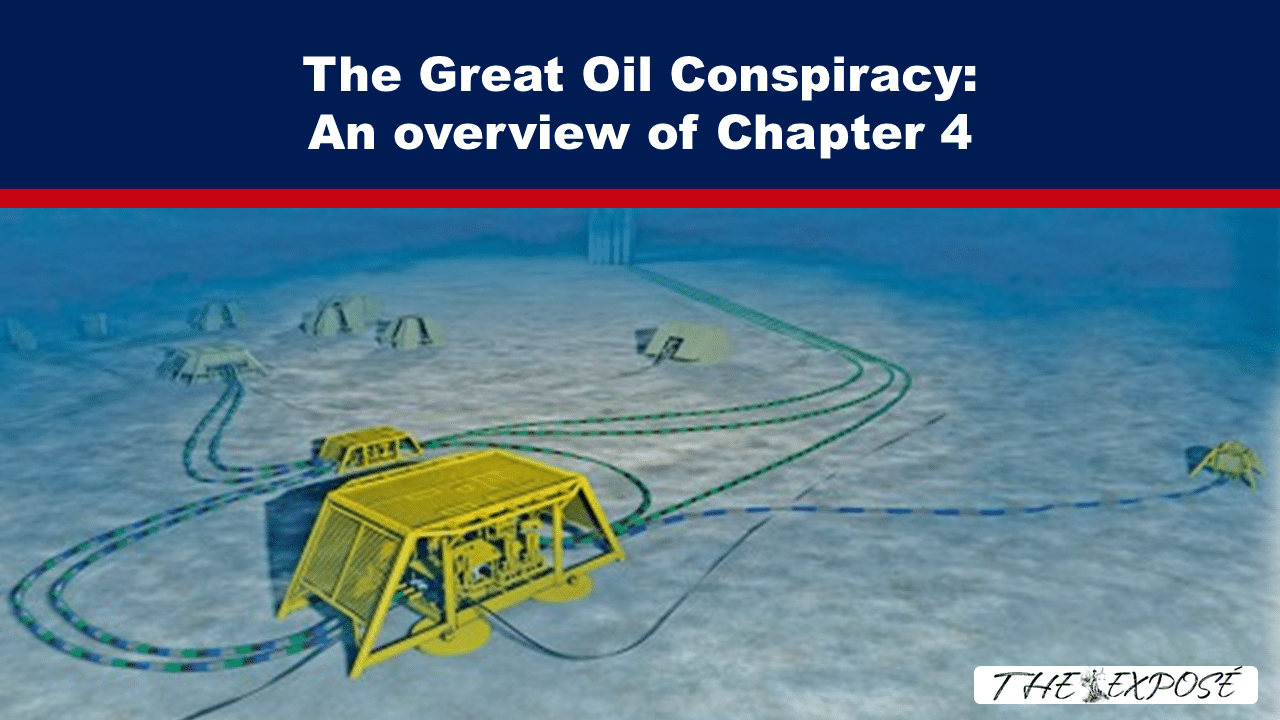
Featured image: Gas and oil in deep water are increasingly being extracted with subsea systems that are located on the sea floor. Source: World Ocean View
The Expose Urgently Needs Your Help…
Can you please help to keep the lights on with The Expose’s honest, reliable, powerful and truthful journalism?
Your Government & Big Tech organisations
try to silence & shut down The Expose.
So we need your help to ensure
we can continue to bring you the
facts the mainstream refuses to.
The government does not fund us
to publish lies and propaganda on their
behalf like the Mainstream Media.
Instead, we rely solely on your support. So
please support us in our efforts to bring
you honest, reliable, investigative journalism
today. It’s secure, quick and easy.
Please choose your preferred method below to show your support.

Categories: Breaking News, World News
how much more do the stupid need to realize their stupid that’s the question
http://www.weathermodification.com/aircraft.php weather modification aircraft
https://aerospaceglobalnews.com/news/cloud-seeding-and-type-of-aircraft-used/
https://admin.osrl.com/globalassets/technical-information-sheets/wide-area-aerial-dispersant-service-b727-tis-v1-04-2025.pdf
https://chempedia.info/info/spray_tanks_aircraft/
Hey, has someone come across this? Sayer Ji has dug up information from the DOJ Epstein files about Bill Gates’ pandemic structures, that Epstein had set up with JP Morgan in 2011. A structure that was designed to fund vaccines into perpetuity.
BREAKING: The Epstein Files Illuminate a 20-Year Architecture Behind Pandemics as a Business Model—With Bill Gates at the Center of the Network
https://sayerji.substack.com/p/breaking-the-epstein-files-illuminate?utm_source=profile&utm_medium=reader2
Part 2 – Inside Project Molecule — How JPMorgan and the Gates Foundation Turned Biology into Investable Infrastructure
https://sayerji.substack.com/p/inside-project-molecule-how-jpmorgan?utm_source=profile&utm_medium=reader2