













On 5 February, the battle over online free speech took a decisive international turn. In a warning aimed squarely at European regulators, US lawmakers accused the EU of exporting censorship to American citizens through pressure placed on US-based technology companies.
What began as a regulatory disagreement has evolved into a broader confrontation over sovereignty and constitutional values. At issue is whether foreign governments, operating through regulatory frameworks such as the EU’s Digital Services Act, can shape what Americans are allowed to say, read, or publish online, even when that speech is lawful under United States law.
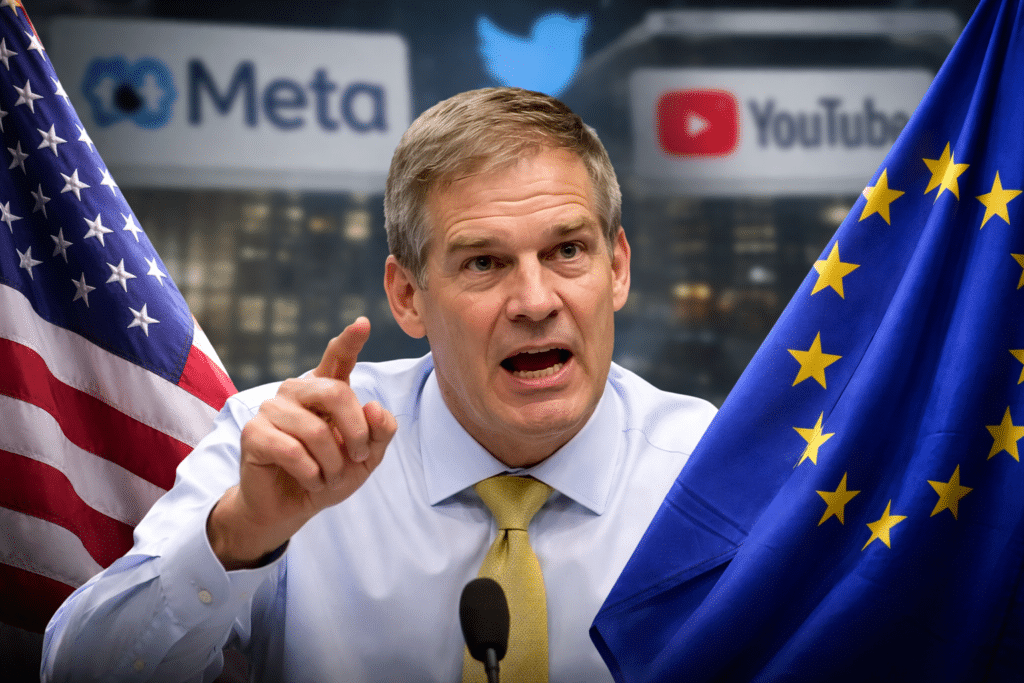
Jim Jordan Warns Europe
At the centre of the dispute is Jim Jordan, chairman of the House Judiciary Committee. Speaking on 5 February, Jordan made clear that his concerns extend far beyond Europe’s internal regulatory choices.
“This is not just about Europe,” he said. “It is about how a global moderation policy ends up shaping what Americans can say, read, or publish online.”
Jordan’s remarks accompanied the release of findings from the Judiciary Committee’s investigation into international censorship practices. The committee argues that EU regulators, particularly those operating out of Brussels and Ireland, are not merely enforcing local laws but exerting influence over global content moderation systems used by major United States-based platforms.
US Says EU Digital Service Act is to Blame
Much of the scrutiny centres on the EU’s Digital Services Act (DSA), which imposes sweeping obligations on online platforms to remove or restrict content deemed harmful, misleading, or destabilising. While European officials frame the DSA as a consumer protection and safety measure, critics argue its definitions are broad enough to invite political enforcement.
According to the Judiciary Committee, the practical effect is extraterritorial. Because US tech companies operate unified moderation systems, content flagged under EU rules is often suppressed globally. This allows European regulators to bypass the First Amendment indirectly.
Jordan and his colleagues argue that the DSA creates incentives for over-compliance. Faced with heavy fines and regulatory threats, platforms may choose to err on the side of censorship, applying Europe’s most restrictive standards worldwide.
Did the EU Interfere With Elections?
One of the most serious claims in the committee’s report concerns elections. The Judiciary Committee concludes that EU regulators, including authorities in Brussels and Ireland, interfered in Irish electoral processes in 2024 and 2025 by pressuring platforms to restrict political content during sensitive campaign periods.
According to the report, these interventions were justified under misinformation and public order provisions, but resulted in the suppression of lawful political speech. This sets a dangerous precedent, where regulatory bodies shape electoral discourse without direct democratic accountability.
The implications extend beyond Ireland. If such practices become standard, similar pressure could be applied in other countries, with platforms acting as de facto enforcers of regulatory preferences rather than neutral hosts of political debate.
Biden Censored COVID-19 & Gender Content
Jordan has repeatedly drawn parallels between European regulatory pressure and what his committee has documented domestically. A key reference is a 2024 message from Mark Zuckerberg, in which the Meta CEO confirmed that the Biden administration had pressured platforms to censor content related to COVID-19, immigration, and gender ideology.
For Jordan, the comparison is instructive. In both cases, governments avoided direct legal bans while relying on informal pressure, regulatory threats, and behind-the-scenes coordination to achieve the same result. The concern, he argues, is not partisan but structural.
When state power is exercised indirectly through private platforms, accountability becomes blurred. Speech is restricted without due process, transparency, or meaningful avenues for appeal.
The Divide Between US & EU Grows
The clash reflects a deeper philosophical divide between Europe and the United States. European regulatory culture prioritises harm prevention and social cohesion, often accepting limits on speech as a necessary trade-off. The American tradition, by contrast, treats free expression as a foundational right, even when it produces discomfort or controversy.
As global platforms sit between these competing models, critics argue that the most restrictive rules inevitably dominate. In practice, that means European standards risk becoming the default for the digital public square.
Final Thought
The dispute now unfolding is about more than content moderation. It is about whether democratic societies retain control over their own speech norms in an interconnected world. If foreign regulators can shape American discourse through regulatory pressure, constitutional protections begin to erode without a single law being passed.
Jordan’s warning is ultimately a question of boundaries. Who decides the limits of speech, and under what authority. As digital platforms increasingly mediate public life, the answer will determine whether free expression remains a right, or becomes a privilege managed from afar.
The Expose Urgently Needs Your Help…
Can you please help to keep the lights on with The Expose’s honest, reliable, powerful and truthful journalism?
Your Government & Big Tech organisations
try to silence & shut down The Expose.
So we need your help to ensure
we can continue to bring you the
facts the mainstream refuses to.
The government does not fund us
to publish lies and propaganda on their
behalf like the Mainstream Media.
Instead, we rely solely on your support. So
please support us in our efforts to bring
you honest, reliable, investigative journalism
today. It’s secure, quick and easy.
Please choose your preferred method below to show your support.

Categories: US News, World News
Just slap them with 100% tarrifs. Job done, they will crumble like the little cowards they really are. Un-elected bureaucrats are trying to exercise power that was never given to them. The EU needs to be broken up as a failed project that only serves those unelected bureaucrats on the gravy train and their hands in the cookie jar, stealing from hard-working people across Europe. No one wants them; no one needs them; they are not fit for purpose.
Congress and Trump secretly screwed America last night. This video will be hard to watch.
THEY PASSED IT: Digital Currency Act Takes Effect This Weekend. (Cash Restricted)
https://www.youtube.com/watch?v=vlCnxuEARaM
Saturday midnight is the deadline to withdraw cash, buy gold, guns, ammo w/o Government surveillance.
Further digging has shown this video to be a damned good FAKE. Likely CCP in origin.
This legislation NEVER HAPPENED.
Shut their servers down. Fry their equipment. I’m sure they US has the means. They are invading US territory in an act of war in my opinion.
Luckily for our world enemies, we have the crop of “political leaders” that we do.
I am not optimistic for the USA.