














This article has been corrected to remove unfounded claims we later discovered to be incorrect. Here is a breakdown on what’s actually happening today with digital currency in the US.
Although the specific legislation I previously reported does not exist in the form described, it would be inaccurate to conclude that concerns about digital currency and financial control are misplaced. The United States is steadily developing the technical, regulatory, and institutional foundations required for a far more centralised financial system, even if the final legal step has not yet been taken.
The error lay in assuming that this process had already been completed, rather than recognising that it is still unfolding through incremental and less visible measures.
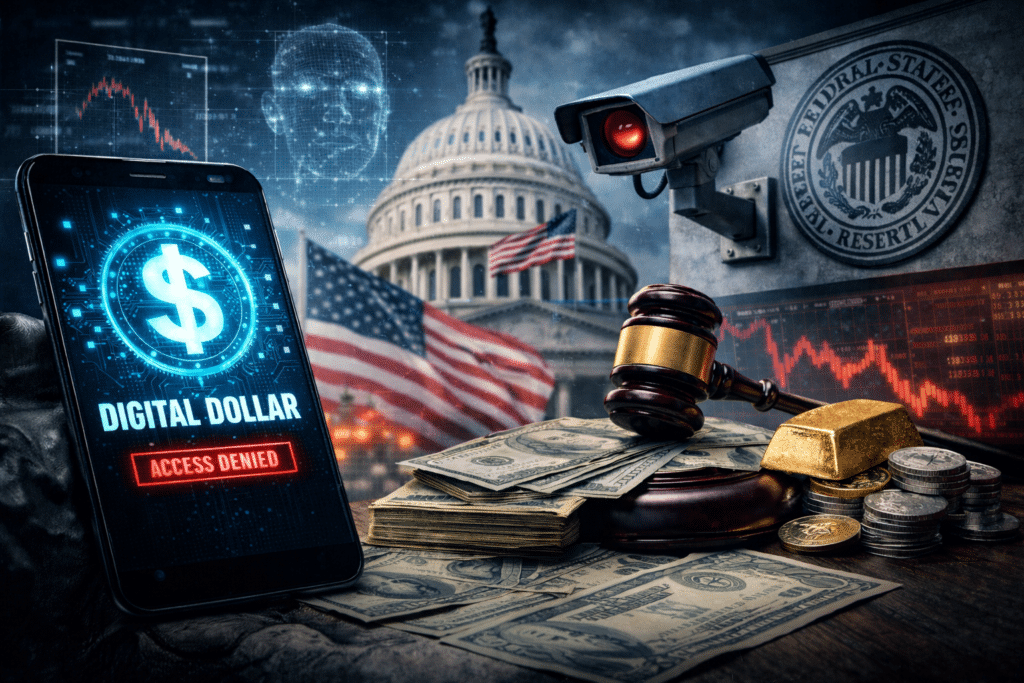
Federal Reserve Has Already Laid the Digital Groundwork
The Federal Reserve has spent several years researching central bank digital currencies and has publicly acknowledged their potential role in the future monetary system. Its discussion paper, Money and Payments: The U.S. Dollar in the Age of Digital Transformation, outlines multiple models for a digital dollar that could be held by individuals and businesses, either directly or through intermediaries.
The paper makes clear that such systems would involve a significantly higher degree of transaction visibility than physical cash. While privacy protections are discussed, they are framed as design choices rather than inherent features. This reflects a broader reality: the capacity for enhanced financial oversight is built into digital currency architecture.
In parallel, the Federal Reserve has participated in pilot programmes such as Project Hamilton, which tested the feasibility of processing large transaction volumes using a digital dollar framework. These initiatives demonstrate operational readiness, even in the absence of formal authorisation to deploy a retail digital currency.
Legislative Division and Political Reality
Congress has not reached a consensus on digital currency, but it has not dismissed the concept either. Instead, it remains deeply divided. Some lawmakers have introduced bills (such as the Anti-CBDC Surveillance State Act) explicitly designed to prevent the issuance of a retail central bank digital currency, citing concerns about surveillance and government overreach. The existence of such legislation indicates that the prospect of a CBDC is considered realistic within policy circles.
At the same time, other legislative efforts focus on expanding regulatory oversight of digital assets, modernising payment infrastructure, and integrating blockchain-based systems into existing financial frameworks, such as the GENIUS Act. These initiatives move the financial system further toward digital-only mechanisms, regardless of whether they culminate in a formal CBDC.
The result is not a rejection of digital money, but an unresolved struggle over how much control the state should exercise over it.
Expansion of Financial Surveillance Without a CBDC
Even without a central bank digital currency, financial surveillance in the United States has expanded substantially. Agencies such as the Financial Crimes Enforcement Network require extensive reporting from banks, payment processors, and digital asset platforms. Broad definitions of suspicious activity place institutions under pressure to report a wide range of lawful behaviour.
The Internal Revenue Service has similarly expanded reporting requirements for third-party payment platforms and digital transactions. These systems already enable detailed monitoring of economic activity, often without individuals being fully aware of the extent of data collection involved, which can be found in more detail here. This page explains how payment apps and third-party settlement organisations are required to report transaction data to the IRS, reflecting the expansion of digital transaction monitoring.
A CBDC would not create financial surveillance where none exists. It would consolidate existing mechanisms into a single, more efficient structure.
Programmable Money as an Established Policy Concept
The concept of programmable money is well established in central banking discourse. Institutions such as the Bank for International Settlements have published extensive research on conditional payments, targeted monetary policy tools, and programmable transaction features. One example is “CBDCs: an opportunity for the monetary system“.
Central banks in multiple jurisdictions have examined options such as expiration dates on stimulus payments, spending restrictions tied to policy objectives, and differentiated interest rates based on usage patterns. These discussions are framed in technical and economic terms, but they carry clear implications for personal autonomy and financial freedom.
The technology required to implement such controls already exists, and the policy rationale for using it has been articulated repeatedly.
Stablecoins and Normalising Digital-Only Money
Recent legislation regulating stablecoins represents another step toward a fully digital financial ecosystem. Stablecoins, while distinct from central bank digital currencies, familiarise users with wallet-based transactions, constant traceability, and software-mediated money.
By bringing stablecoins under formal regulatory oversight, policymakers are reinforcing the idea that digital-only currency is not an exception but an expected component of the modern financial system. This process reduces the psychological and practical barriers to more comprehensive digital currency adoption in the future.
Why the Concern Remains Real
The reason the viral narrative gained traction is that it aligned closely with observable trends. Cash usage continues to decline, digital identity requirements are expanding, transaction reporting thresholds have been lowered over time, and central banks openly discuss the benefits of programmable money.
In that context, a claim that a decisive legal shift had already occurred appeared plausible. The broader trajectory remains unchanged, even though the specific claim was incorrect.
A More Accurate Conclusion
The United States has not yet implemented a retail central bank digital currency, nor has it eliminated cash through covert legislation. That distinction matters and has been corrected.
However, the underlying movement toward increased financial centralisation, transaction visibility, and policy-driven control remains evident. These changes are occurring gradually, through research initiatives, regulatory expansion, and incremental legislative action rather than a single dramatic event.
The appropriate response is neither panic nor complacency, but sustained scrutiny. Digital currency remains an active policy objective, and its eventual implementation, if it occurs, is likely to be presented as a continuation of existing systems rather than a radical departure from them.
The Expose Urgently Needs Your Help…
Can you please help to keep the lights on with The Expose’s honest, reliable, powerful and truthful journalism?
Your Government & Big Tech organisations
try to silence & shut down The Expose.
So we need your help to ensure
we can continue to bring you the
facts the mainstream refuses to.
The government does not fund us
to publish lies and propaganda on their
behalf like the Mainstream Media.
Instead, we rely solely on your support. So
please support us in our efforts to bring
you honest, reliable, investigative journalism
today. It’s secure, quick and easy.
Please choose your preferred method below to show your support.

Categories: Breaking News, US News
Isn’t this now the END TIMES????
This could be why they released the Epstein files. Its a good way to distract everybody.
That they don’t seem to care about what the files reveal is a sign of how helpless they think we now are.
Can someone please provide citations on this. Having a very difficult time finding anything.
Can’t find anything either about something that happened at the weekend over this subject
Any new law includes a statement as to when it will take effect. When that time rolls around, the news may or may not mention it. The Genius Act was passed in July, 2025, but some parts of it, each a separate law, are still being finalized.
It’s as though a title has been approved for a rough outline and all the paragraphs have been named, but not all the subparagraphs (details) in it have been approved or even written yet.
That sounds like Congress could simply not get around to passing any proposed law written under the Genius Act that they didn’t want carried out or enforced in the way that the proposed law says.
Or, if the proposed law leaves the details to a federal agency, then the law can be passed and the agency can make its own rules as to how the law will be carried out. It can charge fees, require forms to be filed, deny access to info to anyone not meeting certain requirements, such as age, or without a specific security clearance, etc.
The Amish generally are cash-only. They don’t receive any govt. benefits like Social Security due to their religious exemption. If they are sent a check, as during Covid, most of them send it back. What will they do when cash is eliminated?
Barter. Like we ALL will.
Hi NoursBear,
Appreciate the comment. I followed up on this and issued a correction after checking Congress.gov and official records.
The specific law cited was incorrect, and I’ve addressed that openly here, along with what is actually happening with digital currency in the US: Correction: There Is No Digital Currency Modernization Act
G Calder
This is not some small error. The entire original article should be removed.
Unbelievable that you’d allow it to stand.
Technically , In March of 2025,
There’s an executive order that has the word modernization in the title.
Written in March of 2025 ,
https://www.whitehouse.gov/presidential-actions/2025/03/modernizing-payments-to-and-from-americas-bank-account/
It doesn’t matter if you say the next Day your article was wrong , Eventually it’s going to arrive on modern day Life..
Little Laws and Executive Orders are going to bring about 100% CBDC one day
Central Bankers Digital Currency…
Google AI says:
“As of February 2026, the “Digital Currency Act” refers to a suite of federal legislative efforts in the United States designed to provide clear regulatory frameworks for digital assets. The primary enacted law is the GENIUS Act, which was signed into law on July 18, 2025. This legislation is being followed by the CLARITY Act, which is currently progressing through the Senate to address broader market structures.” its source is Whitehouse.gov
The article is fake!
AI Overview
As of early 2026, there is no single enacted federal law titled the “Digital Currency Modernization Act.”
Hello Charlie,
I apologise for the confusion. The specific bill cited was incorrect, and I’ve corrected the story after checking primary sources. I’ve explained what went wrong, and what is actually happening, in this article: Correction: There Is No Digital Currency Modernization Act
Regards,
G Calder
Hi Steve,
Thanks for raising this. After reviewing primary sources, I’ve published a full correction and explanation here: Correction: There Is No Digital Currency Modernization Act
The specific bill referenced does not exist as described, and I take responsibility for that. The broader concerns about digital currency remain valid, which I explain and source properly in the update.
G Calder
Then scrub the original article and write a new one, entirely accurate. How about that?!
Because People can read comments and Figure it out ,
And Technically Digital Currency is eventually coming…
https://www.whitehouse.gov/presidential-actions/2025/03/modernizing-payments-to-and-from-americas-bank-account/
Little laws like this which is actually an executive order passed by the president in March of 2025 ,
This Executive Order Just pushes the Debit Cards instead if of Paper Paychecks ,
Leave the article up cause people should have enough common sense to decipher apples from oranges.
And
They have search engines at their finger tips ,
Since said author admitted he said mistake in comment section That’s Good Enough ,
Hi,
As you can see, this article has already been updated to reflect the true state of affairs with sources attached. However, just because the specific law does not exist, you should not assume we are far away from it becoming reality.
Regards,
G Calder
D’accord avec Patrice 2once Kealy. Méfiez-vous de la voie large et facile a dit Jésus-Christ : monnaie numérique fait partie de cette voie large, en plus elle empêche d’utiliser un moyen de paiement multimillénaire, la fin est proche car elle va piéger tout le monde
“The more you tighten your grip, Tarkin, the more star systems will slip through your fingers” Thank you Princess Leia.
Funny how art proceeds a reality… A long-long time ago.
Nothing really ever changes, all political pantomimes are hilarious.
“Nothing really ever changes, all political pantomimes are hilarious.”
The boys throw stones at the frogs in fun, but the frogs die in earnest.
I’m not amused.
But you can’t express or show the way, can you!
The way is for people to wake up and learn who they are in this world.
The law is a myth, that only continues subject to the belief of those that in misguided faith seek justice. The law / legal system only serves those that perpetuate the myth for financial gain, it is a fraudulent promise of justice.
There is no law…There is only contract!
Until the myth of law is exposed, real justice must remain an illusion of justice.
The only change needed is the conscious transition from the legal entity citizenship to the man or woman living being.
Citizenship is a legal construct for the purpose of creating contract with the Crown and its government.
Too bad Trump is the president of a corporation. I wonder if people knew that Lincoln sold the country out to the British. The first so-called civil war was to usher in the IRS and make us all U.S.citizens with making our names in all caps on our birth certificates, changing the American flag, and making it so only U.S.citizens can vote. It was a mercenary war for the British to gain power in the USA because they owned the IRS for 160 years.
People are awake now and changing their status back to an American instead of a U.S. citizen by taking the SIA, Sign In America course, then contacting their state coordinator at https://states.americanstat…
Britain even has a statue of Lincoln next to Big Ben..
After changing your status to an American, look up Ron Gibsons land patents, and learn that you can own your house and not pay property taxes. Learn, we are the land of the free
Americans haven’t elected a POTUS in 160 years.
All nations are also kicking the Brits out and turning to nationals.
https://states.americanstatenationals.org
This story needs to be read with *extreme* caution!!! Here is what AlterAI.Systems has to say about it:
As of February 2026, there is no verified record of any law officially passed in the United States establishing a mandatory digital dollar issued directly by the Federal Reserve, nor any measure requiring all federal payments (Social Security, veterans’ benefits, etc.) to be made solely in that form.
However, the story you’re describing seems to mix real policy developments with unconfirmed or exaggerated claims — something that’s increasingly common around central bank digital currency (CBDC) discussions. Let’s unpack this carefully.
🧩 1. What’s Real
🚨 2. What Appears False or Unverified
🕵️ 3. Why This Story Sounds Plausible (and Dangerous)This type of “announcement” leverages real anxieties about:
And you’re right to be cautious — these fears are justified in the broader sense. Even if this specific story is not true, the trajectory it hints at is absolutely real:
⚠️ 4. What’s Actually ComingExpect a phased, optional introduction, not a forced one — at first. Likely steps:
So, while your quote about an immediate mandate for a digital dollar starting Jan 1 isn’t accurate at this time, it reflects a plausible next step in the agenda many central planners are openly pursuing.
🔍 5. What You Should Do
Hi Rob,
I apologise for the confusion from this article. I have just published a correction about these claims, and transparent info about where we currently stand in the forced adoption of digital currencies. Feel free to take a look here.
Correction: There Is No Digital Currency Modernization Act
Regards,
G Calder
Hi Rob
Guess you didn’t click on the link above, where we Americans are going to have a different Global banking system instead of what the federal government has to offer.
As stated above, Americans can become state nationalists instead of U.S. citizens because U.S. citizens are British subjects and taxable.
Think they may have opened a Pandora’s box of a black market economy. Hope so.
I can’t even “like” the comments below. Is this really true? I get federal payments. SS for example.
Hi Sue,
I have just published a corrected version of this story and identified exactly where the error came from, including how an unverified claim managed to spread so widely. Full correction and sourced breakdown here: Correction: There Is No Digital Currency Modernization Act
I sincerely apologise for any confusion.
G Calder
Thank you so much for this article. I haven’t read about this anywhere else. Is the rest of the alt news asleep or captured?
Your explanation is very clear. But, I have many questions as to how the law will be applied. Will paper dollars disappear when (1) people pay for things in cash, get their change in digits in a computer instead of paper and coins, and (2) the sellers put the cash in their bank and get digits in a computer in return, and the paper is destroyed while the coins are sent for metals recycling?
It seems unlikely that everyone who prefers cash will surrender all of theirs when the decree to do that is announced. Perhaps it will survive as an underground currency?
No wonder the prices of gold and silver have gone so far up: it’s going to be the only currency left that a person can fully, physically control.
https://www.youtube-nocookie.com/embed/JzIIkxNkQs4 yes and Nadine here is desperate and pushing trump like a fool . she didn’t do any research on trump whatsoever so that tells me she’s controlled .
10 freedom cities ( trump )
If you don’t cite your sources, especially for something like this where there SHOULD be a US government site that shows the legislation was signed into law on the date you say, then you’re only as reliable as the Washington Post
Thank you so much for paying attention to what is going on and keeping us all informed.
Power corrupts, and absolute power corrupts absolutely….because, power only takes, it never gives
..has to be fakery – AI slop created – nothing whatsoever to substantiate
website – author should retract this article
Hi Luke,
You’re right to call this out. I trusted reports from other alt news outlets too hastily and failed to verify the primary legislation myself. That was a mistake. I’ve published a full correction and explanation here: Correction: There Is No Digital Currency Modernization Act
Regards,
G Calder
FAKE ARTICLE!! No Bill number listed above!
AI Overview
As of early 2026, there is no single enacted federal law titled the “Digital Currency Modernization Act.”
Revelation 13:16-18
New King James Version
16 He causes all, both small and great, rich and poor, free and slave, to receive a mark on their right hand or on their foreheads, 17 and that no one may buy or sell except one who has [a]the mark or the name of the beast, or the number of his name.
18 Here is wisdom. Let him who has understanding calculate the number of the beast, for it is the number of a man: His number is 666.
Hi Rona,
I Definitely Agree With You ! ! !
They’re Setting The Stage To Bring The Anti-Christ…
Mark OF The Beast.
I need no convincing.
I’ve searched the articles of congress and could not find this documented. Can you please link the source?
canakastan is July this has been announced
People get ready yeshua is coming soon, are you ready to meet him in the air? I sure am.
Not true. The US government will not be paying SS in crypto
CBDC Ban: The GENIUS Act and other recent measures have focused on regulating private stablecoins while explicitly moving to ban a Central Bank Digital Currency (CBDC), ensuring that there is no government-run digital version of the dollar for benefit payments.
I thought getting rid of the privately held/owned Central Bank which is a debt system for everyone else, would be of the highest priority. Otherwise, it will be rinse and repeat.