














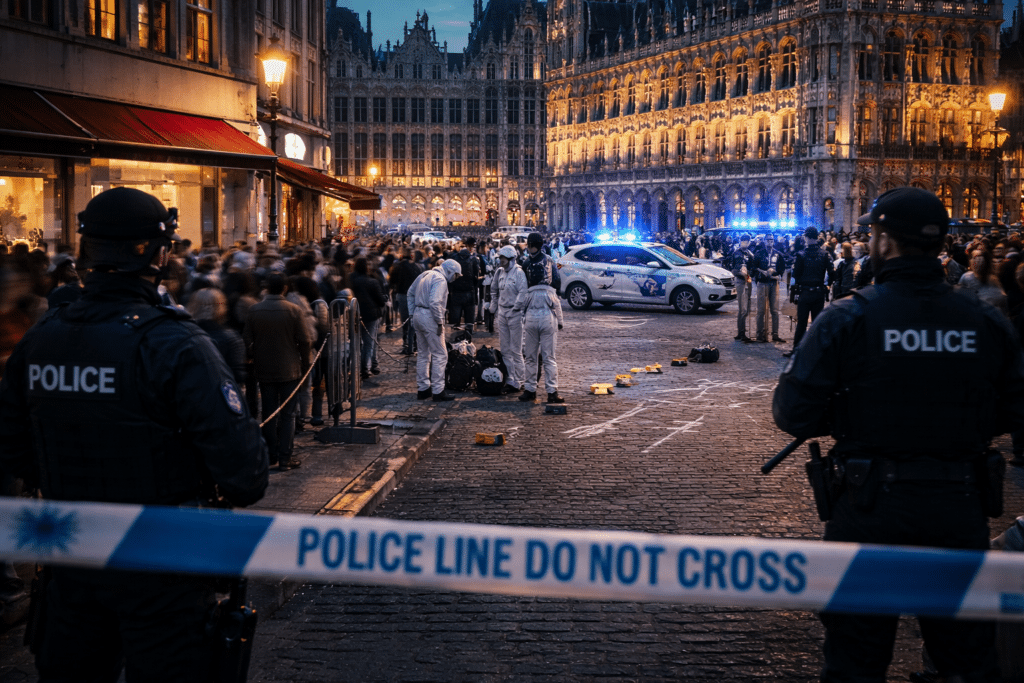
On Friday afternoon in the Molenbeek district of Brussels, gunfire rang out near the Étangs Noirs metro station. Police recovered shell casings and launched an investigation after officers confirmed that a firearm had been used, though no injuries were reported. Prosecutors have opened an inquiry to identify suspects and motive, and forensic teams are scouring the scene. This incident adds to a growing pattern of violence in what’s known as the capital of Europe, which officials have repeatedly downplayed even as shootings, gang-related crime, drugs, and unrest escalate in ordinary neighbourhoods.
The response from politicians has often been to reassure elites rather than address the reality of crime on the ground, reflecting a broader pattern in Europe where rising violence in urban areas collides with official narratives of stability and integration.
A Crisis Downplayed by the Political Class
Brussels has seen violence become a recurring headline rather than a rare event. In the past year, the city recorded around 96 shootings, eight of which were fatal, and many linked to drug-related crime and gang activity concentrated in areas such as Molenbeek and Anderlecht. These are not isolated flukes; multiple armed incidents and gang confrontations have occurred near metro stations and public spaces, making the daily commute a site of potential danger. Residents from some neighbourhoods have even penned open letters urging stronger law enforcement to counter trafficking and gang violence.
Part of the problem is that official responses tend to frame violence as confined to “problem neighbourhoods,” implying that the rest of the city is largely unaffected. Brussels commissioner Alain Hutchinson recently said shootings and crime “do not occur where international officials live and work” and downplayed their significance, even as recorded violence tells a different story. His comments reveal a disconnect between the lived reality of many residents and the political class’s portrayal of safety.
Meanwhile, Brussels public prosecutor Julien Moinil has continued insisting that additional resources are needed to tackle drug trafficking and the associated violence. In a 2025 interview, he laid the numbers bare:
“Since the beginning of this year, 6,211 adult suspects and 874 minors have been brought before the public prosecutor’s office,” says prosecutor Moinil. “That is a threefold increase compared to last year. For example, 1,250 drug dealers have already been arrested and arraigned this year.”
What’s the Real Cause of the Chaos in Europe?
Brussels is not unique. Across European capitals, large and growing immigrant populations are reshaping the social fabric of cities. In 2024, almost 10 per cent of the EU’s population were non-nationals, with significant numbers in France, Germany, Italy and Spain — major destinations for migration from outside Europe. While diversity brings economic and cultural benefits, it also intersects with challenges of social integration.
In many cities, migrant communities are concentrated in specific districts, creating de facto ghettos where economic opportunity is limited and formal social ties are weak. Social science research suggests that urban segregation and lack of integration can exacerbate tensions and feed crime dynamics. When large metropolitan centres also serve as transport hubs and economic magnets, their conditions make them more prone to crime simply because of the sheer scale of daily movement and population density. Academic studies show that every 1 per cent increase in inbound commuters to a city correlates with measurable rises in various crimes.
Official Narratives Deliberately Miss the Point
Despite statistics and on-the-ground incidents, political leadership frequently rejects the idea of a systemic crime problem. In Brussels, officials have portrayed violence as geographically limited rather than embedded in broader social trends. Commentators critical of this stance argue it reflects a class divide in governance — one where the concerns of ordinary residents are subordinated to the priorities of international institutions and transient elites.
This pattern is not confined to Belgium. In parts of Sweden and the Netherlands, shootings and violent incidents have increased, and some neighbourhoods experience social breakdown that feels more like a cautionary urban experiment than a thriving 21st-century city. As of 2025, one analysis showed 55 shootings in Stockholm alone, resulting in multiple deaths and highlighting a trend of rising gun crime across European capitals.
Police and political figures often reject linking crime rates directly to migration, arguing crime statistics are complex and influenced by many socioeconomic factors. Independent fact-checkers note that even as immigration levels rise, the statistical correlation with crime is contested and data must be interpreted cautiously. Nevertheless, public perception tells a different story in many countries, where surveys show rising anxiety about safety and a belief that migration has strained public order.
Violent Incidents Across Europe
Brussels’s latest shooting incident sits alongside other troubling episodes in Europe:
- Munich, a vehicle-ramming attack left multiple people injured and caused a political uproar about asylum and deportation policy.
- Aschaffenburg, Germany, a mass stabbing by an individual with asylum seeker status killed civilians and revived debate about deporting criminal non-citizens.
- Torre-Pacheco, Spain, violence between locals and migrant populations triggered ethnic unrest and days of disorder.
- Ireland and Northern Ireland, uproar over crimes by migrant-linked suspects fuelled riots and civil unrest.
These conflicts illustrate that Europe’s urban security landscape is being shaped by a combination of demographic change, policy gaps, and reactions to violent events.
Each of these incidents has its own context and causes. But taken together, they underscore that European societies are struggling to model integration and public safety in a way that maintains public confidence without suppressing debate. Whether the causes are economic marginalisation, failed assimilation, or policing strategy, the effect is similar: ordinary citizens feel less secure in places where once they felt safe.
The Politics of Downplaying Reality, and the Cost of Denial
The tendency of some officials to dismiss rising violence as confined to certain “dangerous pockets” may reassure diplomats and elite residents, but it does little to address the lived concerns of commuters, shoppers, families and workers. When city administrators publicly normalise areas as “rotten” yet safe for elite enclaves, they risk eroding trust in institutions. Critics argue that policies prioritising multicultural optimism over law and order create blind spots that allow criminal networks to expand — particularly drug trafficking and gang activity documented in statistics as driving many of the shootings.
Belgian authorities have struggled with understaffed police forces and recruitment challenges, further compounding the sense that official responses lag behind on-the-ground realities. In some neighbourhoods, young people face lack of employment and opportunity, conditions that can feed into criminal involvement. Crime surveys in Brussels show thousands of incidents of violent robbery, harassment, and street crime every year, with significant portions of the population reporting fear of using public transport or walking alone at night.
Is It Time for Europe to Face the Facts?
Europe’s demographic and cultural evolution is not inherently problematic. But ignoring or minimising the social strains that come with rapid change will not make them disappear. If political elites continue to downplay rising violence while citizens feel increasingly unsafe, the social fabric risks further strain.
Brussels’s latest shooting, like recent incidents elsewhere, should be a wake-up call. Public safety and integration policies need honest assessments rather than comforting reassurances. The question is not whether Europe will face these challenges, but whether its leaders will acknowledge them and craft solutions that protect communities rather than gloss over the symptoms.
Final Thought
European capitals are changing faster than their leaders admit. When violence moves from statistical footnotes into metro stations and marketplaces, ordinary citizens deserve clear analysis and effective policy, not minimisation and geographical spin. The path forward depends on confronting reality rather than pretending it remains comfortably distant.
The Expose Urgently Needs Your Help…
Can you please help to keep the lights on with The Expose’s honest, reliable, powerful and truthful journalism?
Your Government & Big Tech organisations
try to silence & shut down The Expose.
So we need your help to ensure
we can continue to bring you the
facts the mainstream refuses to.
The government does not fund us
to publish lies and propaganda on their
behalf like the Mainstream Media.
Instead, we rely solely on your support. So
please support us in our efforts to bring
you honest, reliable, investigative journalism
today. It’s secure, quick and easy.
Please choose your preferred method below to show your support.

Categories: World News
Anyone on your team a stats expert? Gov ONS stats re life expectancy very confusing on purpose? To hide deaths being caused by covid jabs ?
The Good News Is: I just saw a video of a guy traveling throughout West Africa and there is plenty of room and all the muslim populations you could ever not want already there for illegal unwelcome invaders to be deported to and dropped off in. YAY!!!