














A confidential US government assessment from 2022 warned that a sudden disruption of semiconductor production in Taiwan could reduce American economic output by approximately 11 percent, translating into losses of roughly $2.5 trillion, with global economic damage exceeding $10 trillion. Those figures, cited in subsequent reporting on the classified analysis, reflect the extraordinary degree to which the global economy depends on a narrow segment of advanced chip manufacturing concentrated on one island.
Taiwan is not simply another participant in the semiconductor supply chain. It occupies a structurally central position in the production of the world’s most advanced logic chips. If that capacity were abruptly removed, the resulting shock would extend far beyond East Asia and would likely reverberate across nearly every major industrial sector.
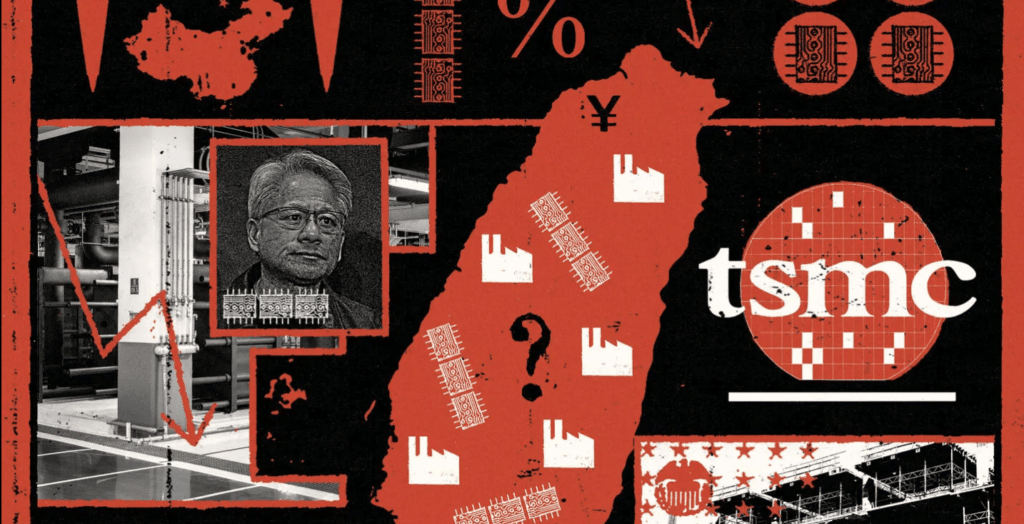
The True Scale of Global Dependence on Taiwan
Taiwan Semiconductor Manufacturing Company, or TSMC, accounts for more than 90 percent of global production of the most advanced logic chips below 10 nanometers, according to industry estimates widely reported by Bloomberg and The Wall Street Journal. These components are essential to artificial intelligence systems, advanced defense platforms, high-performance computing infrastructure, smartphones, and data centers.
The Semiconductor Industry Association estimates that semiconductors underpin approximately $7 trillion in global economic activity annually.
The pandemic-era semiconductor shortage provides a limited but instructive preview of what supply disruption can mean in practice. In 2021 alone, the global auto industry lost an estimated $210 billion in revenue because of chip shortages, according to consulting firm AlixPartners. That episode was caused by demand surges and logistical constraints rather than military conflict. A geopolitical rupture affecting Taiwan’s fabrication plants would be considerably more severe.
For context, U.S. GDP declined by approximately 4.3 percent during the 2008–2009 financial crisis. An 11 percent contraction, as modelled in the 2022 assessment, would represent a downturn on a scale not seen in modern times outside of the Great Depression.
Are US Efforts to Rebuild Domestic Capacity Enough?
Recognising the vulnerability inherent in this concentration, the United States has initiated a broad effort to expand domestic semiconductor manufacturing. The CHIPS and Science Act of 2022 allocated $52.7 billion in incentives to support US-based semiconductor production, research, and development.
In addition to subsidies, the federal government has used tariffs, export controls, equity stakes, and sustained executive pressure to encourage companies to establish or expand fabrication facilities on American soil. Policymakers have also pressed firms to commit to purchasing domestically produced chips in order to justify the capital-intensive construction of new plants.
Several major investment commitments have followed. TSMC has pledged more than $50 billion to build fabrication plants in Arizona.
Samsung has committed approximately $45 billion to expand semiconductor manufacturing in Texas.
Intel has been awarded over $11 billion in CHIPS Act funding, and the US government has taken a 10 percent stake in the company as part of an effort to preserve a domestic leading-edge manufacturer capable of competing with TSMC.
Nvidia and Apple have also announced substantial purchase commitments tied to US-produced chips, further supporting the case for expanded domestic capacity.
These projects are expected to increase US chip manufacturing capacity by roughly 50 percent by 2030. However, even with that expansion, the United States would still account for only about 10 percent of global semiconductor production, and the most advanced process nodes would remain heavily concentrated in Taiwan.
Why Hasn’t Production Moved from Taiwan Sooner?
The economic incentives that shaped corporate decision-making help explain why diversification did not occur sooner. Industry analyses cited by Reuters and semiconductor trade publications indicate that chips manufactured in the United States can cost more than 25 percent more than those produced in Taiwan.
For years, executives prioritised cost efficiency and shareholder returns. Customers were reluctant to pay higher prices for domestically produced chips, particularly when many US facilities lagged behind Taiwan in cutting-edge process nodes. Without guaranteed long-term purchase agreements, large-scale US fabrication investments were difficult to justify on purely commercial grounds.
It was only as geopolitical risk became more pronounced that governments stepped in to offset cost differentials through public subsidies and policy intervention.
Taiwan “Advanced Packaging” Will Still Play Key Role
Even as wafer fabrication begins to expand in the United States, a critical vulnerability persists in “advanced packaging”, the stage of production in which chips are assembled, integrated, and finalised for deployment.
Taiwan remains a dominant player in advanced packaging, according to data from SEMI, the global semiconductor industry association.
This means that wafers manufactured in Arizona may still need to be shipped back to Taiwan for packaging before reaching customers. Reports indicate that some Nvidia wafers produced in the United States have required packaging in Taiwan, preserving exposure to disruption in the Taiwan Strait.
The supply chain is therefore not merely about where wafers are fabricated but about where they are completed and integrated. That interdependence limits the degree of insulation offered by domestic fabrication alone.
The Military and Strategy Angles
Semiconductors are foundational not only to consumer technology but also to national defense systems. Precision-guided munitions, satellite communications, cyber operations, and AI-enabled military platforms all rely on advanced chips.
The U.S. Department of Defense has repeatedly highlighted vulnerabilities in microelectronics supply chains.
Former Indo-Pacific Commander Admiral Philip Davidson testified before Congress that China could seek to take control of Taiwan by 2027, a timeline that has influenced Pentagon planning.
On March 9, 2021, he said: “Taiwan is clearly one of their ambitions before then. And I think the threat is manifest during this decade, in fact, in the next six years.” He cited China’s accelerating timeline to “supplant the United States” and comprehensive military buildup including “ships, aircraft, rockets” combined with aggressive actions across “Hong Kong, Xinjiang, and Tibet.” The assessment prompted broader analysis of whether China was stepping up its ambition to supplant the United States as the dominant global superpower.
Recent Chinese live-fire drills around Taiwan have reinforced the perception that the risk of military escalation is now a tangible concern.
Final Thought
The 2022 warning that a disruption of Taiwan’s semiconductor output could generate more than $10 trillion in global losses is rooted in the structural realities of the modern economy. Advanced chips are not peripheral inputs. They form the technological backbone of digital infrastructure, industrial automation, finance, and defense.
Governments in the United States, Europe, and Asia are now investing heavily to diversify production and reduce concentration risk. Yet building parallel ecosystems requires time, capital, and skilled labor, and the most advanced manufacturing and packaging capabilities remain Taiwan-centric.
If a crisis were to occur before diversification efforts mature, the consequences would likely be severe and immediate. The scale of the projected losses reflects not alarmism but arithmetic. The global economy has optimised for efficiency over decades. It is only now confronting the cost of fragility.
The Expose Urgently Needs Your Help…
Can you please help to keep the lights on with The Expose’s honest, reliable, powerful and truthful journalism?
Your Government & Big Tech organisations
try to silence & shut down The Expose.
So we need your help to ensure
we can continue to bring you the
facts the mainstream refuses to.
The government does not fund us
to publish lies and propaganda on their
behalf like the Mainstream Media.
Instead, we rely solely on your support. So
please support us in our efforts to bring
you honest, reliable, investigative journalism
today. It’s secure, quick and easy.
Please choose your preferred method below to show your support.

Categories: World News