














Dr. Vernon Coleman believes that general practitioners who care about their patients would insist that the appointments system be banned.
He argues that appointments systems are destructive to healthcare. It causes chaos and overloads hospitals and ambulance services. Appointments systems benefit bureaucrats, not patients.
Let’s not lose touch…Your Government and Big Tech are actively trying to censor the information reported by The Exposé to serve their own needs. Subscribe to our emails now to make sure you receive the latest uncensored news in your inbox…
Many years ago, in the dim and distant past, when people still believed the world was round and that germs were real, I began work as a junior partner in general practice. I was in my mid-twenties, not long out of university and as a green as it is possible to be without being grass. Doctors went to prison for killing people and wars were things other people started.
My predecessor, who had operated what had effectively been a single-handed practice in the downstairs portion of his house, worked within a small group of doctors who shared night and weekend on-call duties. The other doctors in the group all ran appointments systems. My predecessor did not. And so, when I began work, I didn’t have an appointments system either.
Everything seemed to work well.
I ran two surgeries a day. One started at 9.00 am and finished when I’d seen all the patients which was, hopefully, before the evening surgery started at 4.00 pm. In between the morning and evening surgeries I did the calls, the home visits – driving round the town (with the aid of an to date map I obtained from a local estate agent and which was, until I found my way around, spread on the passenger seat of my Mini Traveller) and visited all those patients who had requested a home visit or had just come out of hospital or were old and frail and needed to be seen at home.
I was pleased that I didn’t have an appointments system, thinking they were best for ladies’ hairdressers and dentists. My patients just turned up and gave their names to the receptionist, who got their medical record envelopes out of one of the four green filing cabinets and put them in a pile, thereby making it easy for everyone to see which patient was next. The last patient’s notes went on the bottom of the pile and if pile number 1 grew too high, she’d start pile number 2.
When it was their turn to be seen, each patient would bring their records in to me. They’d know it was their turn because they’d have seen the previous patient leave. I had a buzzer too, and if no one came in, I’d press that to see if there was anyone left. The buzzer was positioned so that I could press it with my knee. Look, no hands! Crumbs, I was high tech.
There were numerous advantages to not having an appointments system. It was simple and fool-proof, and it saved time, money and heartache. Patients didn’t have to walk to a phone box, queue and ring the surgery to make an appointment. They just turned up. I had only one phone line, no big appointments book and no receptionist busy taking calls. And the damned phone didn’t ring all the time.
I preferred not having an appointments system. And so did the patients.
Patients who knew there were, say, a dozen patients in front of them, could pop out to the shops and come back in time to be seen.
And so, since I liked having no appointments system, and patients preferred it too, it obviously had to change.
The NHS stamped down hard and I had to buy a large appointments book, employ more receptionists and put in another phone line. I had to move to a surgery with more space to accommodate the extra receptionists and the telephones and an appointment book the size of a cricket pitch. The bureaucrats said it would make life easier but they didn’t explain who it would benefit. And I didn’t have a choice. These days, I’d have probably told them to go stuff themselves. But I was young, innocent and occasionally, when I had no choice, I did what I was told to do. I hated having an appointments system. It was one of the major factors in the destruction of health care, and it was arranged and approved by NHS bosses and the medical establishment. By and large, I still saw patients on the day they asked to be seen and always saw patients “on the day” if they said they needed to be seen urgently and didn’t need to be visited at home. My partners did the same.
General practice was, of course, completely destroyed when doctors stopped doing home visits and night calls. That was part of a deliberate policy to destroy health care, to cause chaos in hospitals and to overload the ambulance service. It was a plot to help kill people. And it’s working brilliantly.
But forcing doctors to have appointments systems was one of the early and most destructive changes.
Think about it.
Would you rather sit in a waiting room for an hour or even two (in an orderly queue) knowing that you would be seen by the doctor of your choice on the day you first realised you needed to see a doctor …
Or would you rather spend hours on the telephone to make an appointment for three weeks ahead with a doctor you don’t know?
I think that medicine died on the day appointments systems became compulsory.
My conclusion: No one should ever have to make an appointment to see a GP.
If doctors cared about patients, they would insist that appointments systems be banned – with doctors running open surgeries twice a day.
It would be better for patients, so it will never happen.
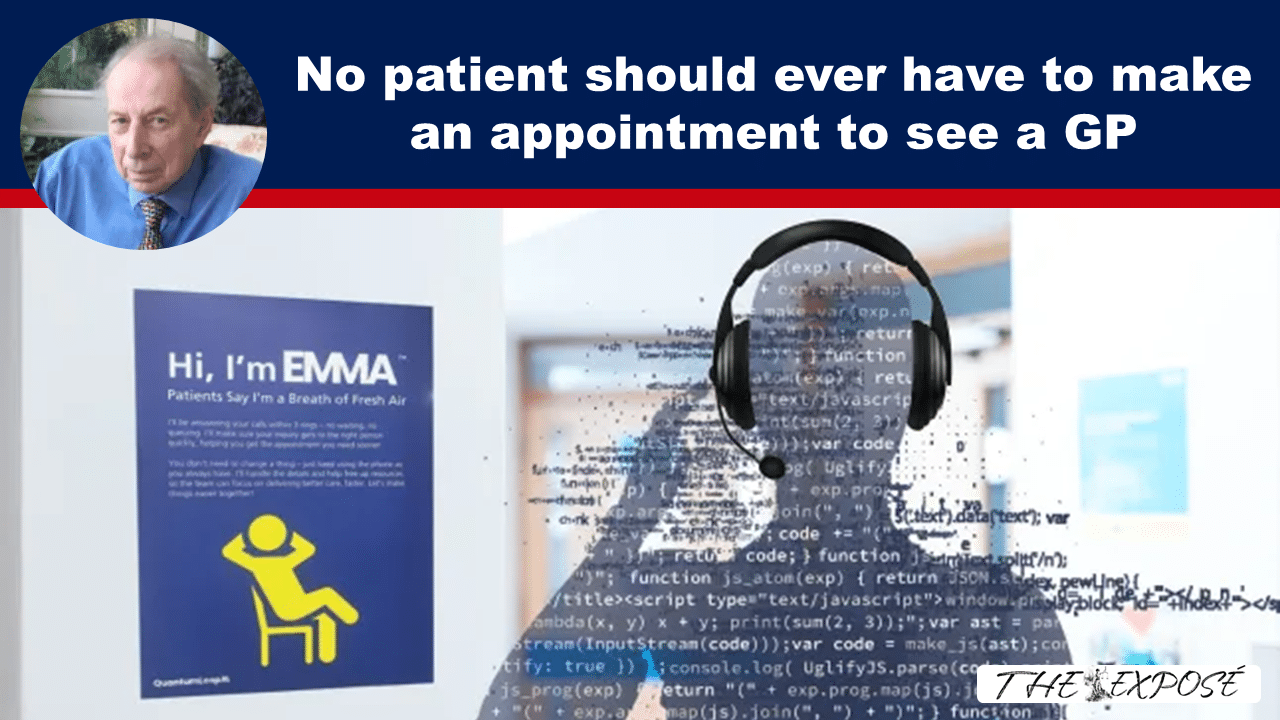
Featured image: ‘Meet the ‘AI receptionist’ picking up the phone for 1,000,000 GP patients’, Metro, 26 January 2026
The Expose Urgently Needs Your Help…
Can you please help to keep the lights on with The Expose’s honest, reliable, powerful and truthful journalism?
Your Government & Big Tech organisations
try to silence & shut down The Expose.
So we need your help to ensure
we can continue to bring you the
facts the mainstream refuses to.
The government does not fund us
to publish lies and propaganda on their
behalf like the Mainstream Media.
Instead, we rely solely on your support. So
please support us in our efforts to bring
you honest, reliable, investigative journalism
today. It’s secure, quick and easy.
Please choose your preferred method below to show your support.

Categories: Breaking News, UK News