













Politicians who cut “renewable energy” subsidies saved the USA’s power grid by incentivising reliable generation which was having its operating revenue looted by subsidised, unreliable solar and wind.
“The politicians who cut solar and wind subsidies didn’t just save taxpayers hundreds of billions of dollars. They saved our grid,” Alex Epstein writes.
Let’s not lose touch…Your Government and Big Tech are actively trying to censor the information reported by The Exposé to serve their own needs. Subscribe to our emails now to make sure you receive the latest uncensored news in your inbox…
Politicians Who Cut Solar and Wind Subsidies Saved Our Grid
By Alex Epstein
Myth: Politicians who cut solar/wind subsidies in the “Big Beautiful Bill” harmed our grid by reducing the amount of electricity generation.
Truth: These politicians saved our grid by incentivising reliable generation, which was having its operating revenue looted by subsidised, unreliable solar and wind.
Last year, America was already in a serious electricity reliability crisis. The North American Electric Reliability Corporation – the body charged with assessing grid reliability – found that over half the country is facing the risk of power shortfalls over the next decade.1
That crisis is far from over. But now, for the first time in years, the economics of building reliable power plants are turning around. And we owe this to a handful of politicians who led the charge to cut solar and wind subsidies in the “Big Beautiful Bill.”
Solar and Wind Subsidies Were Defunding Reliable Power Plants
To understand what these politicians accomplished by cutting solar and wind subsidies, you have to understand the condition of the grid as of last year.
For decades, the US federal government paid massive subsidies – the ‘Investment Tax Credit’ and ‘Production Tax Credit’ – to solar and wind projects. These subsidies didn’t just take hundreds of billions of taxpayer dollars. They systematically destroyed the economics of the reliable power plants that keep our grid running.
When subsidised solar and wind flood the grid with cheap electricity every time the sun shines or the wind blows, they take away operating time and therefore revenue from reliable power plants.
Thanks to subsidies, many reliable plants had no choice but to shut down prematurely, while investors were deterred from investing in building new reliable plants whose revenue under subsidies and unfair market rules would be taken by unreliable generation.
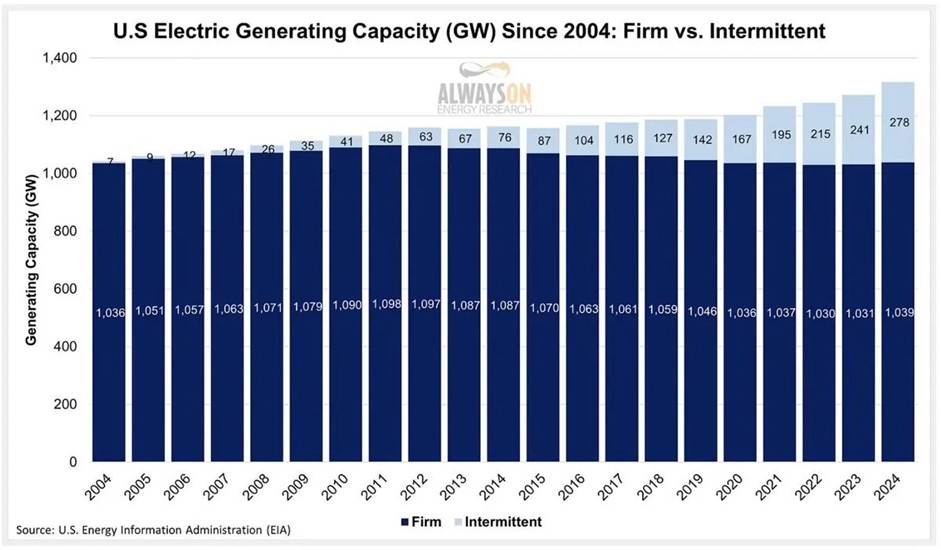
Subsidies were a big reason why, as electricity demand increased over the past decade, America saw a decline in reliable capacity.
The IRA Accelerated the Catastrophic Effects of Solar and Wind Subsidies
Then came the ‘Inflation Reduction Act’ of 2022 (“IRA”). The IRA increased solar/wind subsidies, and it also extended them for over a decade. These subsidies were projected to cost taxpayers over USD$1 trillion over that decade.2
But the damage to the grid would have been incomparably greater than the tax bill. The biggest cost by far was the defunding and disincentivising of reliable power plants.
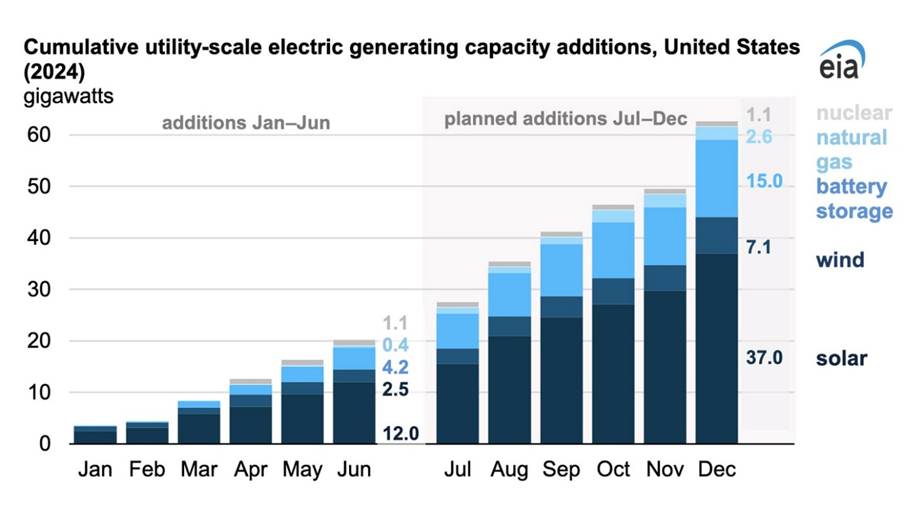
By 2024, solar and wind “capacity,” which, as we saw during a recent winter storm, can’t be relied on at all,3 represented 70% of all new electricity additions in the US.
Energy Secretary Chris Wright was not exaggerating when he said solar and wind subsidies are “a big mistake,” which “result in higher costs and less reliable electricity.”4
A Handful of Energy Freedom Fighters Cut Solar/Wind Subsidies in the “Big Beautiful Bill”
When the “Big Beautiful Bill” budget negotiations began early last year, the solar/wind subsidy lobby descended on Washington in full force. The expected outcome was that Republicans, despite running on a promise to dismantle the IRA, would keep most of the solar and wind subsidies.
That’s not what happened. Instead, a handful of energy freedom advocates fought relentlessly to cut the IRA’s solar and wind subsidies – and won.
The initial draft of the budget bill produced by the House Ways and Means Committee included a long “phase-out” of the subsidies that would have allowed new solar and wind projects to continue receiving 10-year subsidies well into the 2030s and even 2040s.5
When this bill came to the House Budget Committee for review, Representatives Chip Roy, Ralph Norman, Josh Brecheen and Andrew Clyde withheld their support (voting “no” or “present”). Because the Republican majority on the committee is very slim, their votes were crucial. This stalled the bill, and they were able to work through the weekend to significantly limit subsidy eligibility to projects that were “placed in service,” i.e., operational, by 2028.
Solar and wind lobbyists threw a fit, claiming that cutting subsidies would raise electricity prices and destroy the grid. But Roy, Norman, Brecheen and Clyde didn’t back down. And in later stages of the process, they were joined by more energy freedom politicians, including Rep. Scott Perry on the House side and Senators Mike Lee, Rick Scott and Ron Johnson on the Senate side.
Unfortunately, a last-second change by the Senate (sneaked in by the solar/wind lobby) weakened the House’s solar and wind subsidy cuts by allowing projects to collect subsidies if they are technically “in construction” (an easy threshold to meet) by 4 July 2026, at which point they have 4 years to be “placed in service.”6
Nevertheless, the final “Big Beautiful Bill” significantly cuts solar and wind subsidies for projects. The upshot: Starting 5 July 2026, virtually no new subsidy-collecting solar/wind projects can be initiated. (They can only collect subsidies if they are actually “placed in service” by the end of 2027, a standard most new subsidy-seeking projects won’t be able to meet.)
Politicians Who Cut Subsidies Are Wrongly Being Blamed For Rising Electricity Prices
As soon as the “Big Beautiful Bill” was passed, the solar and wind lobby began blaming the politicians who cut solar/wind subsidies for depriving our grid of power and causing electricity prices to rise.
Not only is the timeframe of this claim absurd – the subsidy cuts would not even go into effect for another year – it gets the relationship between subsidies and price increases exactly backwards.
Solar and wind subsidies have contributed to the electricity price increases we’ve seen so far – by forcing the premature shutdown of the reliable power plants our grid needs to function. (And we’re also paying for the subsidies through taxes and inflation.) Cutting these subsidies was necessary to stop price increases going forward.
The energy freedom fighters who cut solar/wind subsidies did not deprive the grid of power; they did more than anyone to ensure that the grid had electricity when it needed it most. They set up a market where new, reliable plants can be profitable. And they did not increase electricity prices; they created the necessary conditions for electricity prices to decrease.
In fact, that’s exactly what we’re seeing already.
The Solar/Wind Subsidy Cuts in the “Big Beautiful Bill” Are Already Saving Our Grid
After the passage of the Big Beautiful Bill, investors looked at the electricity market and saw that building reliable power would soon become much more profitable than if the solar/wind subsidies had continued. At the same time, they became more and more aware that they need ultra-reliable power to power AI data centres.
The US nearly tripled its gas-fired capacity in development in 2025, reaching 252 GW – more than any other country.7 Developers plan to add 18.7 GW of combined-cycle natural gas capacity by 2028.8 Major utilities are announcing record capital plans to build reliable generation.
This is what happens when you stop paying people to build an inferior product. Capital flows to what actually works: power plants that can run when you need them, in the quantity you need them, regardless of the weather.
The AI data centre boom makes the timing of the solar/wind subsidy cuts even more crucial. Data centres need power that is available 24/7, 365 days a year. The subsidy cuts arrived just in time to help redirect investment toward the reliable generation that America’s growing digital economy urgently needs.
The Lesson: Energy Freedom Works
Any energy source that is genuinely cost-effective will thrive without subsidies. The path to affordable, reliable electricity isn’t subsidies for some politicians’ and lobbyists’ preferred energy sources – it’s the freedom to produce and invest in the energy sources that actually work.
A year ago, NERC was warning that more than half the country faced electricity shortfalls. Today, the market is responding to restored price signals by building reliable power at a pace we haven’t seen in decades.
The politicians who cut solar and wind subsidies didn’t just save taxpayers hundreds of billions of dollars. They saved our grid.
Notes:
- 1 NERC – Long-Term Reliability Assessment, January 2026
- 2 Goldman Sachs – Carbonomics
- 3 Alex Epstein – Solar and wind aren’t real power sources, they’re intermittent fuel-savers
- 4 Trump Energy Secretary: Clean energy tax credits a ‘big mistake’ and Trump’s energy chief says clean energy credits waste taxpayer money and worsen the grid
- 5 Alex Epstein – Why the proposed “phaseout” of IRA subsidies is unacceptable
- 6 Alex Epstein – The Senate totally fails to terminate the Green New Scam
- 7 American Public Power Association – U.S. Now Leads World for New Gas Power Development
- 8 Reuters – Developers to add 18.7 GW of natural gas-fired capacity by 2028, EIA says
About the Author
Alex Epstein is an American author, philosopher and energy policy commentator. He is the author of ‘The Moral Case for Fossil Fuels’ (2014) and ‘Fossil Future’ (2022), which argues that increased use of oil, coal, and natural gas is essential for global human flourishing. He is also the co-founder of the platform ‘Thoughtful’. Epstein publishes articles on his Substack page ‘Energy Talking Points’, a free-to-read newsletter “designed to give as many people as possible access to concise, powerful, well-referenced talking points on the latest energy, environmental and climate issues from a pro-human, pro-energy perspective.” You can also follow him on Twitter (now X) HERE.
The Expose Urgently Needs Your Help…
Can you please help to keep the lights on with The Expose’s honest, reliable, powerful and truthful journalism?
Your Government & Big Tech organisations
try to silence & shut down The Expose.
So we need your help to ensure
we can continue to bring you the
facts the mainstream refuses to.
The government does not fund us
to publish lies and propaganda on their
behalf like the Mainstream Media.
Instead, we rely solely on your support. So
please support us in our efforts to bring
you honest, reliable, investigative journalism
today. It’s secure, quick and easy.
Please choose your preferred method below to show your support.

Categories: Breaking News, US News