














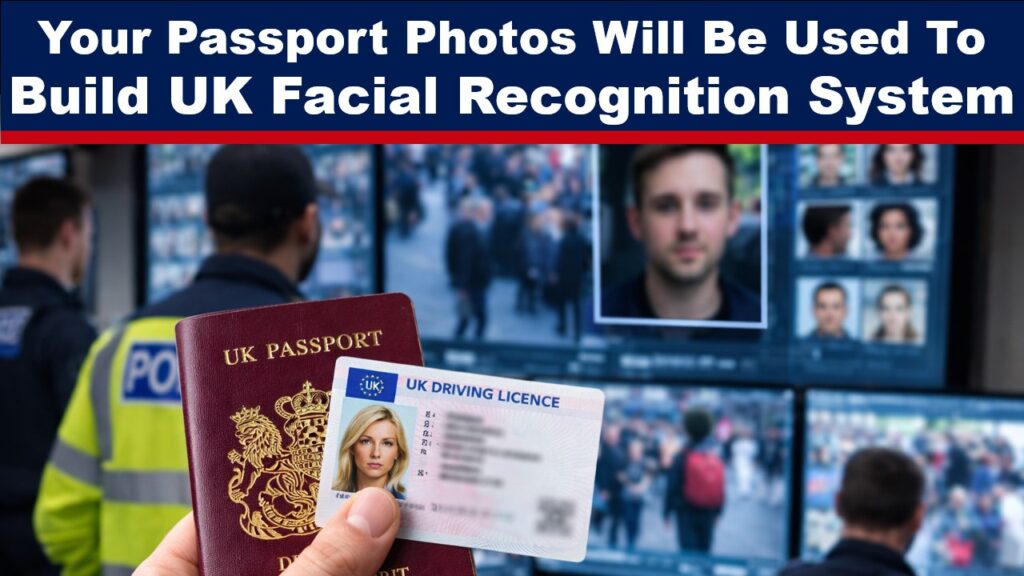
The UK government’s recent digital ID consultation contains a detail that should have triggered far more alarm than it did. Ministers are proposing a national identity system built around a biometric image while openly stating that police facial recognition “may include access to biometric data held by government.” That means this is not simply about a new app for proving your age or accessing services. It points towards a system in which photos already handed to the state for passports, visas, or other official purposes could help underpin both a national digital ID and a broader facial recognition framework. This development needs to be clearly understood.
The government is now signalling that existing biometric data will form its expanding surveillance architecture, and is no longer asking for trust in a future digital ID.
A Summary of the Digital ID Consultation
The official explainer presents the scheme as a practical reform. A new digital ID, UK ministers say, will make it easier to access government and private-sector services, prove residency, and complete right-to-work checks. The government says the ID will be rolled out to all UK citizens and legal residents by the end of this Parliament, and that employers will be required to use it as evidence of the right to work. It will also be available for uses such as voting ID and proof of identity across public services.
What matters here is the data the system is designed to hold. The explainer says the new ID will include name, date of birth, nationality or residency status, and “a photo as the basis for biometric security.” That is the key phrase. The state is not merely proposing a digital wallet for existing paper documents. It is designing a biometric identity layer intended to become the “authoritative proof” of who someone is in this country. Once that exists, the distinction between administrative convenience and surveillance capacity becomes much thinner.
This is why the new development deserves attention now. Readers already know the broad risks of digital ID, from exclusion to mission creep. The consultation moves the story forward by showing how digital identity is being tied, in official language, to biometric data and to the legal framework for police facial recognition. And that’s no longer a theoretical concern — it’s the government’s own wording.
Facial Recognition Data Already Held by UK Government
The most important passage in the consultation states that there is already a legal basis for police use of facial recognition, “which may include access to biometric data held by government.” It goes on to say the current legal framework is “complicated” and notes that the government has already consulted on a new framework that would create “consistent, durable rules” for facial recognition and similar technologies in relation to biometric data held by government in the future. It then states plainly that the current biometric images and a future national digital ID “will be subject to” any new framework introduced in the UK.
So, this development means that ministers are not just proposing a new form of ID. They are quietly planning to use your existing images to power the entire surveillance system. We’re told to think about “easier access to services” while the consultation is discussing biometric data, facial recognition, and much wider-reaching legal powers.
Big Brother Watch seized on exactly this point. Its senior legal and policy officer, Jasleen Chaggar, said the consultation contained “an admission that the police would be allowed to repurpose our digital ID photos as mugshots to create a population-wide facial recognition database.” That is deliberately forceful language, and it accurately captures the political significance of what ministers have written. People provided many of these images for one purpose. The government is now outlining a framework in which they may support another.
UK is Building the Framework Before Proving the Need
It’s worth considering that a biometric policing apparatus is already up and running, before any evidence exists telling us that we need it. We recently published another article (Essex Police Pause Facial Recognition, But Why Was It Rolled Out at All?) exploring this point. But in addition to the prior article, a Home Office summary published in December confirmed that police and law-enforcement agencies conduct approximately 25,000 retrospective facial recognition searches every month. These searches run against around 19 million custody images held on the Police National Database, and confirms the existence of a national system already operating at scale.
Simultaneously, ministers are trying to simplify and expand the legal framework around facial recognition technology. The digital ID consultation explicitly references that effort. Big Brother Watch warned in January that a large-scale rollout of facial recognition across England and Wales would represent one of the biggest civil-liberties threats in modern British policing and noted that police have already scanned “millions of innocent people” in public spaces. The underlying direction is unmistakable. The state is standardising identity, expanding biometric capability, and tidying the legal groundwork afterwards.
In short, the UK government is effectively implementing deeper biometric infrastructure now and asking the public to debate the implications later. But once a national digital ID with afacial recognition system is embedded in daily life, it will be too late to resist. Function creep is in full effect; additional surveillance capabilities will not arrive as one dramatic rupture, but rather as a series of “practical” expansions built on infrastructure already in place.
No Evidence That Facial Recognition Reduces Crime
If the UK government were pairing this push with strong evidence that facial recognition materially reduces crime, it would at least have a potential argument to make. Instead, one of the clearest recent studies points in the opposite direction. Essex Police’s March 2026 report, based on Cambridge-led research, found “no statistically significant evidence” that live facial recognition deployments reduced crime in the short term. Researchers compared crime levels in deployment areas during the 24 hours before, during, and after operations and found no meaningful difference. The report concluded that the main effect of live facial recognition was identifying specific people on watchlists, not generating an immediate deterrent effect on wider offending.
That is a damaging finding because it strips away one of the most politically useful justifications for expanding the system. Facial recognition is often sold as a tool that will make public spaces safer and suppress crime more broadly. Essex’s own evidence did not demonstrate that. It suggested something much narrower. Police can use the technology to search for particular people by scanning very large numbers of others. That is not a trivial capability, but it is also not the sweeping public-safety case usually presented to the public.
Big Brother Watch has pressed this point hard. Responding to the Essex pause, Jake Hurfurt said the technology is “authoritarian, inaccurate, and ineffective in equal measure,” and noted that the report’s findings came only after 2.5 million people across the county had their faces scanned. That enormous figure demonstrates just how quickly mass biometric monitoring can be normalised even when the evidence base is non-existent.
Final Thought
People gave the state their photos to get documents, prove status, and navigate ordinary civic life. They did not give them in order to help build a biometric framework that now sits within reach of police facial recognition and a national digital ID system. Yet that is increasingly what the UK government’s own documents point towards. When ministers ask the public to accept this as efficient administration, they are asking people to ignore the obvious: a system built on already-held facial data, tied to identity, work, services, and policing, is not just a minor reform. It is the quiet construction of a more controlled, closely-monitored society.
The Expose Urgently Needs Your Help…
Can you please help to keep the lights on with The Expose’s honest, reliable, powerful and truthful journalism?
Your Government & Big Tech organisations
try to silence & shut down The Expose.
So we need your help to ensure
we can continue to bring you the
facts the mainstream refuses to.
The government does not fund us
to publish lies and propaganda on their
behalf like the Mainstream Media.
Instead, we rely solely on your support. So
please support us in our efforts to bring
you honest, reliable, investigative journalism
today. It’s secure, quick and easy.
Please choose your preferred method below to show your support.

Categories: UK News