














Trial by jury is a cornerstone of a free society, yet UK Justice Secretary David Lammy is attempting to restrict the use of juries in England and Wales. He has proposed limiting jury trials to only the most serious offences while scrapping jury trials for crimes carrying sentences of up to three years.
The move against jury trials reflects a growing trend among modern governments and legislators – not only in the United Kingdom, but in many other places – to assert their own authority over the constitutional order in exaggerated and destructive ways, David Thunder writes.
To quote Lord Patrick Devlin: “The first object of any tyrant … would be to make Parliament utterly subservient to his will; and the next to overthrow or diminish trial by jury.”
Related: UK dictatorship is attempting to scrap jury trials – Who really benefits?
Let’s not lose touch…Your Government and Big Tech are actively trying to censor the information reported by The Exposé to serve their own needs. Subscribe to our emails now to make sure you receive the latest uncensored news in your inbox…
Those Who Seek to Scale Back Jury Trials Profoundly Misunderstand Their Authority Over the Constitutional Order
The Labour-led British government is currently attempting to hollow out an ancient pillar of English constitutionalism, trial by jury. Under their planned reforms, trial by jury would survive in England and Wales for certain types of crimes, but its use would be significantly curtailed. For example, according to a government press release issued earlier this month, new “Swift Courts” will assign cases “with a likely sentence of three years or less” to be heard by “a Judge alone.”
The campaign against jury trials, one of the most free-spirited and universally lauded institutions bequeathed to us by the common law tradition, would be baffling in a healthy constitutional regime. But sadly, it is predictable enough in a regime whose political leaders have developed the habit of tinkering with civil liberties as though they were trimming their lawn.
Being an ancient institution that evolved gradually over a millennium, a significant restriction of jury trials would have unpredictable effects on the justice system. We simply do not know with any confidence how, in the long run, such a move would alter the incentives of prosecutors, change the pattern of convictions for different crimes, or alter public perceptions of the justice system.
What we do know is that it would constitute a dangerous and completely unnecessary constitutional experiment, eroding one of the most time-honoured bulwarks of civil liberty. Furthermore, it is worth noting that according to an analysis published by the Free Speech Union, drawing on Ministry of Justice data, overall acquittal rates are much higher with juries than with magistrates’ courts (21.6% vs. 11.4%), and this difference also holds specifically for speech-related offences (27.6% vs. 15.9%). Assuming these figures are accurate, citizens will likely be much more vulnerable to prosecution and conviction if the use of jury trials is thrown out or significantly eroded.
Trial by jury has been lauded by generations of learned and respected scholars of law and democracy as a cornerstone of a free society. Alexis de Tocqueville, whose 1835-40 volume ‘Democracy in America’ offers one of the most incisive of reflections on the pros and cons of modern democracy, opined that “the jury … is the most energetic means of making the people rule, [and] is also the most effective means of teaching it how to rule well.”
An eminent 17th-century English jurist, Sir Edward Coke, insisted that no Englishman could be lawfully condemned “but by the lawful judgment of his peers.” The esteemed 18th-century legal commentator, Sir William Blackstone, likewise described trial by jury as “the glory of the English law” and “the most transcendent privilege which any subject can enjoy,” emphasising its role as a shield between the individual and arbitrary power.
Budding constitutional reformers would do well to pay heed to Lord Patrick Devlin’s warning that “the first object of any tyrant … would be to make Parliament utterly subservient to his will; and the next to overthrow or diminish trial by jury, for it is the lamp that shows that freedom lives.”
If marginal gains in the duration of trials are deemed an adequate justification for tinkering with this bastion of the legal order, then we might as well just go ahead and subject the whole constitutional order to an “efficiency” test: if we can shave a few days or weeks off this or that legal procedure, then why not engage in a bit of constitutional engineering?
But this is a cheap and shallow argument. To begin with, we should not be so sure of our own understanding of the mechanics of such a complex and evolved order, nor should we be so confident that we can predict the short- and long-term impact of our well-intentioned meddling.
Equally importantly, those who bring a revolutionary pickaxe to the constitutional edifice destabilise public expectations about the basic “rules of the game.” In doing so, they open the door to political opportunists who would happily overturn the rules and conventions that keep citizens free in order to advance their own careers or curry favour with party bosses or the fickle tides of public opinion.
These constitution-wreckers have bought into a reckless form of positivism that views the legal system as the handiwork of each new generation of human lawgivers rather than as a hallowed constitutional inheritance, and conceives the legislator as an ambitious constitutional reformer, ever poised to introduce “enlightened” reforms in the longstanding customs of liberty, whether in the name of “efficiency” “progress,” “social justice” or some other ostensibly noble end. While the seeds of positivism and its contempt for the common law have been in place for centuries, its bitter fruits are now on full display.
The outcome of happy-go-lucky constitutional engineering is that citizens are perpetually vulnerable to political fanaticism. And not just any old fanaticism, but the sort that dismantles or radically alters fundamental constitutional rights such as privacy, freedom of speech, or the right to be tried before one’s peers.
Sadly, the move against jury trials is not an anomaly. Rather, it reflects a growing trend among modern governments and legislators – not only in the United Kingdom, but in many other places – to assert their own authority over the constitutional order in exaggerated and destructive ways.
Instead of recognising that they are standing on the shoulders of giants and acting as humble stewards of an ancient tradition of ordered liberty, whose inner workings have evolved gradually over countless generations, legislators and government ministers have gotten it into their heads that they can stand majestically above the constitutional order and remake it at will, as one might re-arrange one’s bedroom.
Unfortunately, the citizenry of Western societies, or at least a large portion of it, is in a state of moral stupor and has become complacent about the risks of governmental tyranny. Many are no longer well equipped to distinguish between the arbitrary utterances of a legislator and the longstanding rules of humanity and decency.
The idolisation of positive law and the downgrading of the customary liberties of Western societies came to a head during the pandemic: people were happy to go along with laws that made life hell for their unvaccinated neighbours, just because they were unvaccinated; large segments of the public acquiesced in, or actively supported, these measures, looking on approvingly while police suppressed public protests in the name of “public health”; and people reported their neighbours for the “offense” of having social gatherings in their homes.
Legal systems are meant to set us free, by providing a framework of public order and reasonable expectations within which we can get on with our lives. But they can only do this if they are beholden to a higher law, of the sort that is discovered rather than made by human fiat. This is the sort of law that binds the King and cannot be unmade by the King, as Magna Carta famously recognises.
Only if citizens believe passionately in a moral code superior to the say-so of legislators and politicians can they find a firm foothold for resisting egregiously unjust and tyrannical laws. But belief in a morality that transcends the will of the legislator is not easy in a culture saturated with moral relativism. We need to recover our confidence in a higher moral law if we are to reverse the current drift toward legal and political authoritarianism.
About the Author
David Thunder is an Irish political philosopher, currently a permanent research fellow at the University of Navarra’s Institute for Culture and Society in Pamplona, Spain. He authored the book ‘The Polycentric Republic’ and publishes articles on a Substack page titled ‘The Freedom Blog’. If you appreciate his blog posts, please consider supporting his work with a paid subscription by clicking HERE.
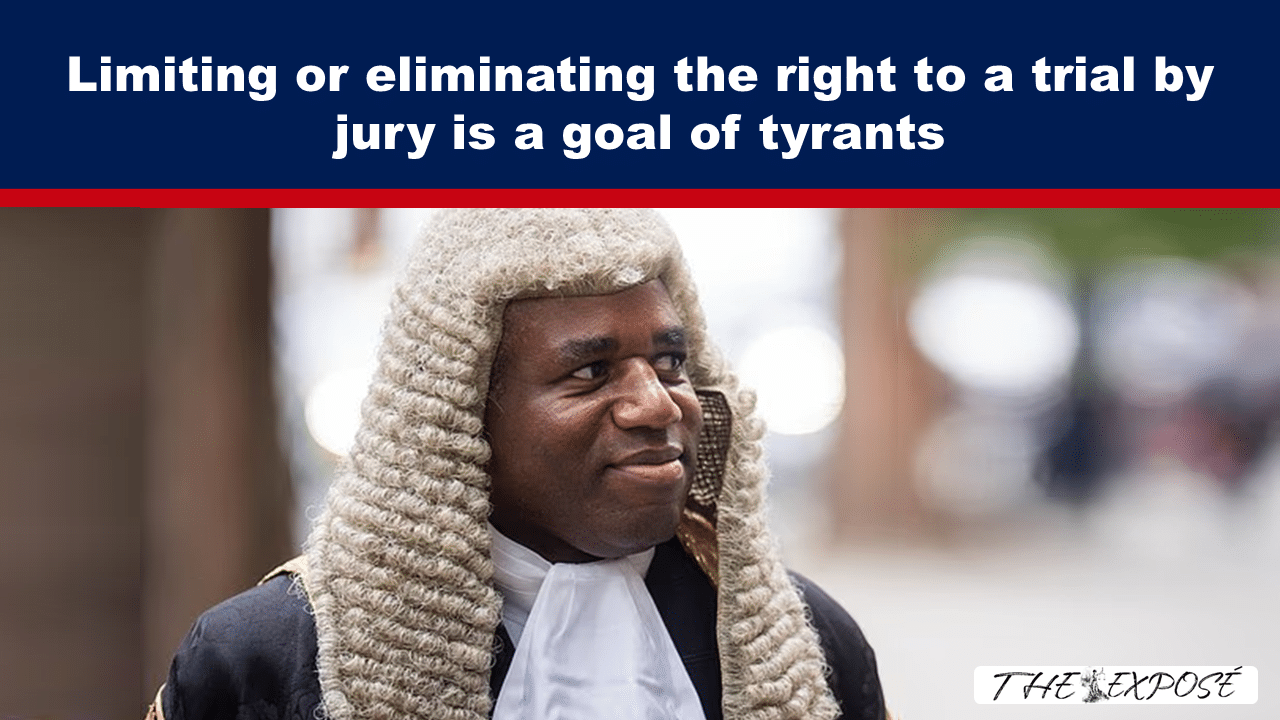
Featured image: Secretary of State for Justice and Deputy Prime Minister David Lammy. Taken from ‘Our probing questions to a judge saved an innocent young man’s life from ruin – that’s why we MUST keep trial by jury’, Daily Mail, 30 November 2025
The Expose Urgently Needs Your Help…
Can you please help to keep the lights on with The Expose’s honest, reliable, powerful and truthful journalism?
Your Government & Big Tech organisations
try to silence & shut down The Expose.
So we need your help to ensure
we can continue to bring you the
facts the mainstream refuses to.
The government does not fund us
to publish lies and propaganda on their
behalf like the Mainstream Media.
Instead, we rely solely on your support. So
please support us in our efforts to bring
you honest, reliable, investigative journalism
today. It’s secure, quick and easy.
Please choose your preferred method below to show your support.

Categories: Breaking News, UK News
Please remember jurisdiction. Law land air water are the primary jurisdictions.
All these fake court fake governments operate in the maritime jurisdiction (water) not the land jurisdiction we are owed. The government is not a government but a corporation acting as government in fraud.
The courts are not courts of law but tribunals of corporations.
They have judges we have justices of law.
These crimes are hundreds of years old and their ending in now! We know the truth we are taking action and we will remove them!!
To do this a new financial system was built for the world in the global prosperity system. This allows us to defund them and force them to comply. It is happening. This is not conspiracy!
This one thing, curtailment of trial by jury, is enough reason for revolution. If the King cannot change it under Magna Carta, then it cannot be changed in his courts, whether by royal decree or by new legislation. Such new legislation would require his signature of approval in any case, before implementation, and so that would ultimately be a Royal decree in essence. To do so is an act of extreme violence against all his subjects and we would be obliged to defend ourselves against such tyranny.
TREASON. Go en masse to the first hearing denied a jury and arrest the Judge and all the legals in attendance. Hold a drum head court on the steps and carry out the penalty for Treason. This is our country. They are SERVANTS not masters. Any Police trying to interfere should be arrested too. Tony Blair tried to do away withthe Treason laws but that was Treason too, so Null and Void. It is time to distrain and distress our leaders, take their property and palaces until we have remedy.
The courts only hold jurisdiction and authority over the property of the Crown their employer. The citizen legal entity identity is Crown property!