














The Wigan Deal, implemented in 2014, has been hailed as a pioneering approach to deliver public services, focusing on an “assets-based approach” and a “new social relationship” between citizens and government.
In reality, the deal involves taxpayers taking on unpaid provision of social services and submitting to the digitisation of communication and services, in exchange for a council tax freeze.
Wigan, as the third-worst hit area for government austerity funding policies since 2010, has been widely recognised as a pioneering council for its work “trialling radical new ways to deliver public services” which secured it a place as one of Nesta and the Local Government Association’s six “creative councils.”
One of Nesta’s core missions is creating a sustainable future. “Sustainable” means the globalese interpretation.
Note: In our 2024 article ‘We are witnessing the rollout of the final stages of a plan that has been 50 years in the making’, we noted what Globalists mean by the words “sustainable development,” read HERE.
Let’s not lose touch…Your Government and Big Tech are actively trying to censor the information reported by The Exposé to serve their own needs. Subscribe to our emails now to make sure you receive the latest uncensored news in your inbox…
The Real Left is publishing a series of essays titled ‘The Health and Social Care Reset for the Big Data Economy’. You can read the first part, ‘The Great Health and Social Care Reset for the Big Data Economy Part 1.1’, which is a timeline of NHS capture during the years 1970s-2013, HERE.
The following is a section of the second part, which is a timeline of NHS capture during the years 2014-2019. We have published the essay in several parts because, totalling a little under 10,500 words, it’s longer than most would read in a single sitting.
The Great Health and Social Care Reset for the Big Data Economy Part 1.2
By Emily Garcia, as published by Real Left on 27 January 2026
Table of Contents
The Wigan Deal: 2014 Onwards
Wigan, as the third worst hit area for government austerity funding policies since 2010, [38] has been widely recognised as a pioneering council for its work “trialling radical new ways to deliver public services” [39] which secured it a place as one of Nesta and the Local Government Association’s six “creative councils.” [40] It has also been lauded by the NHS privatisation lobbying think tank King’s Fund as an “NHS role model,” [41] since they suggest that the NHS, in place of the council, could lead a similar “placed-based” cross-agency endeavour elsewhere. [42]
On a side note, Nesta states on their website that they “shared the learning from the Creative Councils programme with our partners at Bloomberg Philanthropies, who applied it to the ‘Mayors Challenge’ in the United States and then across Europe,” with a “Mayors Grand Prize for Innovation” awarding cash sums for winning initiatives. [40]
The Wigan Deal was implemented in 2014 under the leadership of then Chief Executive of Wigan Council Donna Hall, now Chair of the ‘innovative national think-tank’ – the New Local Government Network – and executive coach to local government and combined authority leaders. [43] Hall has held several senior level NHS positions including Chair of Bolton NHS Foundation Trust [44] and Integrated Care System Adviser to NHS England. [45] She was awarded a CBE in 2009 for innovation in public service. [46]
The Deal centres on an “assets based approach,” entailing a “new social relationship” [38] between citizens and government. In a nutshell, what this amounts to is taxpayers taking on (pared down) unpaid provision of social services, including social care for adults and disabled people, sporting and library facilities, and community centres. In addition, Wigan residents are required to submit to the wide-scale digitisation of communication and many services (e.g. the MyAccount website to enable residents to access information and services and the ‘Report It app’ for reporting local issues such as litter and pollution), enabling collection and sharing of data about service users. In “return,” the council pledged to freeze council tax. [38]
Despite their rhetoric around the “relational” and “co-creative” aspects of the Deal, the council admit stakeholders such as council staff and the public were not involved in its design or planning. [38] A number of residents and market traders accused the council of ignoring their concerns and campaigning efforts to prevent the demolition of Wigan town centre and outdoor market [47] to make space for a new development. The council’s development plan entailed building a hotel and residential housing, and replacing retail space with “co-working hubs” for digital and technology start-up businesses. The council was also reproached by the Member of Parliament for Leigh for “acting like communist China,” after it removed a librarian from his/her workplace mid-shift for a social media comment objecting to the involvement of the Chinese firm ‘Beijing Construction Engineering Group International’ in the redevelopment. [48]
Hall herself previously attracted controversy for allegedly using the police force as her “private enforcement agency” to intimidate and silence four other councillors who had successfully objected to her unlawful staging of a by-election, to replace a councillor who had not actually resigned. [49]
Hall attributes part-inspiration for this model to Hilary Cottam, the founder of social enterprise ‘Participle’ and her concept of “relational welfare.” The council participated in Participle’s ‘LIFE’ programme (building new Lives for Individuals and Families to Enjoy) from 2011, [50] which targeted families in chronic crisis, to reduce their dependency on services and collect and monitor their data on online “lifeboards.” [51] Cottam, who received an OBE in 2019 for her “services to the welfare state,” also boasts on her illustrious CV a period of employment at the World Bank and recognition by the World Economic Forum as a Young Global Leader for her work in the field of social change.
Wigan Council has transferred ownership of certain former council-owned buildings to community organisations [52] to run under the community asset scheme [38] as part of its move from “building-based services to flexible provision accessed within community settings.”
Smaller “seed funding” council grants have been offered to local community groups. However, the lack of availability of larger pots of grant funding from either Wigan Council or other national bodies [53] opened the door to financing by Nesta’s ‘Arts Impact Fund’ for the renovation and expansion of The Old Courts, operated by ‘Arts at The Mill’. [54]
As part of Nesta’s involvement in the project, which included the provision of a more than half-a-million-pound loan, “tracking social impact metrics” were embedded into the Centre’s running operations. [55]
Managing Director of the centre, David Jenkins, said on the Good Finance podcast, “The Old Courts – using investment to create a sustainable arts centre,” regrets that the majority people in the sector he had spoken to viewed social finance as a “last resort,” “once all grant seeking routes have been exhausted.” [56] However, he admits that for the purchase of the Old Court theatre (part of the centre’s expansion), he had sought to blend social finance with grants, “as opposed to going solely for social investment,” to keep overheads low enough that local groups had consistent access to the space instead of having to prioritise commercial hire: “We want to have a turnkey approach to enable community groups to be able to use the space, which, the less revenue we have to pay back on a monthly basis makes that easier.” [56]
It was reported in October last year that Arts at The Mill had gone into temporary administration to safeguard creditors interests, after huge costs were incurred from routine construction work causing structural damage to the Old Courts venue. [57] The amount owing to Nesta by 2025 was £678,000, which appears to represent a significant return on investment for Nesta over the original £590,00 loan they provided in 2017. [57]
Wigan Council has more recently updated the deal with its ‘The Deal 2030‘ plan. [58] The accompanying ‘2019-2025 Digital Strategy‘ sets out:
During the 10 years of our Deal 2030 Strategy the world and our communities will be transformed again through the digital developments that will enhance (and potentially cause harm) to the lives of our residents. 5G, full dark fibre, Artificial Intelligence, Augmented Reality, Smart Cities and ubiquitous internet of things devices will all impact on all aspects of our lives from education, health, employment opportunities and our physical infrastructure and what we do and how we do it as public services. [59]
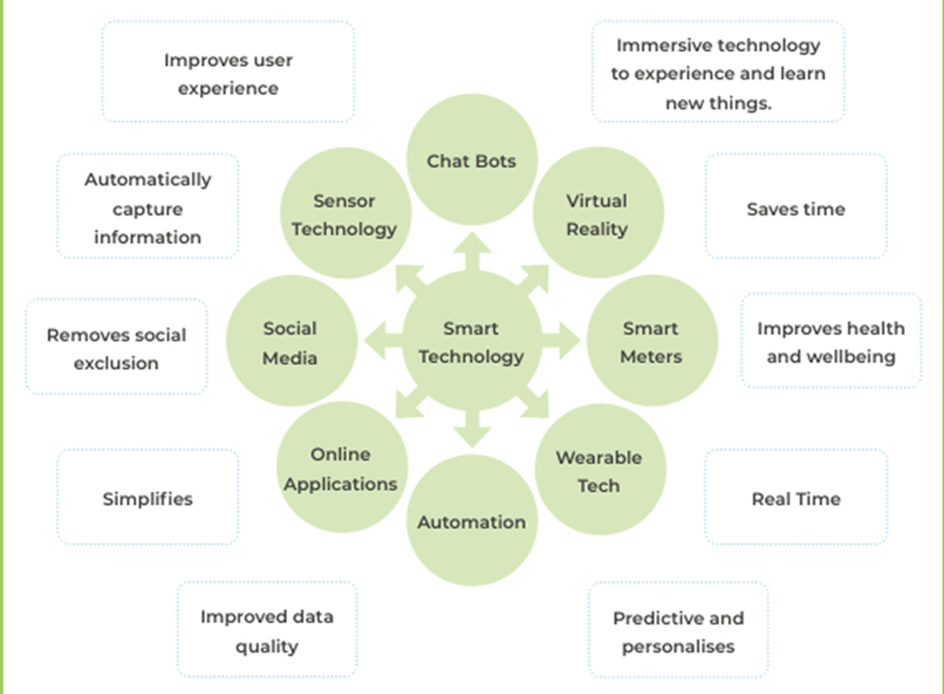
They express intent to “leverage new emerging ‘SMART’ technologies as they enter the digital market ,,, to improve our delivery going forwards across all our services,” as well as to improve health and wellbeing as illustrated below:
Nesta’s People Powered Results and ‘The NHS in 2030’ Report: 2013-2015
Geoff Mulgan, Nesta chief executive until 2019, claims credit for developing “the set of ideas under the label of ‘the relational state’ in the late 2000s,” [60] which went on to inform the Wigan Deal. Mulgan characterises the relational state as, “intelligence shared between state and citizen … which implies changes to roles, metrics and accountabilities, and often bigger roles for personal coaches, mentors and guides.” [61]
In 2013, Nesta’s ‘People Powered Results’ programme succeeded Nesta’s ‘People Powered Health’ initiative (see article 1.1), informed by the latter’s foundations. [62] People Powered Results, which ran until 2023, developed “the approach for national and regional programmes,” including NHS England’s personalisation agenda and elective care transformation strategy, which were taken up by The NHS Long Term Plan. [58]
Central to the personalisation agenda was the initiation of integrated personal commissioning (“IPC”): “a new voluntary approach to blending health and social care funding for individuals with complex needs.” [63] In addition to “care plans and voluntary sector advocacy and support,” IPC introduced “an integrated, ‘year of care’ budget” to be managed either by patients, councils, the NHS or a voluntary organisation on the patient’s behalf.
In a report by SharedLivesPlus, an organisation promoted in Nesta’s People Powered Results write-up, “networked models of care,” facilitated by personal health budgets and involving key roles for family and community members, are lauded as a “cost-effective intervention.” [64]
As part of People Powered Results, Nesta partnered with Re!Institute in Essex to adapt their ‘100 day challenge’ method to the UK’s health and care system, and scaled this across the health system. One such challenge took place in Essex in 2019, with the stated goal of “increas[ing] opportunities for people with a learning disability and/or autism to live meaningful lives.” It resulted in the transformation of the Council’s largest day centre provider to an “innovative and inclusive employment and community inclusion service,” which saved the council an estimated £15 million in lifetime costs for the 129 service users who were transferred into paid employment through it. [65]
As explained by SharedLivesPlus, harnessing “community development and building social capital” to actualise “collaborative healthcare” means not just “finding ways for people to help services or vulnerable people” but also seeking contributions to the community from people with support needs, which they claim helps such people to “achieve better health and wellbeing.” [66]
Another of the ‘100 day challenges’ was the reduction of Accident and Emergency admission rates through schemes such as ‘zero day admissions’. [67]
In July 2015 Nesta released the report ‘The NHS in 2030: a vision of a people-powered, knowledge-powered health system’.
The document focuses on two thus far “underexploited” assets to leverage transformation: digital innovation and social innovation. The latter was also a target of People Powered Results, and according to Nesta, “key to a revolution in how people are involved in their own care and that of others.” [68] It presents many themes by now familiar to the reader in envisaging:
- Self-management and peer support/digital health communities [69] to realise the “financial benefits” of reducing demand for primary and acute care services. [70]
- Reduction in the need for expensive buildings or services. (“Big hospitals can reduce in size, and district hospitals have closed altogether, or been reconfigured as community health resources where a range of clinical and non-clinical groups support communities to live healthier lives.”). [71]
- New specialist centres utilising a “factory-line model of production” standardised processes/procedures, and employing fewer people than current equivalent services. [72]
- Lowered prices and reduced time-to-market for drug and treatment development, achieved by changing regulations and executing multiple steps in parallel. [73]
- The whole of the NHS as a “natural laboratory” with a new institute to “support and evaluate People Powered Health research.” [74] They state, “Frontline centres are also research facilities, connected to a network of regional research hubs. Together they continue to try to understand the complex interactions between biological, behavioural and environmental factors in an individual.” [75] (It is admitted that obtaining consent from all patients being experimented on, “particularly when those experiments are built on behavioural insights,” [76] i.e., behavioural manipulation, is problematic, however this is not seen as an obstacle to implementation).
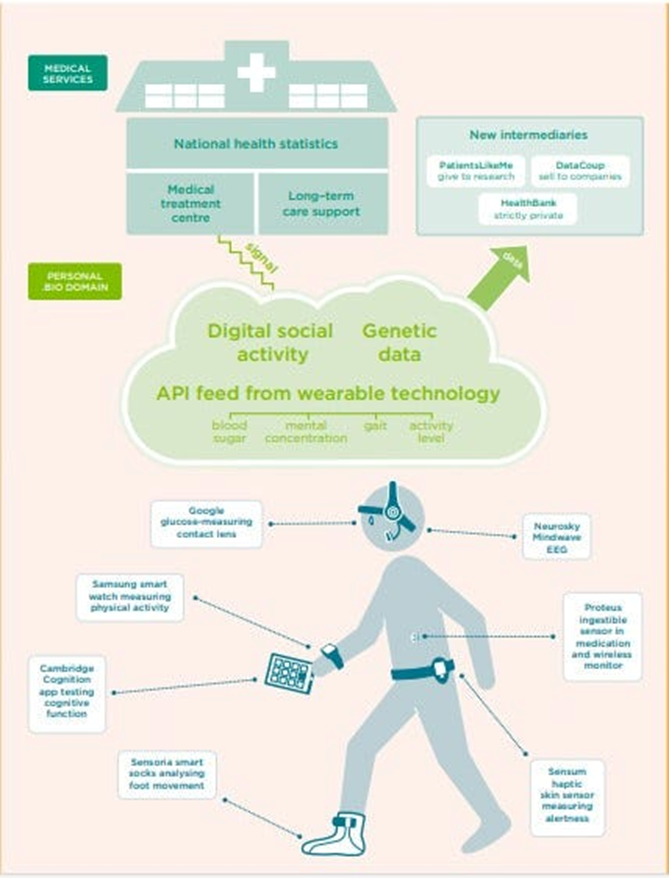
- A “precision medicine” paradigm entailing the increasing replacement of pharmaceutical treatments with “more devices and behavioural change” interventions; from-birth genome-sequencing; [77] use of phenomic data; [78] ubiquitous “sensor technology” for biological and behavioural monitoring including molecular diagnostics/ testing kits, portable EEG monitors, [79] wearables and ingestible sensors. [80]
- Healthcare data no longer comprising specific “parcels” but the aforementioned continuous monitoring. [81] Doctors similarly are expected to be under like surveillance to monitor their performance. [82]
- Coordination with food retailers, architects and town planners to prompt healthier choices, and actions taken to reduce consumption of “vice goods.” [83]
The report also endorses social impact bond (“SIB”) centred funding models, stating, “Key to scaling these practices will be financial models that enable upfront investment to fund preventative work,” and mentions the ‘Ways to Wellness’, Newcastle based “social prescribing” SIB, (see also ‘The NHS Long Term Plan’ section), as an example of one of the “handful of SIBs in this field already”; Ways to Wellness was part of Nesta’s People–Powered Health/Results programme. [84]
Nesta, which boasted the accolade of being “the most active impact investor in the UK” by 2022, [85] began providing seed funding for other impact investing foundations in addition to making direct investments itself through Nesta Impact Investments from 2012, as part of its stated objective of driving innovation in investing. [86] Its portfolio of 40 includes investments in edtech, food tech, climate tech and the future of work and productivity, as well as health tech investments, which [87] align with its three key missions of giving every child a “fair start,” halving obesity by 2030 and creating a “sustainable” future.
A more recent article on Nesta’s website endorses Alex Pentland’s “living lab” concept (see article 1.1) as key to preventative health enthusing, “With smart regulation, the UK could become the centre of this global effort – a living lab – anchored in the unmatched data opportunities offered by the NHS as the world’s largest healthcare system.”
It introduces the idea of the “exposome”, i.e., “the system of all external factors that influence our health and wellbeing trajectory,” and argues for the necessity of “connecting genetics, biological, behavioural, environmental and financial data” (my emphasis) to realise this “holy grail of health akin to the genome.” [88]
References
- [38] Centre for Public Impact. ‘The Wigan Deal.’ 22 May 2024. [Online]: https://www.centreforpublicimpact.org/case-study/the-wigan-deal (https://archive.is/myMCB)
- [39] Ibid.
- [40] Nesta. ‘Creative Councils.’ [Online]: https://www.nesta.org.uk/project/creative-councils/ (https://archive.is/QMctC)
- [41] The Newsroom, Wigan Today. ‘Health expert says Wigan Deal is an NHS role model.’ London: National World Publishing; 10 July 2018. [Online]: https://www.wigantoday.net/health/health-expert-says-wigan-deal-is-an-nhs-role-model-1015103 (https://archive.is/xWpM5)
- [42] Naylor, C., Wellings, D. A citizen-led approach to health and care: Lessons from the Wigan Deal. London: King’s Fund; 2019 [Online]: https://www.kingsfund.org.uk/insight-and-analysis/reports/wigan-deal p. 3
- [43] LinkedIn. ‘Donna Hall.’ Accessed September 2025. [Online]: https://uk.linkedin.com/in/prof-donna-hall-cbe-11555a322
- [44] Bolton NHS Foundation Trust. ‘Professor Donna Hall CBE to step down as Chair of Bolton NHS Foundation Trust.’ 11 October 2022. [Online]: https://www.boltonft.nhs.uk/news/2022/10/donna-hall-to-step-down-as-chair-of-bolton-nhs-foundation-trust/ (https://archive.is/j6vuX)
- [45] Hall, D., Pearson, D. ‘Stop Debating whether ICSs are the Answer – Get on and Make them Work.’ Health Service Journal. 29 June 2023. [Online]: https://www.hsj.co.uk/integrated-care/stop-debating-whether-icss-are-the-answer-get-on-and-make-them-work/7035080.article (https://archive.is/EGznp)
- [46] PossAbilities. ‘Professor Donna Hall CBE -Chair.’ [Online]: https://www.possabilities.org.uk/lone/?post=113 (https://web.archive.org/web/20220524234932/https://www.possabilities.org.uk/lone/?post=113)
- [47] Timan, J. ‘Wigan Market Traders Fear for their Futures.’ Wigan Today. London: National World Publishing; 18 May 2021. [Online]: https://www.wigantoday.net/news/people/wigan-market-traders-fear-for-their-futures-3241487
- [48] Vincent, M. ‘Council is Accused of Acting like “Communist China” after Librarian of 30 Years is Suspended for Criticising a Beijing Firm’s Investment in the City.’ Daily Mail. London: Associated Newspapers Limited; 6 June 2021. [Online]: https://www.dailymail.co.uk/news/article-9657335/Wigan-Council-accused-acting-like-communist-China-librarian-30-years-suspended.html (https://archive.is/CGCFD)
- [49] Johnston, N. ‘Greater Manchester Police Accused of Conspiring to Silence Council Chief’s Critics.’ The Times. London: Times Media Limited; 17 October 2019. [Online]: https://www.thetimes.com/uk/crime/article/greater-manchester-police-accused-of-conspiring-to-silence-council-chiefs-critics-t7xjx6ls0 (https://archive.is/THmHT#selection-1401.0-1401.82)
- [50] Naylor, C., Wellings, D. A citizen-led approach to health and care: Lessons from the Wigan Deal. King’s Fund; London; 2019. [Online]: https://www.kingsfund.org.uk/insight-and-analysis/reports/wigan-deal p. 16
- [51] Nesta. ‘LIFE: from Participle and Swindon Borough Council.’ [Online]: https://www.nesta.org.uk/project/reboot-britain/life-from-participle-and-swindon-borough-council/ (https://archive.is/ZJjZy)
- [52] Mutch, J. ‘The Beehive Centre “Thriving” Two Years After Volunteers Given Control of Facility.’ Leigh Journal. London: Newsquest Media Group; 14 April 2018. [Online]: https://www.leighjournal.co.uk/news/16159987.beehive-centre-thriving-two-years-volunteers-given-control-facility/
- [53] Good Finance. The Old Courts – using investment to create a sustainable arts centre. [Online]: https://old.goodfinance.org.uk/latest/post/old-courts-using-investment-create-sustainable-arts-centre (Timestamp, from 02:52.)
- [54] Nesta. ‘The Old Courts.’[Online]: https://www.nesta.org.uk/feature/arts-impact-fund-portfolio/old-courts/ (https://archive.is/oeGYV)
- [55] Figurative. ‘Case study: The Old Courts.’ [Online]: https://figurative.org.uk/case-study/the-old-courts/ (https://archive.is/1RXUX)
- [56] Good Finance. The Old Courts – using investment to create a sustainable arts centre. [Online]: https://old.goodfinance.org.uk/latest/post/old-courts-using-investment-create-sustainable-arts-centre (Timestamp, from 14:35.)
- [57] Stone, M. ‘NPO Owing Over £1.6m Enters Temporary Administration to Safeguard Creditors’ Interests: Arts at the Mill has gone into administration more than two years after its Old Courts venue was forced suddenly to shut its doors due to structural damage caused by contractors, resulting in income loss of around £4m.’ Arts Professional. 28 October 2025.[Online]: https://www.artsprofessional.co.uk/news/npo-owing-over-1-6m-enters-temporary-administration-to-safeguard-creditors-interests (https://archive.is/U2zmY)
- [58] Wigan Council. The Deal 2030: our people, our place, our future. [Online]: https://www.wigan.gov.uk/Docs/PDF/Council/The-Deal/Deal-2030.pdf
- [59] Wigan Council. Digital strategy 2021-2025. [Online]: https://www.wigan.gov.uk/Docs/PDF/Council/Strategies-Plans-and-Policies/Digital/Digital-strategy.pdf p. 3
- [60] Mulgan, G. ‘Ideas: Governments: The Relational State.’ [Online]: https://www.geoffmulgan.com/faqs-2 (https://archive.is/XjF27)
- [61] Henggeler, A., Marsh, O., Mulgan, G. ‘Navigating the Crisis. How Governments used Intelligence for Decision-Making During the Covid-19 Pandemic.’ International Public Policy Observatory; December 2022. [Online]:https://theippo.co.uk/wp-content/uploads/2022/12/Navigating-the-crisis-Intelligence-Report-12.12.pdf p. 11
- [62] Nesta. People powered results: reflections on 10 years of people power in action. London; 2023. [Online]: https://media.nesta.org.uk/documents/People_Powered_Results_Reflections_on_10_years_of_People_Power_in_Action_dD6ppAv.pdf p. 9
- [63] NHS England. Five year forward view. October 2014. [Online]: https://www.england.nhs.uk/wp-content/uploads/2014/10/5yfv-web.pdf p. 13
- [64] Inclusive Change Partnership (Shared Lives Plus, Community Catalysts, In Control, Inclusion North and Inclusive Neighbourhoods). Collaborative healthcare: supporting CCGs and HWBs to support integrated personal commissioning and collaborative care. October 2017. [Online]: https://inclusiveneighbourhoods.co.uk/wp-content/uploads/2017/10/collaborative-healthcare-guide.pdf p. 15
- [65] Nesta. People powered results: reflections on 10 years of people power in action. London; 2023. [Online]: https://media.nesta.org.uk/documents/People_Powered_Results_Reflections_on_10_years_of_People_Power_in_Action_dD6ppAv.pdf p. 23
- [66] Inclusive Change Partnership (Shared Lives Plus, Community Catalysts, In Control, Inclusion North and Inclusive Neighbourhoods). Collaborative healthcare: supporting CCGs and HWBs to support integrated personal commissioning and collaborative care. October 2017. [Online]: https://inclusiveneighbourhoods.co.uk/wp-content/uploads/2017/10/collaborative-healthcare-guide.pdf p. 13
- [67] Nesta. People powered results: reflections on 10 years of people power in action. London; 2023. [Online]: https://media.nesta.org.uk/documents/People_Powered_Results_Reflections_on_10_years_of_People_Power_in_Action_dD6ppAv.pdf p. 16
- [68] Bland, J., Khan, H., Loder, J., Symons, T., Westlake, S. The NHS in 2030: a vision of a people-powered, knowledge-powered health system. London: Nesta; July 2015. [Online]: https://media.nesta.org.uk/documents/the-nhs-in-2030.pdf p. 4
- [69] Ibid., p. 14
- [70] Ibid., p. 8
- [71] Ibid., p. 8
- [72] Ibid., p. 31
- [73] Ibid., p. 8
- [74] Ibid., p. 9
- [75] Ibid., p. 12
- [76] Ibid., p. 34
- [77] Ibid., p. 9
- [78] Ibid., p. 11
- [79] Ibid., p. 17
- [80] Ibid., p. 12
- [81] Ibid., p. 34
- [82] Ibid., p. 27
- [83] Ibid., p. 28
- [84] Ibid., p. 25
- [85] Pratty, F. ‘Nesta has a Fresh £50m to Back UK Impact Startups with Patient Capital.’ Sifted. 30 November 2022. [Online]: https://sifted.eu/articles/nesta-uk-impact-investment-50m (https://archive.is/1TlBP)
- [86] Nesta. ‘Impact investment.’ [Online]: https://www.nesta.org.uk/feature/innovation-methods/impact-investment/ (https://archive.is/TfK4E)
- [87] Nesta. ‘Nesta impact investments.’ [Online]: https://www.nesta.org.uk/project/impact-investments/ (https://web.archive.org/web/20251206214900/https://www.nesta.org.uk/project/impact-investments/)
- [88] Nesta. ‘Make the UK a Living Lab for Mapping the Exposome.’ [Online]: https://www.nesta.org.uk/feature/minister-for-the-future/better-than-well/make-the-uk-a-living-lab-for-mapping-the-exposome/ ((https://web.archive.org/web/20250126105627/https://www.nesta.org.uk/feature/minister-for-the-future/better-than-well/make-the-uk-a-living-lab-for-mapping-the-exposome/)
Featured image taken from ‘NHS75 – History of the NHS’, NHS North East London, 4 July 2023
The Expose Urgently Needs Your Help…
Can you please help to keep the lights on with The Expose’s honest, reliable, powerful and truthful journalism?
Your Government & Big Tech organisations
try to silence & shut down The Expose.
So we need your help to ensure
we can continue to bring you the
facts the mainstream refuses to.
The government does not fund us
to publish lies and propaganda on their
behalf like the Mainstream Media.
Instead, we rely solely on your support. So
please support us in our efforts to bring
you honest, reliable, investigative journalism
today. It’s secure, quick and easy.
Please choose your preferred method below to show your support.

Categories: Breaking News, UK News