














When Donald Trump floated the idea of a “Board of Peace,” the reaction from much of the political and media class was predictably dismissive. Some framed it as vague branding, others as naïve at best or cynical at worst. Yet beneath the reflexive scepticism lies a question worth asking in good faith. What is this proposal actually trying to do, and why does it provoke such hostility before it has even been defined?
Trump’s foreign policy record complicates the easy caricatures. Unlike many recent presidents, he presided over a period without major new US-initiated wars, prioritised negotiation over escalation, and treated diplomacy as transactional rather than ideological. Against that backdrop, the idea of a standing body designed to de-escalate conflicts deserves closer examination, even from critics.
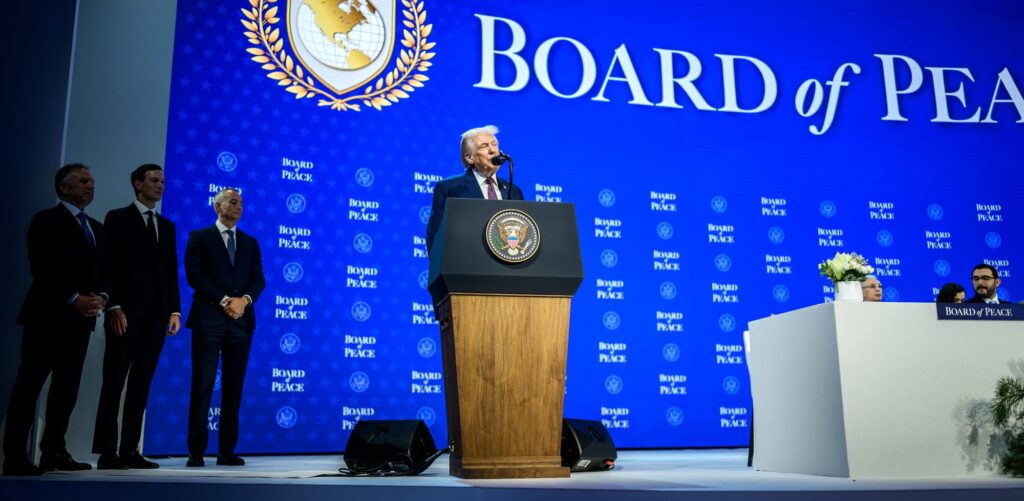
What Exactly is the Board of Peace Supposed to Be?
Details about the Board of Peace remain limited, but that is not unusual for early-stage policy concepts. The broad outline appears to be a permanent advisory or mediation body, composed of experienced diplomats, military figures, and geopolitical negotiators, tasked with identifying flashpoints before they erupt into full-scale conflict.
Unlike the United Nations, which is often paralysed by internal politics and veto structures, a Trump-aligned Board of Peace would likely operate with speed, flexibility, and direct executive influence. Rather than issuing resolutions or moral condemnations, its function would be pragmatic. It would focus on incentives, pressure points, and deal-making.
But does such a body risk redundancy? Well, supporters counter that redundancy might be precisely the point. Existing international institutions have failed repeatedly to prevent wars that were widely anticipated. A parallel mechanism, unburdened by multilateral bureaucracy, could offer an alternative path.
Trump’s Record on Conflict Avoidance
Any assessment of the Board of Peace must consider Trump’s actual record. During his presidency, the US did not enter a new major war. He pursued direct talks with adversaries long considered untouchable, including North Korea, while pressuring NATO allies to take greater responsibility for their own defence.
Trump’s approach was often criticised as erratic, yet it produced results that orthodox diplomacy had failed to deliver. The Abraham Accords, for example, reshaped Middle Eastern relations through economic incentives rather than endless peace conferences. They reflected a worldview in which stability emerges from aligned interests, not abstract commitments to global norms.
Seen through that lens, the Board of Peace looks less like an idealistic project and more like an institutionalisation of Trump’s existing instincts. It would formalise a deal-first approach to global security.
Early International Reactions
So far, international responses to Trump’s proposed Board of Peace have been limited but revealing. In Europe, Hungary and Bulgaria are the only countries that have publicly indicated their willingness to join or support the initiative in its current form. Both governments have previously aligned themselves with Trump’s scepticism toward large multilateral institutions and have favoured state-centric, interest-based diplomacy.
Elsewhere in Europe, reactions have been more cautious. Germany and Italy have explicitly stated that they cannot participate in the Board of Peace as currently envisioned. Their leaders have cited concerns over its structure, mandate, and relationship with existing international frameworks, particularly NATO and the United Nations. The objections appear procedural rather than outright hostile, but they underscore broader unease within Western Europe about parallel diplomatic bodies operating outside established norms.
Other Western governments have so far withheld formal positions, neither endorsing nor rejecting the proposal outright. Outside Europe, no countries have officially joined, but neither Russia nor China has issued a public condemnation, suggesting a wait-and-see approach rather than immediate dismissal.
At this stage, the pattern is clear. Governments already critical of the post-Cold War diplomatic architecture are more open to the idea, while those invested in maintaining existing institutions remain sceptical. Whether that balance shifts will depend less on rhetoric and more on whether the Board of Peace develops into something concrete.
Why the Board of Peace Threatens the Establishment
Opposing the Board of Peace says as much about the current foreign policy establishment as it does about Trump. For decades, Western diplomacy has operated on a model that rewards process over outcomes. Conferences are held, statements are issued, and conflicts continue largely unchanged.
A Trump-backed body that prioritises results would threaten entrenched interests. Defence contractors, permanent diplomatic bureaucracies, and international organisations all benefit from a system in which crises are managed rather than resolved. A mechanism that aims to defuse tensions early undermines that equilibrium.
There is also ideological resistance. Trump’s rejection of moralistic foreign policy language unsettles those who believe international legitimacy flows from institutions rather than power. A Board of Peace rooted in negotiation and leverage challenges that assumption.
So, Could It Actually Work?
Sceptics are right to ask how such a board would function in practice. Would it have authority or merely advisory influence? Would it operate transparently, or behind closed doors? Could it avoid becoming another symbolic body with no teeth?
These are legitimate questions, but they are not reasons for outright dismissal. In fact, they point to the importance of design. A Board of Peace that combines intelligence assessments, economic tools, and diplomatic outreach could intervene earlier than traditional channels allow.
Examples already exist in less formal forms. Back-channel diplomacy, special envoys, and quiet mediation have often succeeded where public negotiations failed. The Board of Peace could consolidate these tools into a coherent framework, backed by presidential authority.
A Brand New Peace Philosophy
At its core, the Board of Peace represents a philosophical shift. It treats peace not as an aspirational moral state, but as a strategic outcome that must be actively managed. This aligns with a realist tradition that recognises the limits of international law and the persistence of national interest.
Rather than pretending all conflicts stem from misunderstanding, this approach accepts that rival powers act rationally according to incentives. Peace, in this view, is achieved by reshaping those incentives, not by lecturing adversaries.
That philosophy will always attract criticism from those who prefer symbolic gestures. Yet history suggests that durable peace is more often forged through uncomfortable compromises than idealistic declarations.
Final Thought
The Board of Peace may ultimately prove flawed, or it may never move beyond concept. But dismissing it outright reflects a deeper unwillingness to question a foreign policy consensus that has delivered endless instability. Trump’s proposal asks whether peace can be pursued with the same seriousness and creativity as war. In a world sliding toward permanent conflict, that question alone deserves a hearing.
The Expose Urgently Needs Your Help…
Can you please help to keep the lights on with The Expose’s honest, reliable, powerful and truthful journalism?
Your Government & Big Tech organisations
try to silence & shut down The Expose.
So we need your help to ensure
we can continue to bring you the
facts the mainstream refuses to.
The government does not fund us
to publish lies and propaganda on their
behalf like the Mainstream Media.
Instead, we rely solely on your support. So
please support us in our efforts to bring
you honest, reliable, investigative journalism
today. It’s secure, quick and easy.
Please choose your preferred method below to show your support.

Categories: World News
All very well, but who represents Palestine?
International Public Notice: Not a Court Issue, a Diplomatic Issue of International Crime
By Anna Von Reitz
Notice to Principals is Notice to Agents; Notice to Agents is Notice to Principals.
American state nationals who don’t work for any species of government, are not obligated to the foreign incorporated “governmental services providers” that have been swaggering around impersonating our actual government.
These foreign governmental services providers have been trying to present administrative court actions under False Pretenses of “public interest” in American private property, and setting their own courts up as the arbiters — leading to illegal takings and confiscations forbidden by both The Constitution of the United States and The Constitution of the United States of America.
Their “District Courts” were improperly and non-consensually allowed to operate in the States of the Union under the pretext that they would be addressing Territorial and Municipal personnel and dependents (see the Insular Tariff cases, 1898-1904) — and then, instead of limiting their activities to their proper jurisdictions and subject matter, the vermin proceeded to “register” American babies as foreign citizens under their control.
All of this was done under color of law and without full disclosure and often without valid witnesses. Millions of Americans have been erroneously branded as British Subjects, when we have already fought eight long years and have the peace treaties to prove that they, the Brits, are in essence the same ilk as cattle rustlers, only instead of cattle, they are trying to justify falsified ownership claims and “salvage interests” attached to living people.
In terms of the Law of the Sea, they have been caught red-handed in illegal and unnecessary salvage operations and ordered to cease and desist by their actual Employers.
This whole situation results in peonage and enslavement, both of which are unlawful and illegal and must be recognized as crimes. The same False Claims of foreign citizenship being held against Americans also results in racketeering and illegal confiscation and taking of private property assets.
The District Courts have to be shut down immediately and removed to the District of Columbia, whether Territorial or Municipal “districts” are invoked. The IRS/ Internal Revenue Service has similarly misaddressed Americans “as if” they were foreign persons in their own country. The IRS and Internal Revenue Service need to be booted out with the District Courts for all the same reasons.
Impersonation is a crime. Barratry is a crime.
Americans are not “sovereign citizens” — they are “foreign sovereigns” with respect to these out of control and criminally maladministered public employees, and this is a diplomatic issue, not only a matter of crime.
These people are our employees and their contract is clearly stated on the public record of all nations. All nations party to our treaties and contracts are liable for their immediate and correct performance of duties, the cessation of all merely “presumed” powers and the liquidation of all merely presumed-to-exist public trust interests in individual American people and their property assets.
This must end now. Not next year. Not whenever the United States Secretary of State and Office of the Inspector General get around to it. This is their responsibility under the Laws of Admiralty, the laws of the British Parliament and International Law presented as public contracts and treaties. This is required of these officers under both The Constitution of the United States and The Constitution of the United States of America, Article IV, which requires all concerned to protect the persons of Americans — not prey upon them.
The US TAX COURT is restricted to addressing actual corporations, not shell public trusts set up in the names of Americans. The IRS and the Internal Revenue Service have no business addressing average Americans or pretending that such Americans are foreign trust estates or business entities profiting from commerce.
Continuing to allow these foreign “courts” to operate once their mode of operation is known, is a criminal act in and of itself. We hold the Principals and their Agents individually 100% commercially and personally liable for all and any continued offers to impersonate Americans as foreigners in their own country.
For more than a year, we have been promised that the IRS would be shut down and promised that their agents would cease and desist. In that year, more damage has been done which owes immediate correction, too. For more than a year, we have been promised that the District Courts and their “systems” would be shut down and returned to the District of Columbia and that they would stop misaddressing declared Americans.
This is not just a criminal misadministration or an offense against the Constitutions (illegal takings under Article IV) but stubborn armed racketeering carried out under color of law —– literal armed robbery being carried out by public employees who receive their paychecks from the victim’s hands.
We are calling for immediate complete shutdown of all District courts operating in the States of the Union. We also require the similar shut down of all foreign incorporated State-of-State and incorporated County Courts, which have been participating in the same racketeering activities.
These organizations are foreign corporations engaged in organized criminal activities on American soil. They are owned and operated by known Principals who are under contract to provide us with good faith service.
The time to stop talking and start walking has arrived.
Notice to Agents is Notice to Principals; Notice to Principals is Notice to Agents.
Someone downvoted you for this so I upvoted you ……. but it stayed at minus one. Go figure ….
Nothing can change while regular folks remain ignorant of the citizen legal construct that is the property of the legal entity of the USA corporation.
We, who are aware and awake are obliged to ensure to wake the others up. We have a moral duty to do so.
Absolutely correct and true words. Thank you!
Trump is the current puppet-in-chief of the GloboCap™ empire, and “his” so-called “Board of Peace” is just a new theatre for the upcoming next season of the infamous Gaza genocide shitshow. Big Don is the least one to be asking any questions regarding how peace can be pursued – especially not while the onslaught of the Palestinian people continues to this day. Donald and his mass murder buddy Bibi united for peace? What a complete joke!
Hi Huey, is it true that DT has been mentioned 38,000 times in the recent Epstein files ?
I’m 404, but even if that were the case, it would not change the course of things. The Epstein files are only a facet of the mirror reflecting our dark times.
How dare someone with principals and morals and foremost with the needs of the people of his own country has anything to do with Peace. Of course “the establishment” will not like this ….. it doesn’t make them any money.
How dare someone with principals and morals and foremost with the needs of the people of his own country has anything to do with Peace. Of course “the establishment” will not like this ….. it doesn’t make them any money.
anything these masons say is the opposite of what’s really happening and we should all know this by know !
now
https://trumpwhitehouse.archives.gov/people/ivanka-trump/ you might want to read this description
Imagine if Trump as the head of the Board of Peace were to publicly state that he’s going to include Palestinians in the process and prioritise their needs ahead of everything else. Imagine what the response of Israel would be to that …..
Hasn’t Trump invited a certain man of deeply dubious character on the board which gives his project a very bad impression of its purpose ? He goes by the name of Anthony Charles Lynton Blair!
Criminals, perverts and satanists..
Indeed. Blair leapt into leadership on the wave of public support for the exterminated John Smith and this in itself set the ‘Tone’ (Brit shorthand for ‘Tony’) of his administration. Over 90% of the public were 100% opposed to joining the US gungho invasion of Iraq which should have settled the matter if the term ‘democracy’ had any value. Instead, they were treated to the Brit version of nine eleven: 777 (7th July 2005) Note the ‘sacred’ trinity of the culprits. In fact, one of the buses involved in the world publicised scene had a poster for ‘The Blair Witch Project’ plastered on its side.
As with the US operation, in the shock ‘n awe, invasion went ahead. In the wisdom of hindsight, It was a classice Epstein/Savile blackmail sting, as Labour’s P-Ring had been active in The Dunblane affair which, if exposed to Joe Public would bring the party crashiing down quicker than the Towers. We are in the situation we have today as the Ring of Fire went from Afghanistan – Iraq, Iraq – Egypt, Egypt – Libya, Libya – Iran …. Palestine has been under duress since the 1920’s ramping up to situation of late. As Gadaffi said, if Libya were taken over, The West would be over-run with Africans seeking revenge.
Palestine is being used as the battering ram under the false flag of ‘Islam’ to usher in ‘Blasphemy Laws’ (read Noahide/Sharia) of Trump/Putin/Starmer (who’se a Saviloy Boy). All are Shabad and aim to exterminte Western indigenous populations first. Call it Bolshevism.
Another seven thousand dollars Rhoda?
Building hotels and casinos on the Graves of thousands of women and children.
Offended by eveything ashamed of nothing…
‘Peace’ = R.I.P. – silence of opposition, removal of dissent. With Blair on the board, can there be any serious ‘debate’ as to the merit of of peace, meaning ultimate War? Rhetorical question, obviously.