














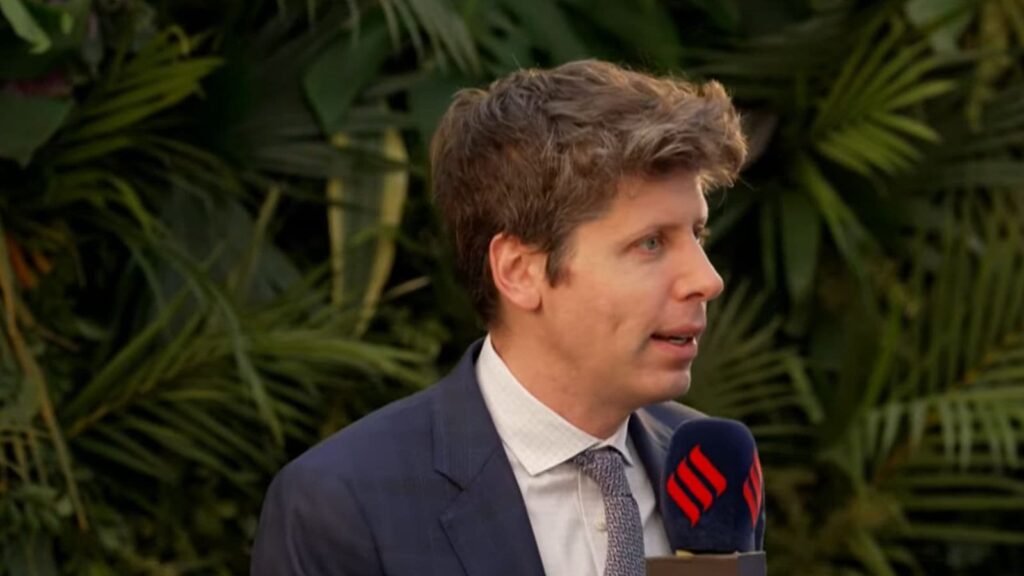
OpenAI’s Sam Altman sparked a firestorm of criticism at the India AI Impact Summit 2026 when he responded to concerns over artificial intelligence’s growing environmental footprint by comparing it to the lifetime energy and food a human consumes before reaching “useful” intelligence. “It takes like 20 years of life and all of the food you eat during that time before you get smart,” Altman said in a much-circulated interview clip, arguing that this makes comparisons between human and AI energy usage “unfair.” What sounded like a hastily crafted metaphor has instead exposed a deeper disconnect between some AI leadership and the public — one that frames human existence and resource use in the same utilitarian terms as server racks and silicon.
A Cold Comparison Missing the Human Point
During a roughly hour-long session with The Indian Express, Altman defended the rapid expansion of AI systems and data centres by reframing the debate around energy consumption. When pressed about claims that a single ChatGPT query uses the equivalent of a smartphone battery charge, Altman dismissed such figures and shifted the focus to broader efficiency comparisons. “People talk about how much energy it takes to train an AI model, relative to how much it costs a human to do one inference query,” he said. “But it also takes a lot of energy to train a human.”
This line of reasoning collapses decades of human development, social interaction, education and embodied experience into a trivial equivalence with computational cycles. In Altman’s telling, the very evolution of humanity is something to be factored into the energy ledger of intelligence, as if centuries of cultural achievement were just another entry on a balance sheet.
Critics say this metaphor not only misses the point but dehumanises the very people AI is meant to serve. On social media sites such as LinkedIn, commentators labelled Altman’s comparison as detached and dystopian, dismissing meaningful concerns about energy, water and land usage surrounding data centre expansion. One popular post derided the idea that a baby’s growth and learning could be equated to training “a non-biological tool” with no intrinsic value beyond utility.
The Appetite of AI is Greater Than Silicon and Servers
Behind the headline-grabbing analogy is a real, quantifiable problem that Altman glossed over. Modern AI infrastructures, particularly large data centres, require vast amounts of electricity and cooling resources. Estimates suggest these facilities already use energy on a scale comparable to millions of households and consume billions of gallons of water annually, figures that are projected to increase as models grow more complex.
Researchers have documented not only the direct energy and carbon footprint of training large models but also the hidden impacts of hardware manufacturing, e-waste and the constant need for retraining as models become obsolete. A 2025 study found that developing and training state-of-the-art language models can emit hundreds of tons of carbon and consume millions of litres of water — a footprint that dwarfs the energy metrics Altman selectively highlights.
It is worth noting that although some efficiency gains have been made at the per-query level, total global energy demand from AI is rising rapidly. Projections by energy agencies forecast that data centre growth could significantly increase electricity demand over the coming decade.
Responses from the Tech World and Beyond
Not everyone in the tech world is willing to let Altman’s framing stand unchallenged. Industry leaders, political figures and environmental commentators alike have pushed back, warning that the relentless build-out of AI infrastructure could strain energy supplies and exacerbate climate and social inequalities. One prominent voice noted that the focus should not be on defending AI’s efficiency by redefining human life in economic terms but on confronting the very real societal costs of resource extraction, grid stress, and ecological degradation.
Sridhar Vembu, founder of Zoho, responded: “I do not want to see a world where we equate a piece of technology to a human being. I work hard as a technologist to see a world where we don’t allow technology to dominate our lives, instead it should quietly recede into the background”. As the Times of India writes, “Vembu also stressed on the fact that AI should remain as a supportive tool and not as a dominant force. He also cautioned [against] allowing machines to be placed on the same level as humans, stressing that technology must serve humanity rather than overshadow it. His remarks reflect growing unease among technologists about the cultural and ethical implications of AI’s rapid expansion”.
Chinese renewable energy entrepreneur Zhang Lei recently warned that unchecked AI energy demand could drive “energy poverty” in vulnerable regions unless massive investments in clean energy are made — a stark counterpoint to Altman’s reassurance that AI is simply another consumer of resources among many.
Final Thought
Altman’s insistence that humans and AI are comparable in terms of energy consumption is symptomatic of a broader reckoning that the tech industry must face: intelligence — whether biological or artificial — cannot be reduced to calories burned or electricity consumed without losing sight of what makes human life meaningful. At a moment when AI is poised to reshape economies, labour markets and even the very idea of human agency, leaders in the field would do well to engage with these ethical and environmental concerns substantively rather than with reductive soundbites.
The future of AI should not be defended on the basis that it merely outperforms human energy metrics. It should be questioned on whether it serves humanity without consuming the world in the process.
The Expose Urgently Needs Your Help…
Can you please help to keep the lights on with The Expose’s honest, reliable, powerful and truthful journalism?
Your Government & Big Tech organisations
try to silence & shut down The Expose.
So we need your help to ensure
we can continue to bring you the
facts the mainstream refuses to.
The government does not fund us
to publish lies and propaganda on their
behalf like the Mainstream Media.
Instead, we rely solely on your support. So
please support us in our efforts to bring
you honest, reliable, investigative journalism
today. It’s secure, quick and easy.
Please choose your preferred method below to show your support.

Categories: World News
Producing tons of carbon, using lots of water…what’s it doing, chucking out pencil lead? Coal? Diamonds? That’s carbon. If you mean the gas of life on this Plant Planet, CO2, say so…stop being so ignorant. Water is endlessly recycled by Nature. Ever heard of RAIN. It doesn’t get destroyed in any process! It might get contaminated but Nature sorts that out. Humans. Think they are educated when what happens is they know more and more about less and less until they know everything about nothing.
So… the man is a complete imbecile. The perfect product of the contemporary brainwashing education system.
Where the hell do they get these absolute idiots from FFS! Totally clueless, and as Sturat rightly puts, “BRAINLESS”
Hi G Calder,
Another bottomless pit, carry on.
Thought I would mention today Wednesday 25 Feb, I have counted about 80 Chemtrails over Yorkshire UK.
What mind control drugs are the American Military spraying us with ?
Bearing in mind Where I live is not on a flight path.
And where are all the insects disappearing.
https://childrenshealthdefense.org/defender/insects-vanishing-earth-why-some-doctors-terrified/
https://rumble.com/v76drbi-from-weather-modification-to-global-control-and-how-we-fight-back-chris-sul.html?e9s=rel_v2_ep
Even though 34 states in US have banned Chemtrailing, it is still happening.