














Humans can do little to nothing to affect the world’s so-called “greenhouse gases.” It’s no surprise then that the UK government’s efforts to reach net zero are futile in terms of changing the climate.
However, the Government’s policies are actively disastrous for the economy and are leading us down the road to poverty and serfdom.
We must reverse Net Zero policies before it is too late, David Turver writes.
Let’s not lose touch…Your Government and Big Tech are actively trying to censor the information reported by The Exposé to serve their own needs. Subscribe to our emails now to make sure you receive the latest uncensored news in your inbox…
Net Zero is the Road to Serfdom
By David Turver, 8 March 2026
Introduction
UK Labour Members of Parliament (“MPs) like Tris Osborne spend a lot of their time claiming our energy system is secure and the National Energy System operator is forever boasting about how much of our electricity comes from wind and other renewables (see Figure 1).
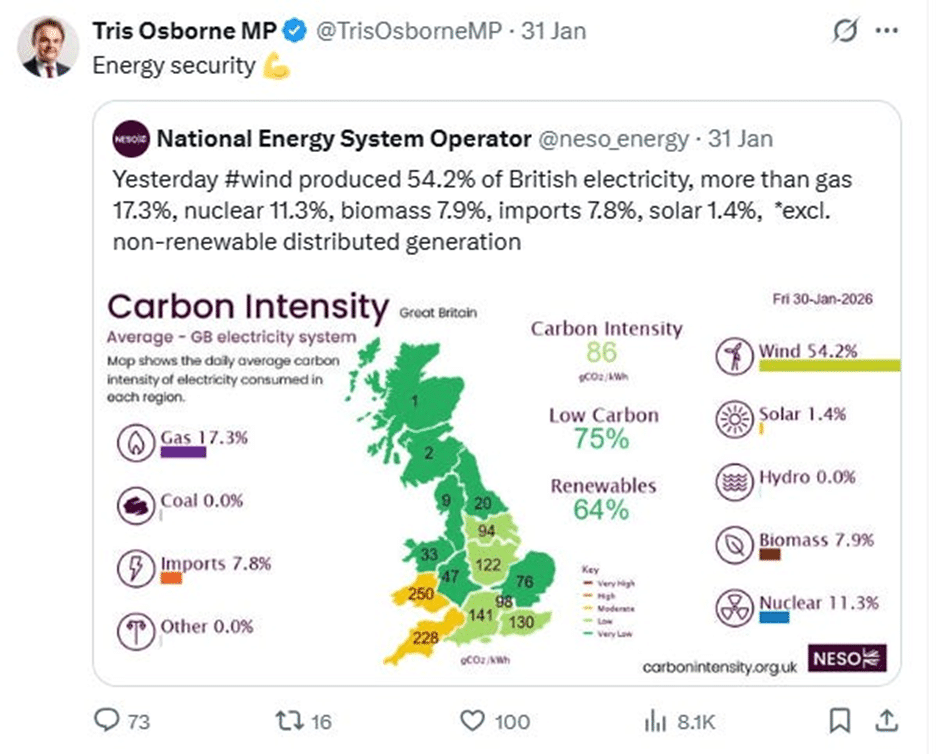
Prime Minister Starmer is also signing us up to EU net zero rules that we will likely mean we have to decarbonise even faster under ever more draconian government dictats.
In his book ‘Road to Serfdom’, Friedrich Hayek warned of the dangers of the tyranny that inevitably results from government control of economic decision-making through central planning. The UK energy system is certainly hamstrung by central government control, so what has it done for our energy security and the performance of our energy system? Just how far are we down the road to serfdom?
Energy Prices
First, let us remind ourselves of one important performance metric, namely energy prices. As we have covered before, UK industrial electricity prices are the highest in the developed world, see Figure 2.
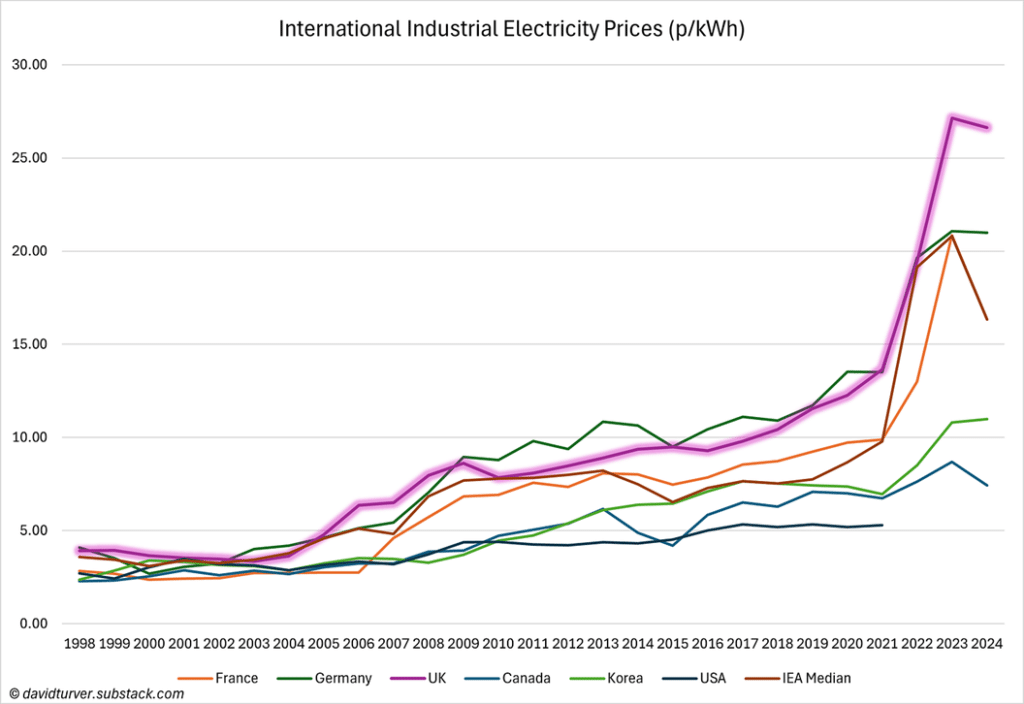
UK industrial electricity prices at 26.63p/kWh are the highest of the 25 countries reporting data to the International Energy Agency (“IEA”). UK prices are three and a half times more than Canada that has the cheapest industrial electricity prices at 7.43p/kWh. Our prices are also 2.4 times those of Korea and 63% higher than the IEA median. The UK fares slightly better on industrial gas, with prices slightly below the IEA median, but still six times higher than Canada.
According to the same IEA data, the UK has the second-highest domestic electricity prices, some 45.8% above the IEA median and 2.4 times those of the US. UK domestic gas prices are more competitive, 2.49% lower than the IEA median but still 3.2 times those of Canada and 1.5 times the price in South Korea.
UK energy prices are certainly nothing to boast about.
Overall Energy Consumption
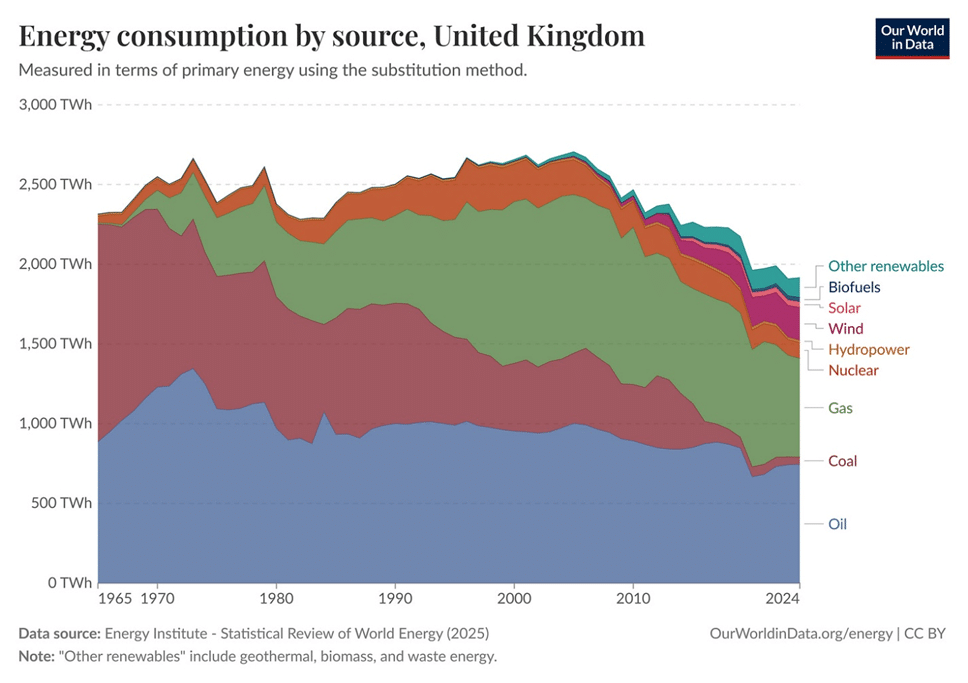
Our World in Data (“OWID”) shows us that UK primary energy consumption is down 29% from its peak in 2005, see Figure 3.
Slightly different data from the UK’s Energy Trends (Table 1.3) shows final energy consumption down 19.9% overall since peaking in 2004 (see Figure 4).
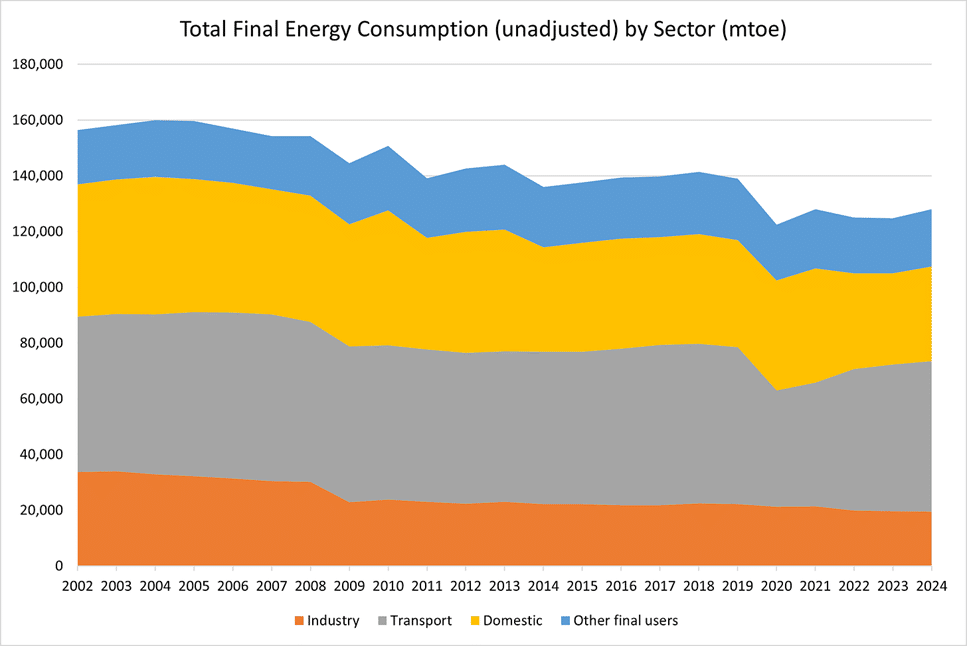
We can see from the detailed sector data that industrial consumption is down 40.7% and domestic consumption is down 31.1%. Transport energy consumption is down a more modest 5.9% and other users (mostly service industries) are up a modest 1.2% since 2004. The first three quarters of 2025 show a further reduction in energy consumption compared to 2024. It is unlikely that the reduction in industrial energy consumption is a result of some efficiency miracle because ONS productivity data shows that hours worked in the Manufacturing and Mining & Quarrying sectors are down 20.7% and 12.4% respectively since 2004, indicating that industry is contracting.
In addition, as shown in Figure 5, “fossil” fuel dependency has fallen from 91.2% in 2007 to 75.2% in 2025. The UK flipped from being a net energy exporter to an energy importer in 2004.
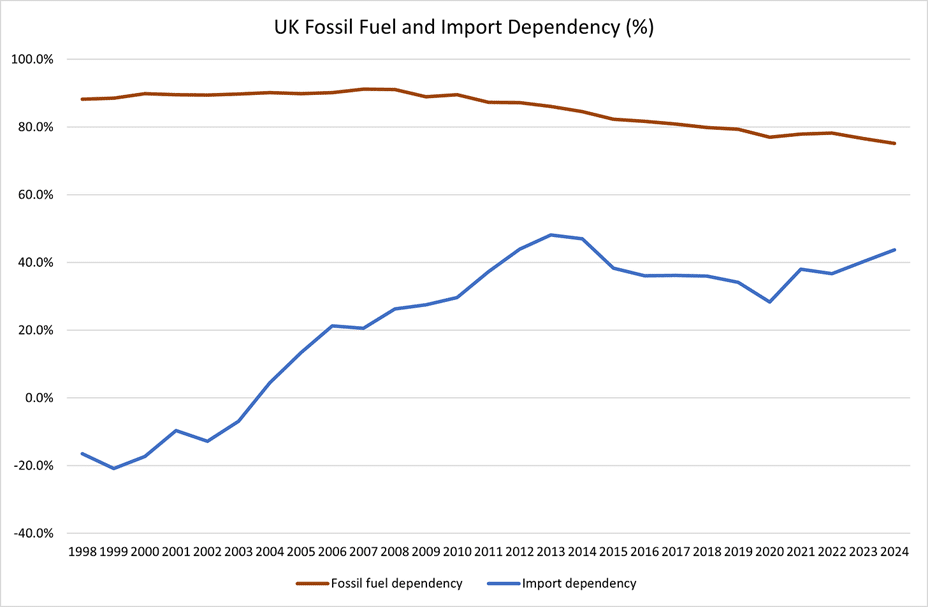
Import dependency rose sharply to 48.2% in 2013 before falling back to 28.4% in 2020 and then rising again to 43.8% in 2024. Being dependent on imports for more than 40% of our energy does not indicate strong energy security. Recent events in the Middle East demonstrate that, given our continuing high dependence on hydrocarbons, we should be doing all we can to exploit domestic resources to maintain energy security.
As might be expected with falling overall energy consumption, energy use per person is falling too, as shown in Figure 6 (again from OWID).
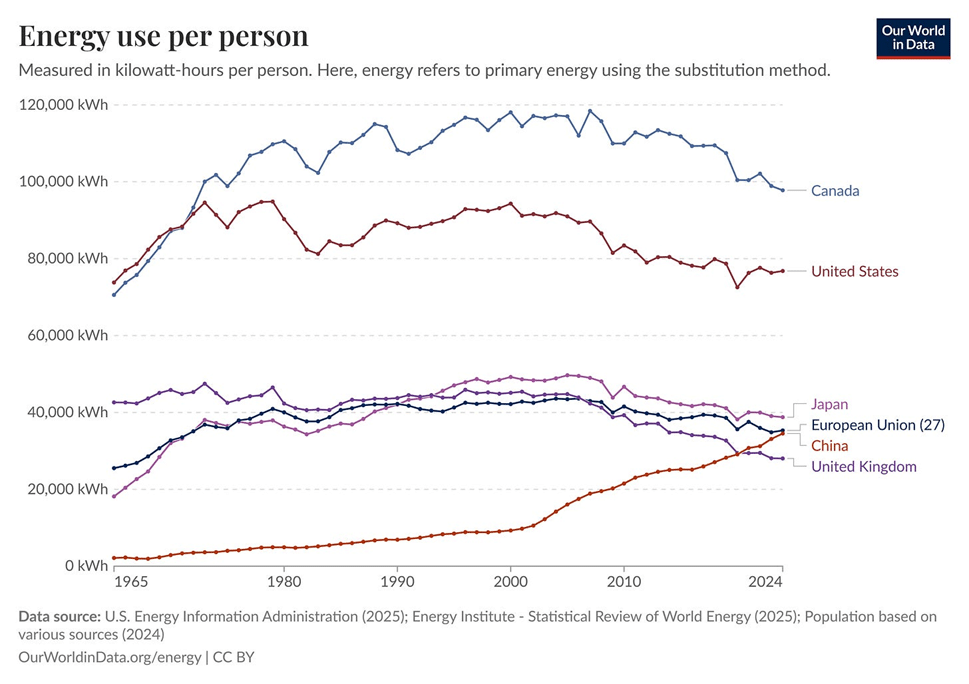
UK energy use per capita is below that of China, the EU27 and the other G7 countries. In fact, looking at the detail, UK energy use per person is also lower than Belarus, Bulgaria, the Czech Republic, Greece, Iran, Ireland, Kazakhstan, Malaysia, Poland, Slovakia, Slovenia and Turkmenistan. We are on a rapid descent to third-world country status. This energy austerity is another way of describing the road to serfdom.
Electricity Generation
Net Zero supporters claim that we might expect primary energy use to fall because switching to electric vehicles (“EVs”) and heat pumps is more efficient than petrol cars and gas boilers. This should lead to increased electricity consumption even though overall energy consumption may fall. How does this claim stack up when we look at UK electricity data?
Energy Trends Table 5.1 provides data on UK electricity supplied over time, as shown in Figure 7.
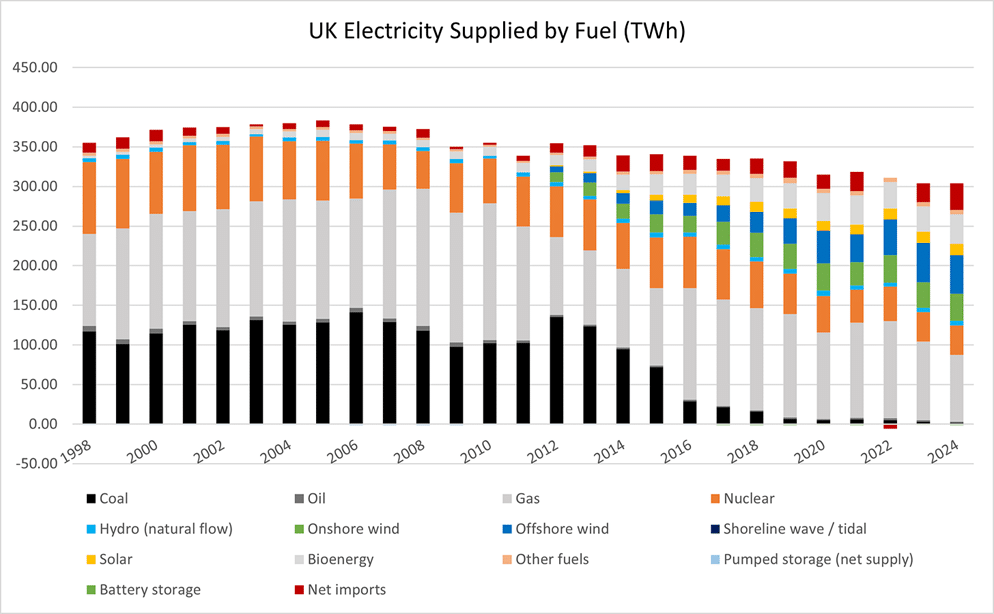
UK electricity supplied peaked in 2005 at 385TWh and has since fallen 21.4% to less than 303TWh in 2024. However, the first three quarters of 2025 show a slight uptick in total electricity supplied compared to the same period in 2024. The overall electricity supplied picture flatters our domestic electricity generation performance, though, because it includes net imports, which have been rising substantially, as shown in Figure 8.
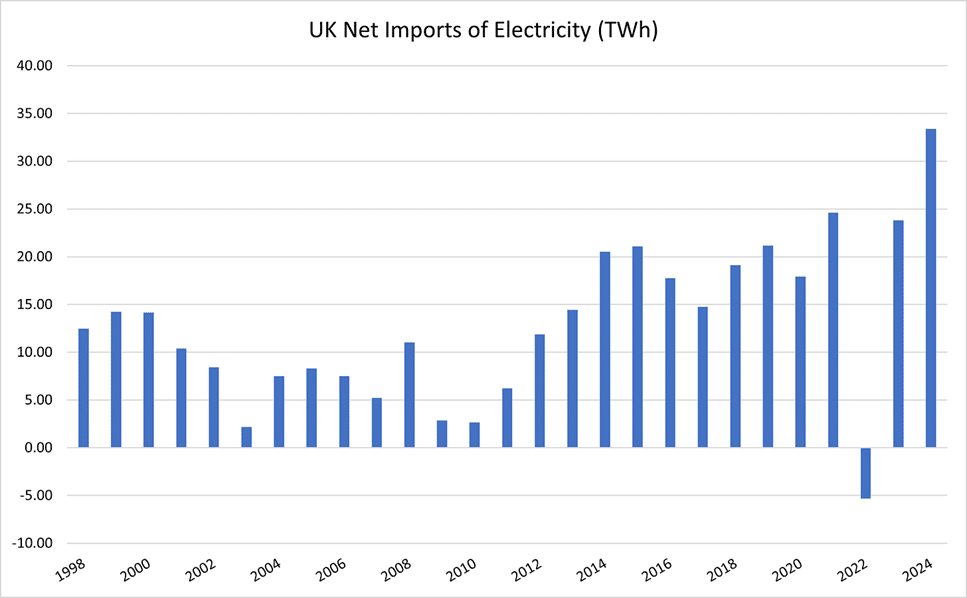
Net imports reached a record 33.4TWh in 2024, or 11% of total electricity supplied. Being reliant upon the kindness of strangers supplying electricity over interconnectors does not look like robust energy security.
Figure 9 shows an international comparison of electricity generation per capita (from OWID).
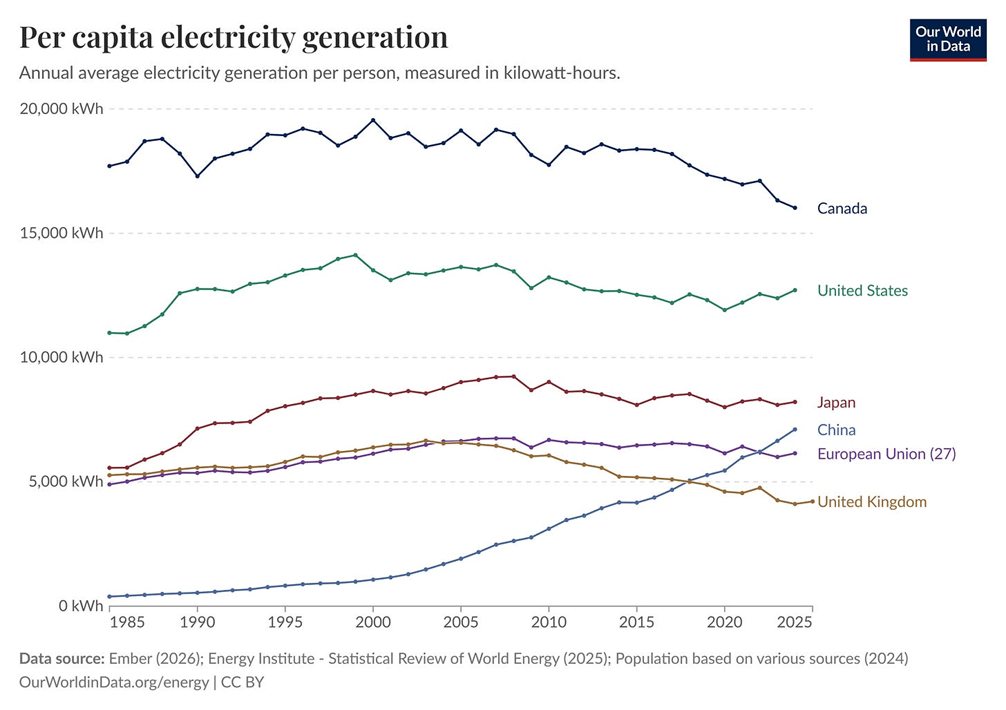
UK electricity generation per person fell from a peak of 6,657kWh in 2003 to just 4,110kWh in 2024, before recovering slightly in 2025. This is lower than China, the EU27 and the other G7 nations. The UK’s 2024 electricity generation performance was worse than Belarus, Bulgaria, Chile, the Czech Republic, Greece, Iran, Ireland, Malaysia, Poland, Serbia, Slovakia, Slovenia and Uruguay.
We might expect the increasing number of EVs and heat pumps to increase demand for electricity in the UK, but there is little sign this is happening. Instead, electricity generation and supply are falling in both absolute and per capita terms. Another indication that we are on the road to serfdom.
Impact on Economic Performance
Of course, expensive and scarce energy and electricity have an impact on economic performance. We can see just how far we are down the road to poverty by comparing the change in energy use per person and gross domestic product (“GDP”) per capita since the Climate Change Act came into force in 2008, as shown in Figure 10.
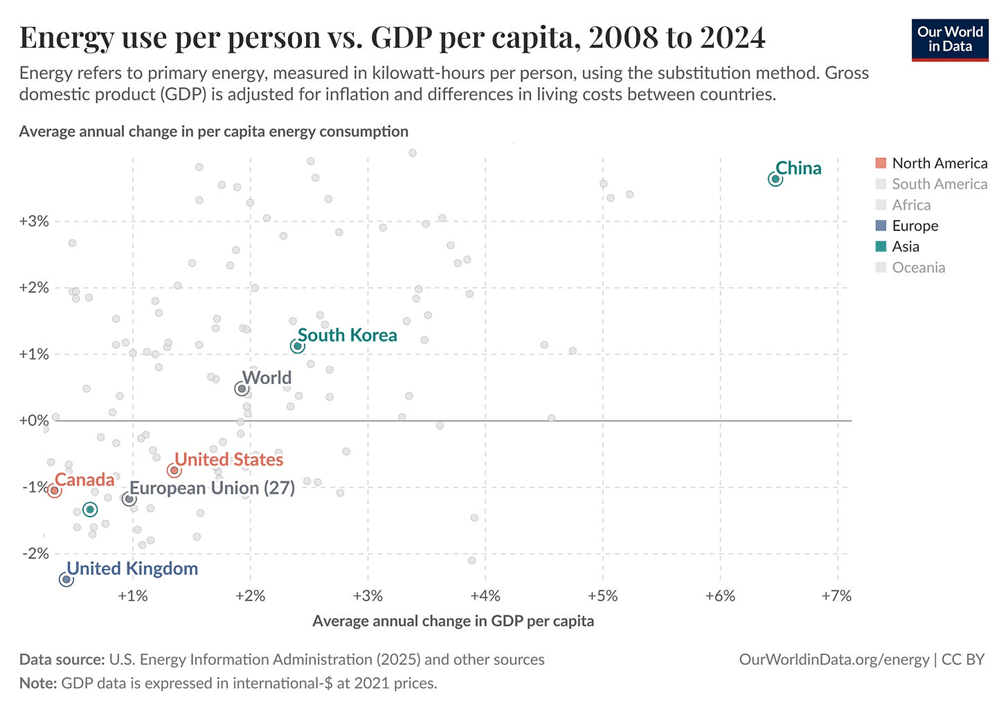
The UK has reduced energy consumption by 2.4% per annum. This is more than Canada, the EU27, Japan and the United States. As a result, GDP per capita has virtually stagnated, growing at just 0.4% per annum, lower than the EU27 and all the other G7 countries except Canada. By contrast, world GDP per capita has been growing at close to 2% per year, and energy use per person has increased by about 0.5% per annum. Asian countries like South Korea and China have increased energy use even faster and have accordingly grown much faster. The UK’s energy consumption per person is much lower than that of many other poorer countries, so we can expect the UK economy to at best stagnate if we maintain this energy austerity.
Emissions
Of course, the whole purpose of our rush to Net Zero is to play our part in reducing global emissions of greenhouse gases. However, emissions data from OWID show global emissions soaring as UK emissions decline to little more than a rounding error, see Figure 11.
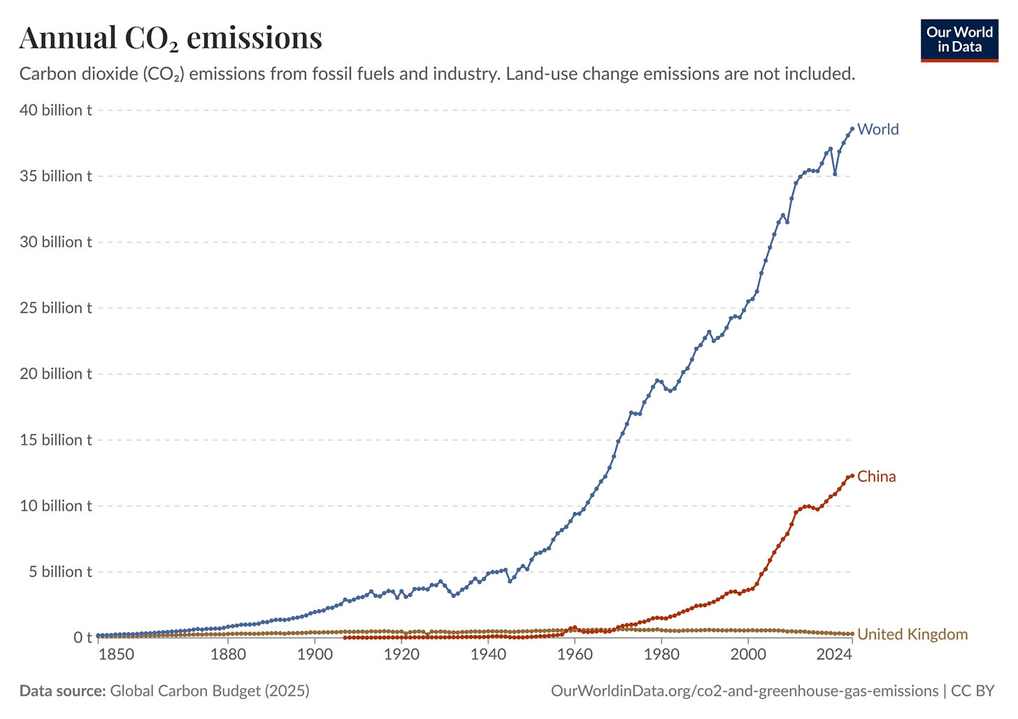
Whatever the UK does to further reduce emissions will make no difference to the climate. On a per capita basis, the picture is even worse, as demonstrated in Figure 12.
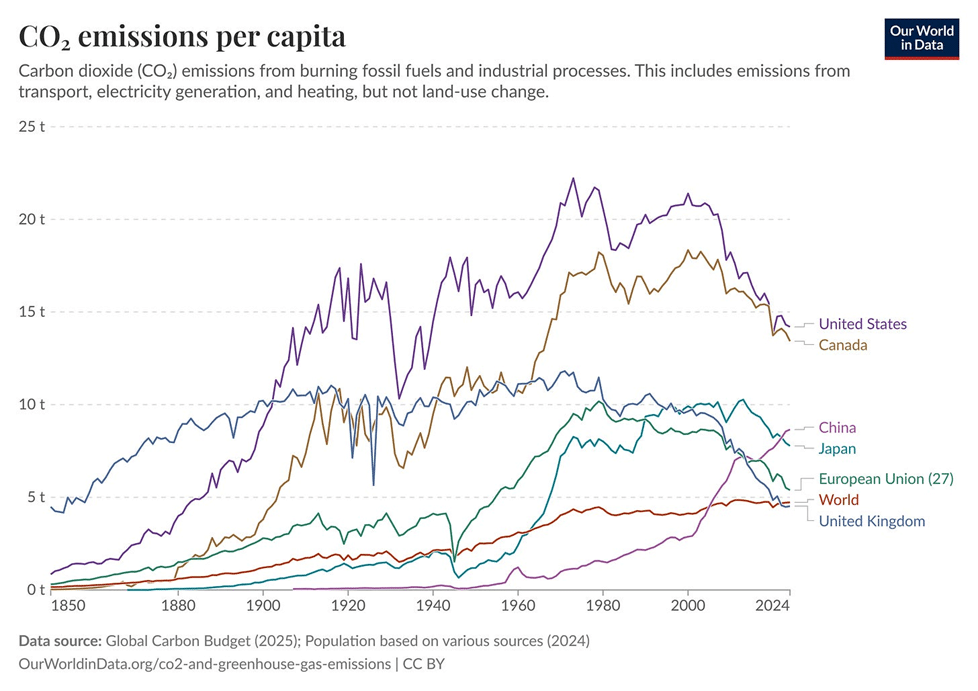
Not only are UK emissions at 4.53t per person, a little more than half those of China (8.66t/person), but UK emissions are also below the world average of 4.73t/person. We are destroying our economy while the world continues to benefit from cheap and abundant energy, and ignores our alleged “climate leadership.” All our attempts to reach net zero are futile in terms of climate and actively dangerous for our economy, leading us down the road to serfdom.
Conclusions
We have, by some measures, the most expensive energy in the developed world. As a result, our overall energy consumption, electricity consumption and generation are all declining. This is particularly evident in the industrial sector where energy consumption has declined over 40% from the peak. Hours worked in the productive sectors of the economy have declined too, indicating severe industrial contraction.
Because of reduced oil and gas production, partly due to punitive taxes and effective bans on drilling, the UK has become a net energy importer. The increased penetration of intermittent renewables has made us dependent upon interconnectors for electricity supply too. Far from Net Zero policies delivering energy security, we are less secure than we have been for decades, perhaps centuries. Recent events in the Middle East demonstrate the importance of energy security. We should be doing all we can to exploit domestic resources.
All this is impacting UK economic performance, with GDP growth all but stagnating as energy consumption falls along with emissions. Far from falling behind on renewables installations, it is evident that we have already fallen behind on energy consumption and economic performance. Our energy consumption per person is already behind many countries that we would regard as the third world, and our economic performance is heading that way too.
The notion that we are doing this to demonstrate some sort of climate leadership is for the birds. Our absolute emissions are but a rounding error in the global scheme of things and we already emit less per person than the world average. The world is not following our example, and they are reaping the benefits of cheap and abundant energy. Net Zero is simply futile virtue signalling, yet Starmer wants to sign us up to even more stringent European Union (“EU”) Net Zero rules. Who would have guessed that rigid state control of energy would lead us down the road to serfdom? We must reverse Net Zero policies before it is too late.
About the Author
David Turver is a British retired consultant, chief information officer and project management professional. He publishes articles on a Substack page titled ‘Eigen Values’ where he writes about contentious issues such as climate, energy and net zero. You can subscribe to and follow his Substack page, ‘Eigen Values’, HERE.
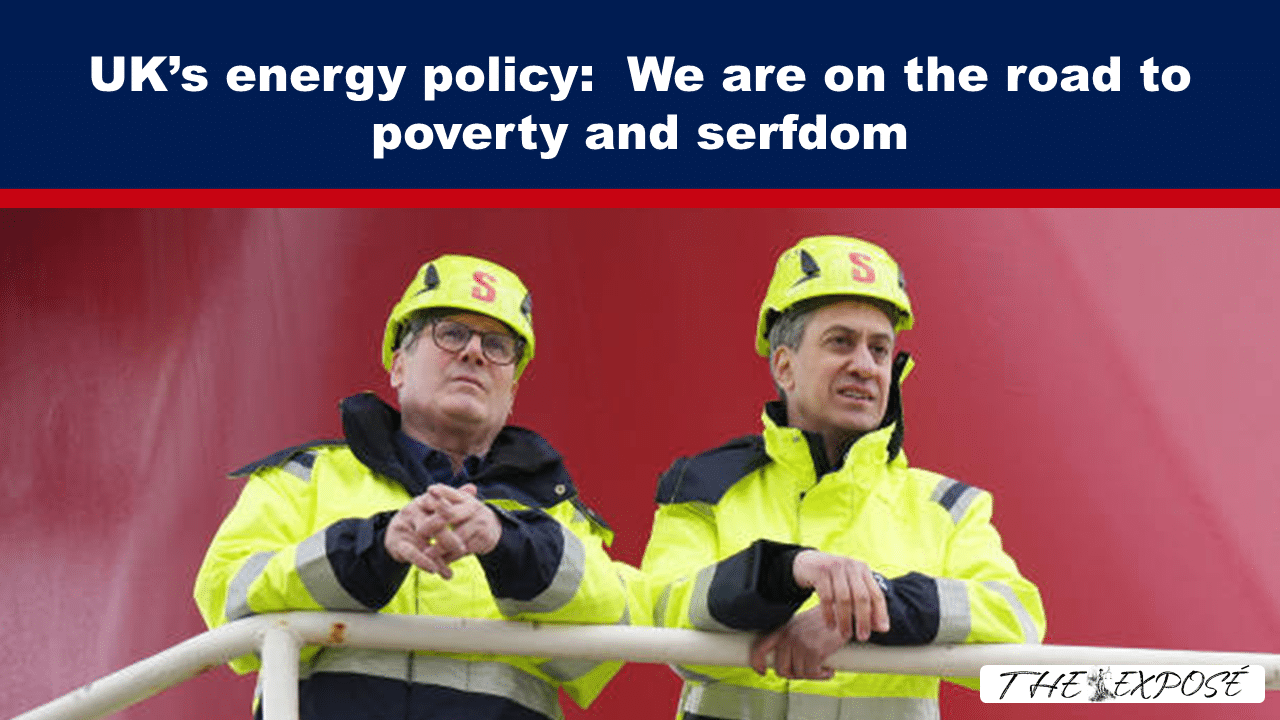
Featured image: Labour leader Sir Keir Starmer and Shadow Energy Secretary Ed Miliband view and tour Excalibur, an offshore jack-up platform for wind turbine construction and maintenance on 25 March 2024 in Holyhead, Wales. Source: Getty Images
The Expose Urgently Needs Your Help…
Can you please help to keep the lights on with The Expose’s honest, reliable, powerful and truthful journalism?
Your Government & Big Tech organisations
try to silence & shut down The Expose.
So we need your help to ensure
we can continue to bring you the
facts the mainstream refuses to.
The government does not fund us
to publish lies and propaganda on their
behalf like the Mainstream Media.
Instead, we rely solely on your support. So
please support us in our efforts to bring
you honest, reliable, investigative journalism
today. It’s secure, quick and easy.
Please choose your preferred method below to show your support.

Categories: Breaking News, UK News
simply put , green fascists in action
Just more political fraud.
James Stewart of HH? Glad you are a survivor!!
While I agree that the globalists are using every means possible to force us into serfdom, including claims of environmental problems and solutions that are as harmful as the problems are, I don’t agree that human activity has not altered the results of natural processes in our environment. Greenhouse gases cannot have remained unaffected when we have so greatly altered all the other natural systems of the planet through the pollution we have generated.
There is no unpolluted air or water anywhere in the US. Forest fires and city are intentionally set. Plant life is dying from chemicals sprayed by airplanes modified to do the job.
Perhaps people in cities don’t notice much because they live in a near-totally man-made environment. Also, the changes are gradual enough so that only someone as old as I am can be an eye-witness to how it used to be and how degraded it is now.
To deny human involvement in the current situation is to throw out the baby — human causes — with the bathwater — their solutions which hurt more than help. They will claim anything, however preposterous, if it enables them to do more harm while lying that it’s really good.