














Elizabeth Fry, a Quaker minister and prison reformer, visited Newgate prison in 1813 and was appalled by the conditions, leading to her campaign for prison reform.
Her efforts resulted in the reform of prisons throughout Britain and Europe, and improved conditions for prisoners being transported to Australia.
Let’s not lose touch…Your Government and Big Tech are actively trying to censor the information reported by The Exposé to serve their own needs. Subscribe to our emails now to make sure you receive the latest uncensored news in your inbox…
Elizabeth Fry (1780-1845)
The Prison Governor was horrified at the prospect of the refined lady who stood before him visiting the female prison quarters at the notorious Newgate prison. He was anxious for her safety and was convinced that the female prisoners would rob her of the clothes on her back. But Elizabeth Fry insisted that she should be allowed to see the prisoners so that she could hand out the warm clothing she had brought for them. The Governor, realising that Elizabeth would not take “no” for an answer, reluctantly let her into the female quarters of the prison.
Walking down the cold, damp stone corridors, the stench was overwhelming and the noise from the mayhem of the prisoners was ear-shattering. However, nothing prepared Elizabeth Fry for what she was about to see.
The room, which was originally planned to house a maximum of 60 prisoners, was crammed with over 300 female prisoners and their children. The living conditions, and the condition of the women and children, were truly shocking. Elizabeth Fry was aghast at the grotesque sight before her.
Suddenly, the deafening noise of sheer pandemonium descended into stillness. The women and children looked in awe as this refined, gentle angel flitted around the room handing out clothing and giving comfort to the frightened and the sick. The prisoners could see that this incongruous vision actually cared and didn’t judge them; they could tell that she looked at them not critically or cruelly but with love and compassion.
Before Elizabeth Fry left the prison, she prayed in front of the prisoners and, as if hypnotised into joining her, the 300-plus women and children fell to their knees in prayer. What an awesome sight this must have been, especially for the Prison Governor who had been so concerned for her safety.
A born philanthropist, English Quaker minister and prison reformer, Elizabeth Fry, was one of 12 children. She was born Elisabeth Gurney on 21 May 1780 in Norfolk to a wealthy Quaker banking family.
Elizabeth – affectionately known as “Betsy” by her family – was a very shy, nervous and sickly child. Sadly, her fragile health was to burden her for the rest of her life. However, Elizabeth’s delicate health did not thwart her innate kindness, which she showed to everybody she met – even to the household servants.
As children, Elizabeth and her 11 siblings were encouraged to talk to and to show respect to the less fortunate. Elizabeth Fry would often adopt young waifs and strays in the street, and – with the help of her father’s wealth – feed and clothe them and teach them basic schooling. These waifs and strays became known by the family as “Betsy’s imps.” At one point, Elizabeth had a flock of over 80 children being taught in one of the wings at the grand family home in Earlham, Norfolk.
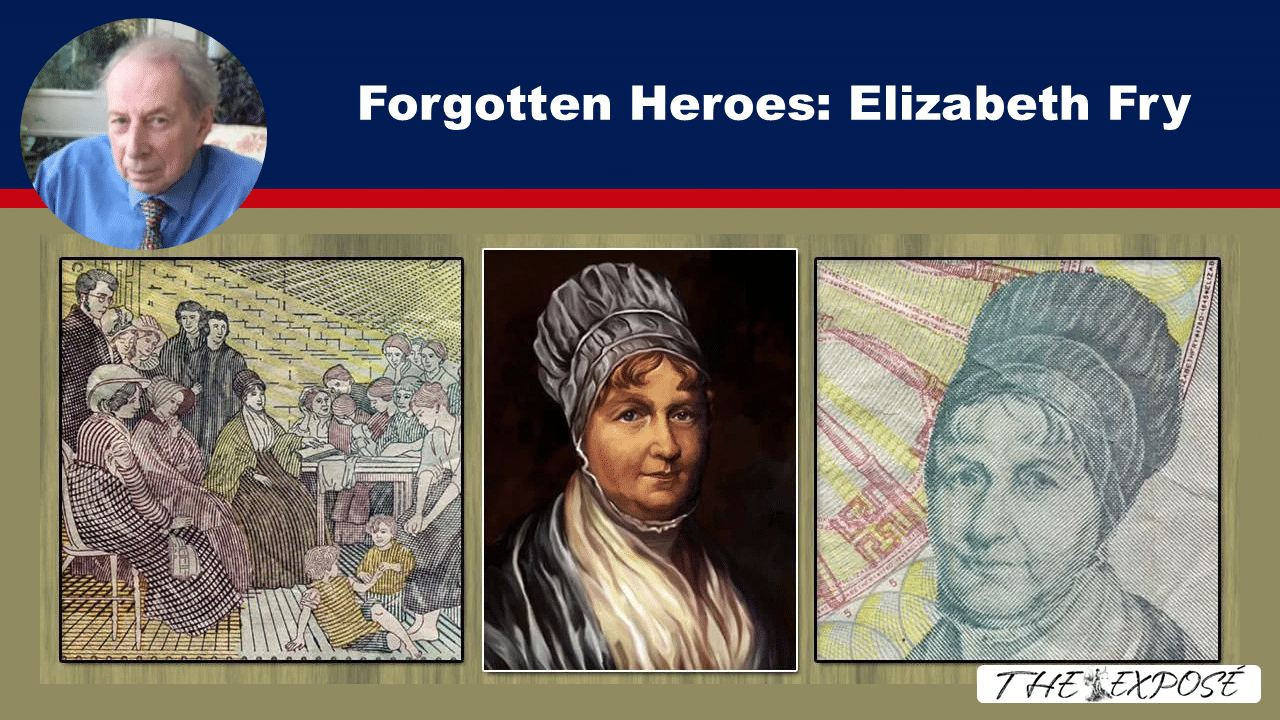
Every week, Elizabeth had to attend the Quaker meetings with her family, although she and her siblings often found them rather tedious and hated going to them. Nevertheless, her attitude was to change when a Quaker called William Savery spoke at one of the meetings. His speech had a profound effect on the 17-year-old girl. It was Savery’s speech that set Elizabeth on the path to doing great things; he was the trigger who resulted in her being immortalised as one of England’s greatest female philanthropists, a woman whose virtuous, benevolent face has adorned England’s five-pound notes.
In 1800, Elizabeth – no doubt she shed many tears of heartache at having to do so – said farewell to her dear family, and to her gang of waifs and strays, before embarking on the journey from Norfolk to London to live in her new marital home. Still only 20, she had married Joseph Fry, also a Quaker. The couple would themselves eventually have 11 children of their own.
Busy married life did not suppress Elizabeth Fry’s inherent desire to look after the less fortunate; she often carried out acts of kindness to those who needed it. She ran schools for poor children and regularly attended Quaker meetings (she became a minister in 1811).
But it was her visit to Newgate prison in 1813 that was to make her famous. Her visit to Newgate prison, where she was appalled at the conditions she found, eventually resulted in the reform of prisons throughout Britain and Europe, and also led to a vast improvement in the conditions of prisoners being transported to Australia.
In 1818, accompanied by her brother, Joseph John Gurney, Mrs. Fry visited prisons throughout the North of England and Scotland. The conditions they witnessed in the prisons were brought to the attention of the public and to the authorities, and this greatly helped Elizabeth Fry’s campaign.
In addition to her lifetime involvement with prison and asylum reform at home and abroad, Elizabeth Fry helped set up refuges for the homeless in London and in Brighton. In fact, every spare moment of her time was spent on helping others and on finding ways to improve the lives of the poor and underprivileged. She even helped to make hundreds of coastguards’ jobs less miserable by organising books to be sent to them.
How this fragile lady, who must have been nearly always pregnant or nursing her own children, found the energy and the strength to do so much is a mystery.
But everything about Elizabeth Fry was extraordinary. In her 65 years on earth (she died on 25 October 1845), Elizabeth Fry achieved much and transformed the lives of millions of people.
This biography is taken from the book `Vernon Coleman’s English Heroes’, which contains mini biographies of 100 of Vernon Coleman’s heroes. Some of the names are well known, but there are a number of surprises. For details of the book, please CLICK HERE.
About the Author
Vernon Coleman, MB ChB DSc, practised medicine for ten years. He has been a full-time professional author for over 30 years. He is a novelist and campaigning writer and has written many non-fiction books. He has written over 100 books, which have been translated into 22 languages. On his website, HERE, there are hundreds of articles which are free to read. Since mid-December 2024, Dr Coleman has also been publishing articles on Substack; you can subscribe to and follow him on Substack HERE.
There are no ads, no fees and no requests for donations on Dr Coleman’s website or videos. He pays for everything through book sales. If you would like to help finance his work, please consider purchasing a book – there are over 100 books by Vernon Coleman available in print on Amazon.
Featured image taken from ‘Elizabeth Fry | 10 Facts On The Angel of Prisons’, Learnodo Newtonic, 19 December 2015
The Expose Urgently Needs Your Help…
Can you please help to keep the lights on with The Expose’s honest, reliable, powerful and truthful journalism?
Your Government & Big Tech organisations
try to silence & shut down The Expose.
So we need your help to ensure
we can continue to bring you the
facts the mainstream refuses to.
The government does not fund us
to publish lies and propaganda on their
behalf like the Mainstream Media.
Instead, we rely solely on your support. So
please support us in our efforts to bring
you honest, reliable, investigative journalism
today. It’s secure, quick and easy.
Please choose your preferred method below to show your support.

Categories: Breaking News, World News
https://stock.periscopefilm.com/xd95695-pyramid-land-a-study-of-egypt-1920s-travelogue-historic-temples-of-ancient-egypt/
https://stock.periscopefilm.com/xd91445b-u-s-china-a-new-beginning-1979-president-nixon-thawing-of-relations-with-china/
https://stock.periscopefilm.com/gg44175-camera-on-the-world-world-events-1959-1963-castros-cuba-macmillan-becomes-p-m/ very interesting weather in those days
Operation fishbowl
Operation plumbbob
operation : tumbler-snapper , sandstone , Dominic 1962 , fishbowl , plumbbob , hardtack , ivy 1952 , upshot knothole 1953 , greenhouse
Operation wigwam