














In 2024, National Energy System Operator (“NESO”) and Department for Energy Security and Net Zero (“DESNZ”) devised their “Clean Power 2030” plan. They claimed their plan would bring down energy bills for both households and businesses for good.
But the plan is failing to meet its targets on cost, time and quality – and grid integration costs are soaring. It is clear the Clean Power 2030 project is off the rails, David Turver writes.
Additionally, wind- and solar-generated energy are not going to be able to meet the UK’s requirements. There will be a significant shortfall in energy supply by 2030 and it’s unclear where this energy will come from.
There are now strong grounds to launch a Parliamentary investigation into the Clean Power 2030 to get the project cancelled before any more damage is done.
Let’s not lose touch…Your Government and Big Tech are actively trying to censor the information reported by The Exposé to serve their own needs. Subscribe to our emails now to make sure you receive the latest uncensored news in your inbox…
Miliband’s Clean Power 2030 Plan Off the Rails
By David Turver, 7 June 2026
Introduction
Back in 2024, NESO and DESNZ outlined their Clean Power 2030 (“CP2030”) plan. That plan called for a big increase in grid spending, an ambitious rollout of wind and solar capacity and also relied on negative emissions from Bio-Energy with Carbon Capture and Storage (“BECCS”) to meet emissions targets. NESO claimed CP2030 “can be delivered without increasing costs for consumers.” DESNZ claimed that CP2030 would “build an energy system that can bring down bills for households and businesses for good.”
Recently, DESNZ released new data (ET6.1) showing the installed capacity of wind and solar at the end of 2025, and Drax announced it had got cold feet about investing in BECCS. So, what do these developments mean for Miliband’s CP2030 plan? Time to look at how well CP2030 is going against the plan. It is customary to analyse projects through three different dimensions: cost, time and quality.
Costs Going Up
Remember, NESO claimed CP2030 can be delivered without increasing costs for consumers and DESNZ claimed the project would bring down bills for good. There are several pieces of evidence to show that these claims were false.
Grid Integration Costs Increasing
NESO has provided a forecast of grid balancing costs and a forecast of transmission costs. The Office for Budget Responsibility (“OBR”) forecasts the future costs of the Capacity Market that backs up intermittent renewables. Combining those forecasts shows grid integration costs are set to rise by £17 billion, from £8 billion in 2024/25 to £25 billion in 2030/31, as shown in Figure 1.
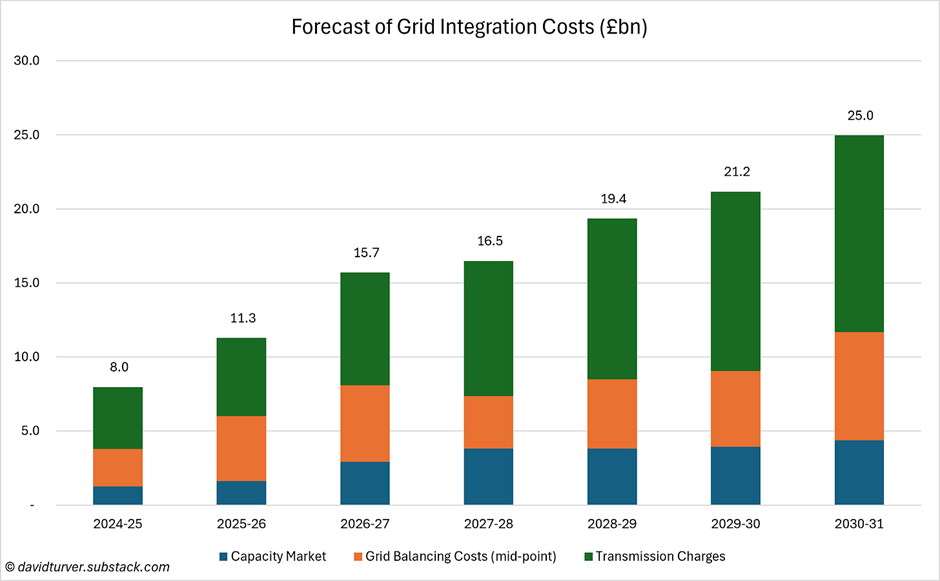
According to the Government’s own figures, the UK already had the highest industrial electricity costs in the developed world in 2024 and the second-highest domestic electricity costs. CP2030 is going to add a further £3 billion of subsidy costs and £17 billion of integration costs and push energy bills up by the equivalent of £700 per household. Of course, this figure will be split across businesses and households, but increasing costs to businesses will be passed on to households.
Generation Costs Going Up
When NESO was calculating the cost of generation for the CP2030 report, NESO used figures from the Government’s Generation Cost Report 2023, adjusted for the strike prices in renewables auction Allocation Round 6 (“AR6”). Although the headline strike prices in Allocation Round 7 (“AR7”) for onshore wind and solar (expressed in common 2024 prices) were relatively close to NESO assumptions, offshore wind was more expensive. However, these raw comparisons do not take into account that AR7 contracts were extended by 5 years to 20 years. In its impact analysis of the contract extension, the Government estimated that fixed bottom offshore wind strike prices would reduce by 12%, onshore wind by 11% and solar by 13%. This pushes up the like-for-like comparison as shown in Figure 2.
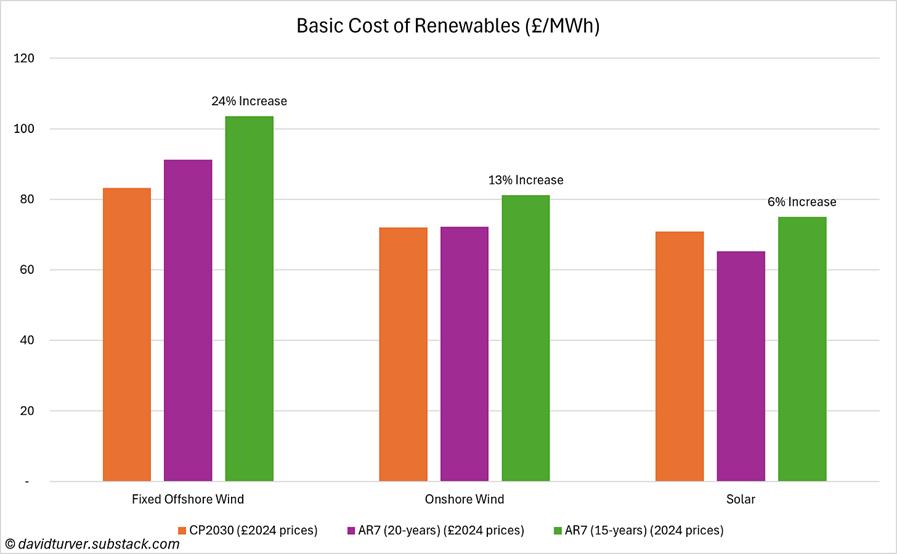
On a like-for-like basis, offshore wind is up 24% from the CP2030 estimate, onshore wind 23% and Solar 6%. Moreover, CP2030 used cost of capital estimates from the 2023 Generation Cost report but these have increased in the 2025 report as shown in Figure 3.
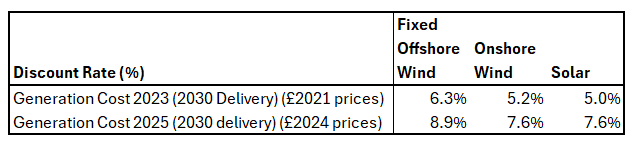
This change will increase “annuitised costs” (another way of expressing annualised costs) used by NESO in their report.
Schedule Slipping
Not only are the costs rising, but time is also slipping away to deliver the required renewables capacity. This section compares how the delivery of each major technology is faring compared to the plan.
Offshore Wind Delivery
The backbone of renewable generation capacity in the CP2030 plan was supposed to be offshore wind. In the Further Flex scenario, capacity was supposed to more than triple from 14.7GW in 2023 to over 50GW in 2030. Figure 4 shows the performance to date against that plan.
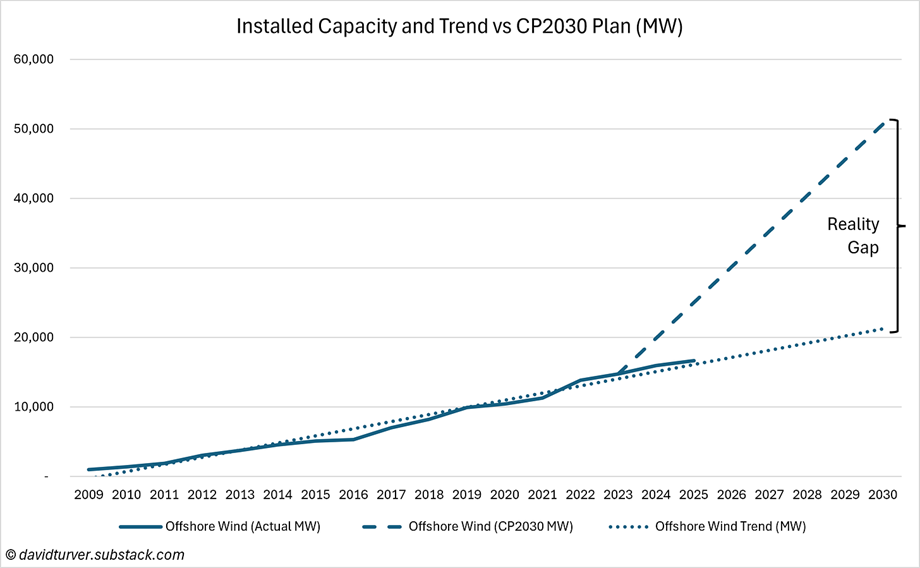
The CP2030 Further Flex scenario was supposed to install 5.1GW offshore wind capacity per year, every year from 2024 to 2030. In reality, just 1.2GW was installed in 2024 and 0.7GW in 2025. The end 2025 result was 8.4GW short of the target. If the installation rate continues at the trend rate since 2009, CP2030 will be 29.5GW short by 2030. This is the Reality Gap annotated on the chart. The New Dispatch scenario was less aggressive but on current trends, they would still be short 21.9GW by 2030.
Onshore Wind
Onshore wind was less important in CP2030 but still capacity was supposed to almost double from 15.4GW in 2023 to 29GW in 2030. Figure 5 shows that onshore wind capacity has also fallen behind plan.
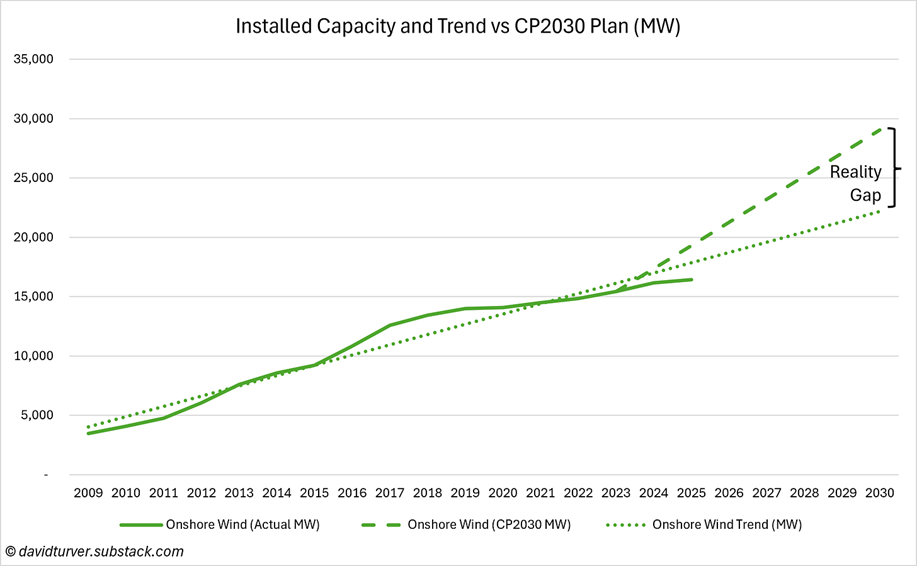
The CP2030 Further Flex scenario was supposed to install 1.9GW of onshore wind capacity per year, every year from 2024 to 2030. In reality, just 0.7GW was installed in 2024 and 0.3GW in 2025. The end 2025 result was 2.9GW short of the target. The current installation rate is below trend and, even if the installation rate rises to trend levels, CP2030 will still be 6.9GW short by 2030. Again, this chart shows the Further Flex scenario, which is identical to New Dispatch.
Solar Power
Solar Power was also expected to triple capacity from 16.2GW in 2023 to 48.5GW in 2030. Figure 6 shows that solar installations have also fallen behind plan.
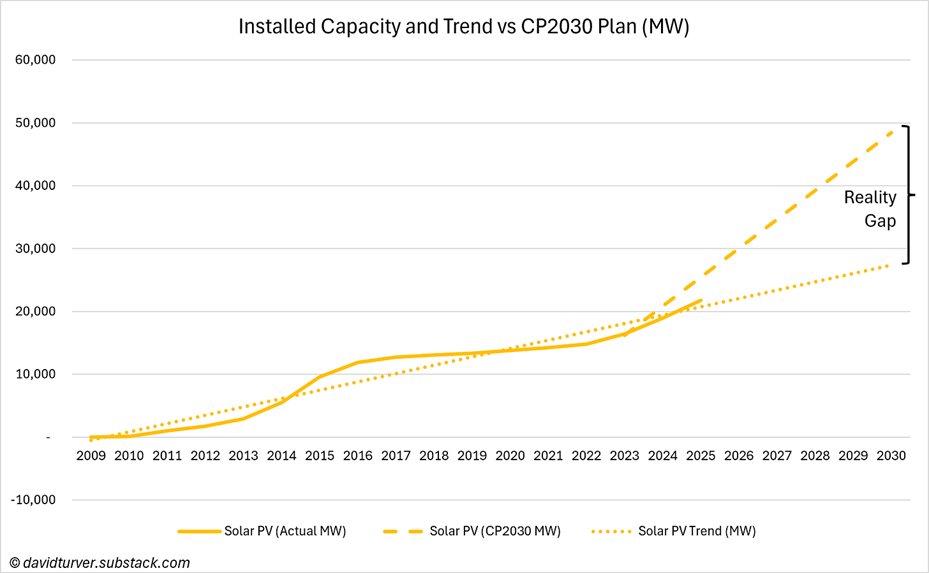
The CP2030 plan called for 4.6GW of solar capacity to be installed each year from 2024 to 2030. In reality, 2.5GW was installed in 2024 and 2.8GW in 2025. The end 2025 result was 3.7GW short of the target. If solar installations continue at the trend rate since 2009, CP2030 will be 21GW short by 2030. The chart for solar shows the Further Flex scenario, which is identical to New Dispatch.
Clearly, all three technologies have fallen behind Miliband’s CP2030 grand plan and the schedule looks even less likely to be achieved.
Emissions Targets At Risk
Not only are costs being exceeded and the schedule slipping but the quality of the project as measured by the emissions targets is also at risk.
Drax Power Station has been receiving subsidies to burn biomass for many years. The subsidies it currently receives are from a mix of Renewables Obligation Certificates (“ROCs”) and Contracts for Difference (“CfDs”). However, the RO scheme is due to expire in March 2027, so last year it entered into an agreement with the Government to replace the ROCs with a new CfD out to 2031. Part of the thinking was that by then, Drax would have figured out how to deliver Bioenergy with Carbon Capture and Storage (“BECCS”) and would presumably be eligible for an entirely new set of subsidies.
However, last month Drax announced that its BECCS project was unlikely to proceed and wrote off the spending to date of £47.6 million saying:
“Whilst UK BECCS is still an attractive option for the Group in the long term, the current political environment and absence of an appropriate regulatory framework has led to a reduction in the likelihood of the project proceeding in the short- to medium-term. Accordingly, the capitalised value has been impaired.”
In other words, they no longer think they will get enough subsidy to make BECCS viable. On this [Eigen Values] Substack, we have always viewed BECCS as an expensive crime against thermodynamics and considered plans to develop it as absurd.
NESO’s CP2030 Workbook shows in its ‘CP17’ pathway that they expect 3.8-4GW of Biomass and BECCS capacity to be in place in 2030. Their 2030 emissions plan shows they expect a significant proportion of this capacity to come from BECCS (or Carbon Capture and Storage (“CCS”) Biomass), banking on alleged negative emissions from this technology to meet their targets (see Figure 7).
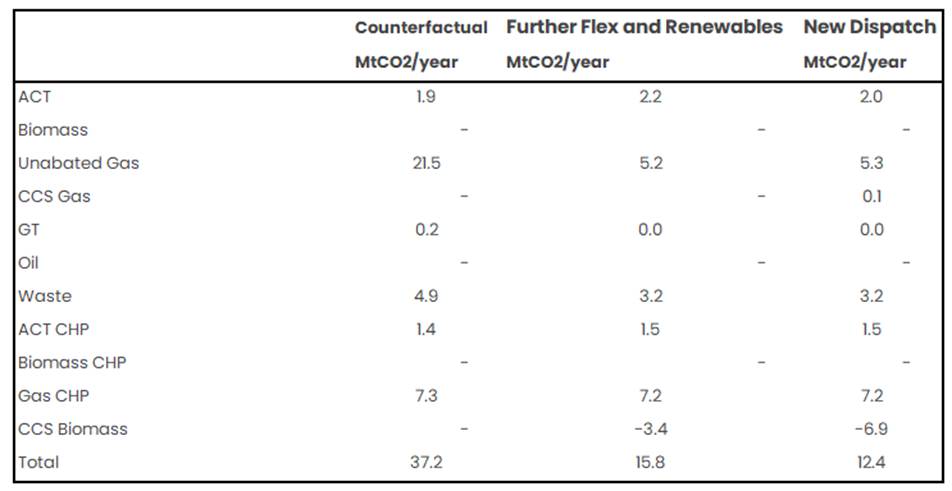
The zero emissions from biomass without carbon capture means that the carbon dioxide emitted from burning wood is simply ignored. Negative emissions from BECCS require us to believe that burying these supposedly non-existent emissions leads to net negative emissions. Now, Miliband is short of between 3.4 and 6.9MtCO2 per year to meet his emissions target. This is another big hole in the CP2030 plan.
Conclusions
The Clean Power 2030 plan is failing on all three dimensions of cost, time and quality. Grid integration costs are soaring, undermining claims that CP2030 can bring down bills or can be achieved without costs to consumers. Wind and solar installations are way behind schedule and now Drax has kiboshed the main element that was supposed to deliver supposedly negative emissions to meet the CP2030 emissions targets. It is clear the CP2030 project is off the rails.
The shortfall in wind and solar is probably going to have to be met from reliable power stations. As we have covered before, the nuclear fleet is being retired and the gas fleet is ageing, so it is unclear where this capacity is going to come from.
There must now be strong grounds to launch a Parliamentary investigation into CP2030 to get the project cancelled before any more damage is done. Perhaps a Parliamentary question along the following lines is appropriate:
Analysis of official forecasts by NESO, the OBR and DESNZ shows that renewables subsidy costs are going to rise by £3.3 billion to £15.2 billion/year by 2030/31 compared to 2024/25, and grid integration costs in the form of the Capacity Market, grid balancing and transmission costs are going up £17 billion/year over the same period. A total increase of over £20 billion/year. Does the minister stand by the claim that CP2030 can bring bills down?
The delivery of wind and solar capacity is well behind the CP2030 plan and Drax has cancelled its BECCS project, putting the emissions target out of reach. Does the minister agree that the CP2030 project is off the rails, and will the project be submitted to the National Audit Office for an independent value for money audit?
About the Author
David Turver is a British retired consultant, chief information officer and project management professional. He publishes articles on a Substack page titled ‘Eigen Values’ where he writes about contentious issues such as climate, energy and net zero. You can subscribe to and follow his Substack page, ‘Eigen Values’, HERE.Featured image: Adapted from image for ‘UK Solar Summit Partnership Prospectus’, 30 June – 1 July 2026. Source: Clean Power 2030
The Expose Urgently Needs Your Help…
Can you please help to keep the lights on with The Expose’s honest, reliable, powerful and truthful journalism?
Your Government & Big Tech organisations
try to silence & shut down The Expose.
So we need your help to ensure
we can continue to bring you the
facts the mainstream refuses to.
The government does not fund us
to publish lies and propaganda on their
behalf like the Mainstream Media.
Instead, we rely solely on your support. So
please support us in our efforts to bring
you honest, reliable, investigative journalism
today. It’s secure, quick and easy.
Please choose your preferred method below to show your support.

Categories: Breaking News, Latest News, UK News
The problem is the investment and return for the end user doesn’t work. It takes six to seven years to pay for and in that the best results are 60% generation on a good day.
These products are good for about seven years, twelve if you’re lucky. Then it’s buying again the end user never really benefits.
Ponsi scheme
What hope is there for a serious rethink on this
policy as long as the man made climate change
hoax is not exposed for what it is. The idea that
CO2 is bad is totally wrong. Plants need it to
grow. Population reduction is the motive
behind all the apparently insane policies,
including the non-existent sars-cov2 virus.
https://www.youtube-nocookie.com/embed/NORnxNuODf0 with what we know about trump and his family , his bankruptcy , his daughter a YGL and her hubby running the wef , Epstein ties and on and on . Listen to these very confused separatists mentality.
There is no mention of or consideration to the impact to the environment, wildlife, livestock or humans in this article. These are hugely important in the debate of “green energy”, which has shown to be not green at all.