













The UN’s latest attack on economic growth comes wrapped in moral language. Its global initiatives are marketed as justice through economic restraint, while its advocates promise less poverty, greater equality and a safer climate.
In reality, their policies would deliver less production, less investment and fewer opportunities. That is managed decline, not prosperity. It will make all societies poorer, Vance Ginn warns.
Let’s not lose touch…Your Government and Big Tech are actively trying to censor the information reported by The Exposé to serve their own needs. Subscribe to our emails now to make sure you receive the latest uncensored news in your inbox…
The Poverty of the UN’s Degrowth Agenda
By Vance Ginn, as published by The Daily Economy on 26 June 2026
The latest attack on economic growth comes wrapped in moral language. Its advocates promise less poverty, greater equality and a safer climate. Their policies would deliver less production, less investment and fewer opportunities. That is managed decline, not prosperity.
The UN-backed ‘Roadmap for Eradicating Poverty Beyond Growth’ proposes 80 policies meant to reduce society’s dependence on growth. A separate ‘Global Justice Report’, led by Thomas Piketty and researchers at the World Inequality Lab, puts numbers behind this vision.
The reports differ, but they share the same central mistake. They treat growth as an obstacle to justice rather than the force that has lifted billions of people.
What Degrowth Would Mean
The Piketty-led model would push rich countries toward output of roughly €60,000 per person, or about $69,000, by 2100. It would hold annual per-person growth in wealthy regions near zero. That figure requires context.
US GDP per capita was about $89,962 in 2025. The proposed level is about $21,000 lower, or roughly 23 per cent below current American output per person. GDP per capita is not the same as a worker’s salary. It measures the total value produced in the economy divided by the population. For another comparison, personal income per capita was running near $77,800 in early 2026.
Not content to slow some distant, future excess, the plan envisions an America that produces less than we do today. The model would also cut annual work hours by more than half, shifting labour away from construction and manufacturing. As Veronique de Rugy notes, “a comprehensive programme for global managed decline … making everyone poorer” isn’t just a likely forecast – it’s the plan’s whole design.
But building fewer homes will not solve a housing shortage. Making fewer goods will not make necessities more affordable. Restricting work will not help families trying to move ahead.
Growth Is Human Progress
Economic growth is not just a line on a government chart. It is the process through which people create more value from limited resources. That process gives us better medicine. It makes food easier to afford. It allows workers to earn more while spending fewer hours producing the same goods.
Productivity is the engine of rising living standards. When a worker produces more value per hour, wages and leisure can rise together. Degrowth reverses this process, reducing production and hoping people will enjoy the loss.
Emile Phaneuf and Christopher Lingle put the stakes plainly in ‘Degrowth Kills People—Yes, Literally’. Wealthier societies are healthier, safer and better able to survive crises. Scarcity carries a human cost.
The Poverty Record Is Clear
The strongest argument against degrowth is what growth has already accomplished. Around 60 per cent of the world lived in extreme poverty in 1950. By 1990, the share was about 40 per cent. The World Bank now estimates that it fell to 10.4 per cent in 2024 and could fall to 10 per cent in 2026.
The number of people in extreme poverty also fell sharply, even as the world’s population grew. Under the World Bank’s updated $3-per-day standard, about 847 million people remained in extreme poverty in 2024. That is still far too many. But the direction matters.
Since 1990, roughly 1.5 billion people have escaped extreme poverty. Much of that progress occurred in Asia as countries expanded trade, welcomed investment and allowed more private enterprise. They did not become wealthier by closing factories.
The World Bank also finds that poverty reduction accelerated after 1990. The average decline doubled from about half a percentage point per year before 1990 to roughly one point annually afterwards. That is what economic liberalisation made possible.
Poverty Is Not Inequality
Degrowth advocates often move between poverty and inequality as though they mean the same thing. They do not.
A poor family does not gain because a wealthy family loses money. A worker is not better off because a factory closes and makes an inequality chart look more balanced. Making fewer goods will not make necessities more affordable. Equality achieved by destroying wealth is shared deprivation.
As I have argued at American Institute for Economic Research (“AIER”), the better question is why government policy blocks people from earning, investing and moving upward. The goal should be to expand opportunity, not punish success. Growth does not guarantee that every outcome is equal. It does create more room for people to improve their lives. Stagnation makes mobility harder.
The Plan Undermines Itself
The Piketty proposal depends on a global fund financed by taxes on income and wealth. Yet it would weaken the economies expected to finance that fund. It also assumes poorer countries can keep growing while rich countries consume and invest less. That does not add up.
Developing countries need capital. They also need customers. If the United States and Europe stagnate, both will become scarcer. A development plan cannot succeed by weakening the world’s largest sources of investment and demand.
Degrowth also creates a political problem. Someone must decide how much people may work. Someone must choose which industries shrink and which goods are no longer produced. Those decisions will not remain inside an academic model.
Markets coordinate millions of choices through prices and voluntary exchange. No global commission has enough knowledge to replace that process. Managed scarcity eventually requires managed lives.
Prosperity Is the Better Path
Rejecting degrowth does not mean ignoring pollution or other real harms. Property rights matter. So does accountability. Innovation can reduce environmental damage without forcing society backwards.
As Joakim Book explained in his review of ‘The Capitalist Manifesto’, prosperous societies have more resources to adapt and invest in cleaner technology. Poor societies must focus on survival. The world’s poorest people do not need comfortable academics deciding they have reached “enough.” They need the freedom to work, save, invest and build.
Degrowth is a luxury belief because its advocates already enjoy the abundance they would restrict. Poverty cannot be overcome by rationing scarcity. It is overcome by economic freedom that lets people create abundance.
About the Author
Vance Ginn, PhD, is founder and president of Ginn Economic Consulting, LLC, based near Austin, Texas, and an Associate Research Fellow with AIER. He is also a staff economist at Americans for Tax Reform, and formerly chief economist at Texas Public Policy Foundation, Pelican Institute for Public Policy, and the White House’s Office of Management and Budget, June 2019 to May 2020.
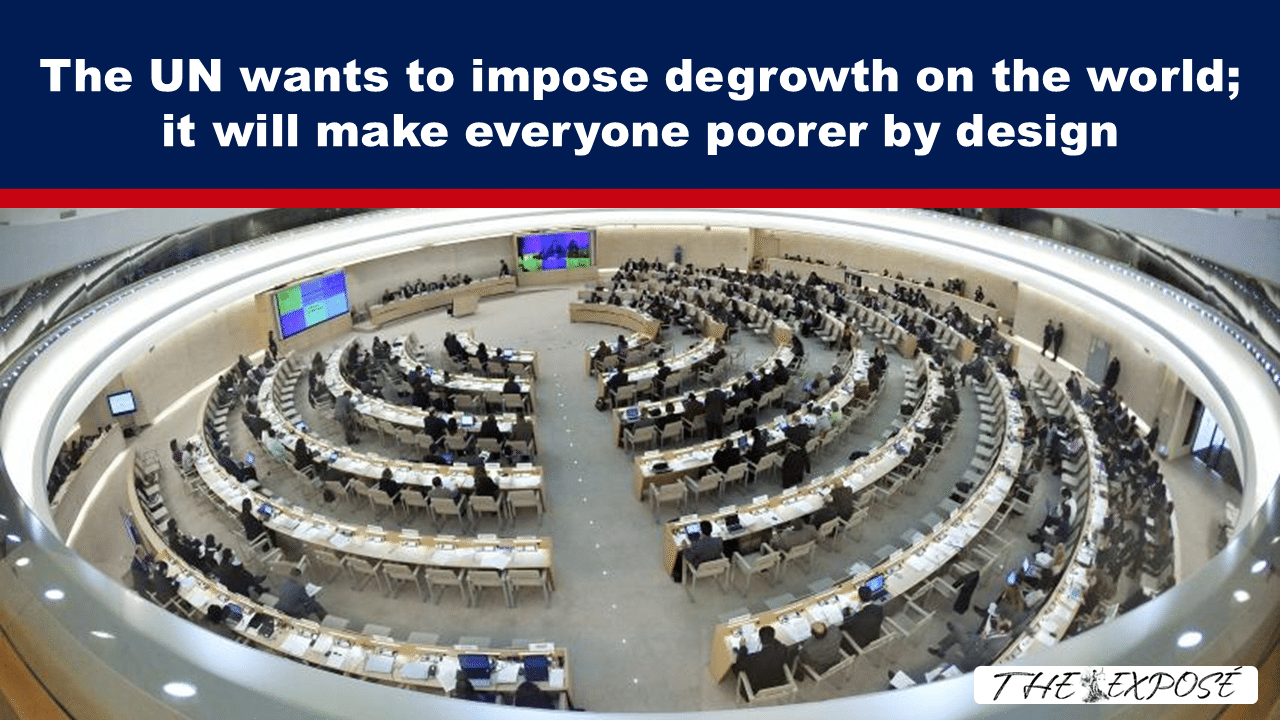
Featured image: A meeting of the United Nations Human Rights Council. It is the Human Rights Council that produced the poverty-inducing plan titled ‘The Roadmap for Eradicating Poverty Beyond Growth’. Source: United Nations
The Expose Urgently Needs Your Help…
Can you please help to keep the lights on with The Expose’s honest, reliable, powerful and truthful journalism?
Your Government & Big Tech organisations
try to silence & shut down The Expose.
So we need your help to ensure
we can continue to bring you the
facts the mainstream refuses to.
The government does not fund us
to publish lies and propaganda on their
behalf like the Mainstream Media.
Instead, we rely solely on your support. So
please support us in our efforts to bring
you honest, reliable, investigative journalism
today. It’s secure, quick and easy.
Please choose your preferred method below to show your support.

Categories: Breaking News, Latest News, World News
Klaus Schwab claims by 2030 every single person that lives on planet earth will own nothing and be happy. The 4th industrial revolution has arrived just in time for Jacob’s trouble, everyone that lives during that time will be transhuman (human and machine). The hour of darkness is starting to engulf the whole planet. Are you ready for what comes next? I sure am.
That’s why everything being sold requires a subscription to use. You never get to own it and must continue to pay the globalists rent to use it. New cars require a subscription to use the tech abilities.
For some time, I have been wondering, if it is possible to create a system that is independent of these tyrannical oligarchy’s systems?
A system that is truly democratic with rules made by the people, for the people, so they can control their own resources and growth. This parallel system should make it impossible for the unelected global corporations and NGOs, to have any say and there would be heavy penalties for corruption, including not being allowed back into this system.
You need to look after yourself, do not depend upon anyone or any government to help you, you may wind up dead if you do that. Grow your own fruits and veggies, can those fruits and veggies for the winter and early spring months that lye ahead raise meat chickens and egg layers, fish and hunt for your own meat, that too can be canned. Self sustained is the key, just do it and you will have no issues.
Since the UN is a private organisation that consumes and is finance via tax fraud of the people, we can defund them and save the planet of their bull-shit idea’s
The grub worms of the UN are already filthy rich so of course they don’t care about the economy of the masses.