














First, we had the ‘Fossil Fuel Treaty’ activists pushing for hydrocarbons to be banned. Now, we have governments joining in.
Radical anti-fossil fuel activists from 57 countries participated in a conference earlier this year hosted by the governments of Colombia and Norway to come up with an action plan to pressure governments around the world to phase out the use of hydrocarbons.
In June, the conference published its report.
Let’s not lose touch…Your Government and Big Tech are actively trying to censor the information reported by The Exposé to serve their own needs. Subscribe to our emails now to make sure you receive the latest uncensored news in your inbox…
In April, the governments of Colombia and the Netherlands co-hosted the first conference on ‘Transitioning Away from Fossil Fuels’ (“TAFF”).
The event was designed as a “coalition of the willing” to accelerate the phase-out of fossil fuels outside the traditional, often gridlocked, UN negotiation framework.
Unlike UN Climate Change Conferences (“COPs”), TAFF was not a negotiating body. Instead, it served as an implementation-focused platform for 57 countries – representing approximately one-third of global GDP – to develop concrete roadmaps to rid the world of using hydrocarbon-sourced energy and fuels. It aimed to solidify political momentum and provide actionable guidance to inform the COP30 Presidency’s roadmap.
In June, TAFF published its report resulting from its conference. Below, Dr. David Wojick briefly explains what it’s all about.
The “Transitioning Away from Fossil Fuels” Project Has Become A Global Programme
By David Wojick, as published by CFACT on 24 August 2026
It started out as the vague idea of building roadmaps for countries to use to phase out fossil fuel use. It was a spin-off from last year’s COP 30, run by people who decided the UN climate process was ineffective (which is true).
See my ‘Hatching a fossil fuel phase-out treaty’HERE.
But after their first international conference, they now have a full-scale global programme with a second annual meeting planned. The roadmaps are still there but they are just part of the bigger show, which may rival the annual UN COPs.
The first meeting was co-hosted by Colombia and the Netherlands, while the second will be by Tuvalu and Ireland. That is one developing and one developed country, a common UN feature.
The programme now has a friendly acronym – TAFF. Easy to say and remember, while 3 Fs would have been difficult, so they dropped “from.”
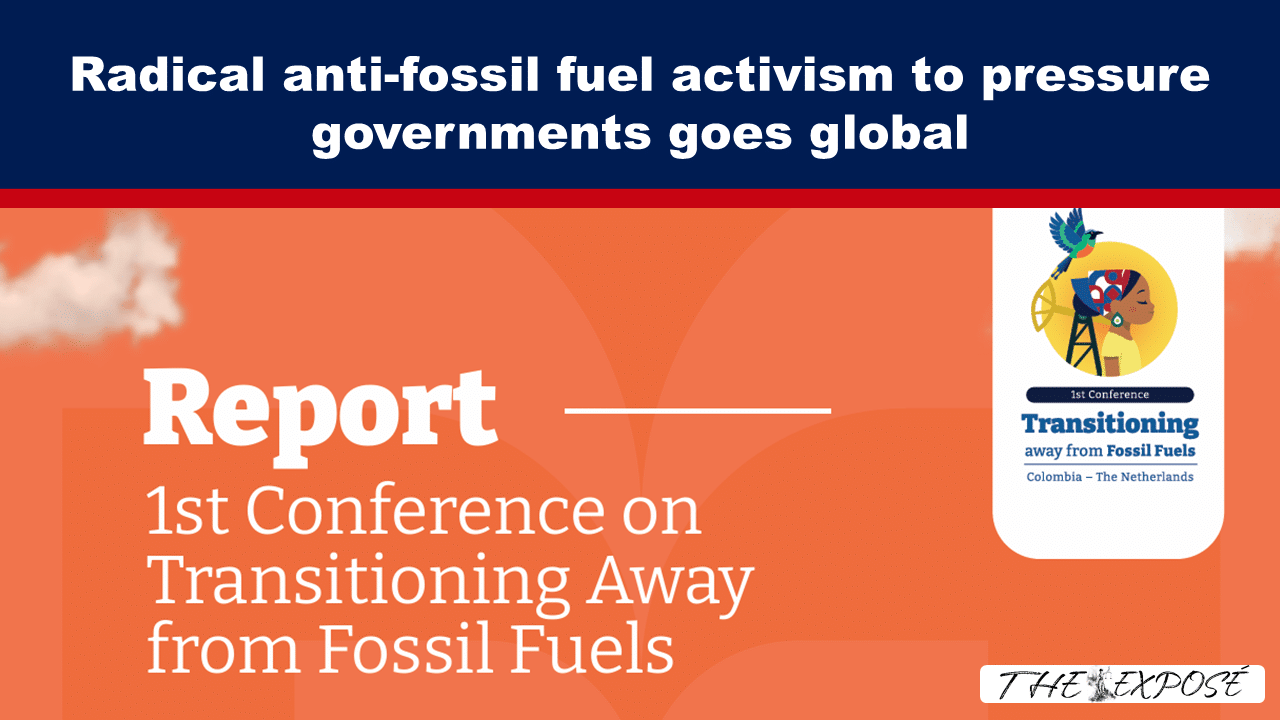
The first conference has a suitably long 176-page report with the uninspired title ‘Report – 1st Conference on Transitioning Away from Fossil Fuels – June 2026’ HERE.
As a kickoff meeting with 57 countries attending plus numerous other “stakeholders,” there were lots of speeches and the Report has many quotes from them. Beyond the speeches, the Report is very action-oriented. It mostly consists of five “pathways,” each containing from one to four “actions.” It is still vague, but at least they look like actions.
By far the longest pathway in terms of text is the 42-page ‘Pathway 3’ on roadmaps. Here is the text along with the actions:
Pathway 3: Develop or strengthen national and regional roadmaps to transition away from fossil fuels.
Action 3.1 Design, planning and implementation of science- and rights-based roadmaps for a socio-economic and energy transition and just workforce development, anchored in sustained economic diversification and new value chains.
Action 3.2: Switching fossil fuels for clean energy, energy security and sovereignty.
Action 3.3. Access to clean energy for rural, remote and marginalised communities.
Action 3.4. Plan the phase-down and definitive closure of fossil fuel extraction.
Report: 1st Conference on Transitioning Away from Fossil Fuels, June 2026, Government of the Netherlands, 23 June 2026
The usual green fantasy, given that something like 80% of global energy production is from fossil fuels.
Action 3.4 may be a serious confusion since fossil fuel extraction includes huge feedstocks for petrochemicals, not just for energy. Vast quantities of consumer and industrial products require these fossil-fuel chemicals, from clothing to fertilisers. The section text makes no mention of petrochemicals or their products, just energy.
There is also the obvious need for huge amounts of money. This is touched on briefly in the fourth Pathway:
Pathway 4: Overcoming fossil fuel-related macroeconomic dependencies, scaling up transition investment, and addressing barriers in the international and domestic financial architecture.
Report: 1st Conference on Transitioning Away from Fossil Fuels, June 2026, Government of the Netherlands, 23 June 2026
The conference was really about roadmaps, which attendees would no doubt say must come before financing the transition.
It will certainly be worth watching as countries struggle to map their way to an impossible future. Mind you, these are professional diplomats who know how to talk about doing impossible things as though they were real. Plus, doing the maps may well be a path to some funding just to do them with. Funding the maps seems not to have been discussed.
What is really worth watching in the short run is how the United Nations (“UN”) handles this and several other splinter groups at November’s COP31.
For example, there is a separate Fossil Fuel Phaseout Treaty organisation HERE.
[Related: “Fossil Fuel Treaty” activism is funded by a small group of global foundations and Who’s funding the campaign to push the ruinous net-zero agenda in the UK?]
I am sure the UN would like to absorb these radical groups that threaten to compete with them for attention and funding. Inviting them to speak at COP31 might be a start, but will they come and what would they say?
Stay tuned to CFACT as this near-term drama unfolds.
About the Author
David Wojick, a civil engineer with a PhD, is an independent policy analyst and senior advisor to CFACT. He specialises in science and technology-intensive issues, especially in energy and the environment. He has written hundreds of analytical articles. As a consultant, Dr. Wojick’s numerous clients have included think tanks, trade associations, businesses and government agencies. He has served on the faculty of Carnegie Mellon University and the staff of the Naval Research Laboratory.
Featured image: Cover page from ‘Report: 1st Conference on Transitioning Away from Fossil Fuels, June 2026’, Government of the Netherlands, 23 June 2026
The Expose Urgently Needs Your Help…
Can you please help to keep the lights on with The Expose’s honest, reliable, powerful and truthful journalism?
Your Government & Big Tech organisations
try to silence & shut down The Expose.
So we need your help to ensure
we can continue to bring you the
facts the mainstream refuses to.
The government does not fund us
to publish lies and propaganda on their
behalf like the Mainstream Media.
Instead, we rely solely on your support. So
please support us in our efforts to bring
you honest, reliable, investigative journalism
today. It’s secure, quick and easy.
Please choose your preferred method below to show your support.

Categories: Breaking News, Latest News, World News