














The surge in US stocks after Donald Trump announced a ceasefire with Iran in early April was widely described as a relief rally driven by easing war fears and falling oil prices. While there was some truth in that explanation, it did not tell the full story. On April 8, immediately following the announcement, the Dow rose 2.85%, the S&P500 gained 2.51%, and the Nasdaq climbed 2.80%. This, at first, looks like investor optimism, and despite the sharp drop after the war started, the stock market was blasting to all-time highs by early May.
Yet the physical oil market, shipping data, and hedge fund positioning all pointed to a much more complicated reality, and what we’re seeing now appears more powered by extreme bearish sentiment, heavy institutional leverage, and trend-following models — not by optimistic investors.
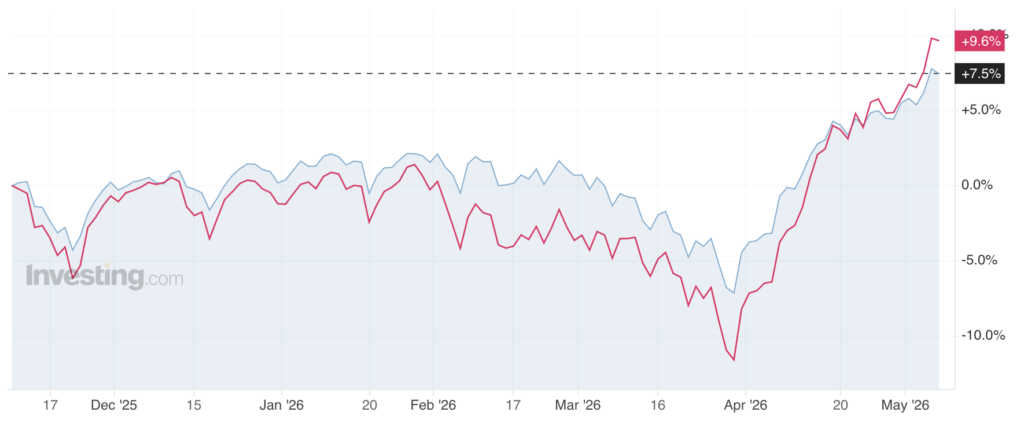
Stock Market Doesn’t Care That Shipping Remains Heavily Disrupted
The Strait of Hormuz itself presents the strongest challenge to the mainstream “peace rally” rhetoric. According to a Reuters report on 29 April, only six ships had crossed the strait in a 24-hour window, called a “minuscule percentage of the normal flow through the crucial waterway at the entrance to the Gulf, which was at 125-140 daily passages before the Iran war began on February 28”.
On 4 May, more reporting confirmed the “standstill” in commercial shipping despite Washington’s latest efforts to restore safe passage, leading to only a single tanker moving into the Gulf of Oman.
And on 7 May, it was revealed that the UAE was resorting to covert tanker movements, AIS blackouts and ship-to-ship transfers to get crude out, because the normal export route remained effectively broken. In short, the physical system that underpins the oil market was still severely impaired despite equity markets behaving as through the crisis had largely passed.
Shipping group Maersk reported a spike in its monthly fuel costs of $500 million, and warned that the energy crisis would persist even if a peace deal was reached. As a result, its stock dropped more than 7% — meanwhile, the greater market continued rocketing.
The Stock Market Is Actually Bearish, So How Is It Still Rising?
The backdrop to the recent rally was a market already under pressure from the late-February escalation. Global hedge funds suffered their worst monthly drawdown in more than four years in March, according to a Goldman Sachs client note, having sold global equities at the fastest pace in 13 years. North American hedge fund selling was the largest since April 2020, and Bloomberg reported the March sell-off as the second largest selling wave since the bank began tracking the series in 2011.
Following enormous selling pressure, everything suddenly changed. Reuters reported on 17 April that a Goldman report seen by the agency revealed systematic hedge funds bought $86 billion of stock exposure in just five trading sessions following the ceasefire — the fastest buying pace on record. Meanwhile, Goldman’s own public 2026 hedge fund industry outlook had already shown that gross leverage across its full prime brokerage book reached a record high by the end of 2025. That highlights an important element: leverage was sharply rising way before the Iran shock, which accidentally became a key factor in what we’ve recently seen.
How Short Covering, Options Hedging, and Algofunds Skewed Stock Market Sentiment
A “short squeeze” looks to be what really caused recent hikes. Short selling — borrowing shares, selling them, and hoping to buy them back at a lower price — is effectively betting on a declining market or stock price. However, if prices rise instead, the short seller faces growing losses and often needs to buy back the shares quickly in order to close the position. When many bearish traders are betting that the market will drop at the same time, their forced buying counterintuitively drives prices up further. In turn, this creates more buying from other short sellers.
The April rally bore the hallmarks of exactly this activity. Hedge funds had spent March selling aggressively and increasing bearish exposure around the Iran war. The ceasefire caused a shock to the system, which sparked a feedback loop as systematic funds were continuously forced to buy back shares they had shorted. These funds, also known as CTAs or rule-based trend-followers, do not believe in peace or longevity of geopolitical situations. Instead, they react solely to price direction. The record-setting $86 billion of equity purchases in just five days strongly suggests that such mechanical models were doing exactly this.
The options market — in which people trade time-limited contracts tied to stocks or indexes, which are often heavily leveraged — is likely to have amplified the process further. Cboe reported that in February 2026, zero-days-to-expiry SPX options (short-term, highly volatile trades) averaged 3 million contracts per day, representing a record 63% of all options trading. SpotGamma, a closely-watched options analytics firm, wrote that the market moved out of a “negative gamma environment” following the ceasefire, in a way that encouraged volatility compression and additional upside chasing.
In other words, heavy short-term options activity forces dealers to hedge dynamically as prices rise, creating additional demand for the underlying index or stocks. And that, in part, is why recent rallies are travelling further and faster than the old-fashioned valuation or uncertainty metrics would imply.
What Happens Next?
Falling crude oil prices would usually indicate that everything is returning to normal, the world is adjusting to the ongoing conflict, and the impact of the larger global energy shock is fading. However, Maersk’s leadership expects the energy squeeze to persist for months as inventories have been depleted and said the supply crunch is likely to worsen before it improves, regardless of any potential de-escalation.
The UAE, who just left OPEC largely due to Iran’s strategic moves in the region, are still down by more than 1 million barrels per day compared to pre-war conditions. Those dislocations cannot be corrected instantly no matter how “peaceful” the news, and constraints on freight costs, industrial activity, and global inflation will be felt long after any resolution is found.
There is also the question of whether the systematic funds and CTAs have inadvertently front-run an end to the war, and priced in future peace. The shipping data suggest Hormuz is nowhere near back to normal, the energy market still faces enormous restrictions on throughput, and security risks continue to linger. Meanwhile, the markets are automatically reacting by mass-buying on misplaced signals. Essentially, prices indicate a neat end to the conflict, without any indication of it arriving. How sustainable will that prove to be?
Final Thought
The stock market used to react to investors reading earnings, weighing up macro conditions, and allocating capital on fundamental judgements. That world is slowly being reshaped into an environment led by automated trading bots and short-term, highly-leveraged option plays, as seen in Goldman’s own figures. In that environment, market moves can be driven more by how other funds are positioned than by genuine assessment of current conditions.
While the mainstream outlets celebrate the rising markets as a celebration of the ceasefire and nearing the end of the conflict, they miss the true cause of recent value hikes, and totally ignore the true state of affairs as shipping remains restricted – which is exactly the cause of the original drop. There hasn’t been a resolution, and the fundamental risks to supply chains and energy prices continue. A market built around passive flows, systematic models, and options hedging seems to have become completely detached from the state of the physical world.
The Expose Urgently Needs Your Help…
Can you please help to keep the lights on with The Expose’s honest, reliable, powerful and truthful journalism?
Your Government & Big Tech organisations
try to silence & shut down The Expose.
So we need your help to ensure
we can continue to bring you the
facts the mainstream refuses to.
The government does not fund us
to publish lies and propaganda on their
behalf like the Mainstream Media.
Instead, we rely solely on your support. So
please support us in our efforts to bring
you honest, reliable, investigative journalism
today. It’s secure, quick and easy.
Please choose your preferred method below to show your support.

Categories: World News
oes anyone else feel like the market has completely stopped being a reflection of the real economy? Six ships crossing Hormuz in 24 hours vs 125-140 before the war and stocks are at all-time highs? At what point does the gap close and who gets hurt when it does? On a business level this kind of instability makes proper systems non-negotiable. We run Vertex HCM as our HR and payroll software in Pakistan at least internally we know exactly where every rupee is going even when the global picture makes no sense.