














Corporate media is creating fear around a hantavirus outbreak, following a familiar pattern of creating fear before providing context, similar to previous “outbreaks” like covid, monkeypox (MPOX) and bird flu.
Hantaviruses are a class of viruses that can infect humans, typically through inhalation of aerosolised rodent urine, faeces or saliva, with human-to-human spread being very rare.
Despite the low number of cases and deaths worldwide over decades, there are already 13 documented hantavirus vaccines and gene therapy programmes in active development.
Once again, it’s the Hegelian dialectic: problem, reaction, solution.
Let’s not lose touch…Your Government and Big Tech are actively trying to censor the information reported by The Exposé to serve their own needs. Subscribe to our emails now to make sure you receive the latest uncensored news in your inbox…
Hantavirus: Have We Learned Nothing?
Watching the headlines unfold this week feels like watching a rerun of a movie we’ve seen multiple times before:
- A virus outbreak on a cruise ship.
- Emergency evacuations. Hospital escorts.
- Contact tracing across multiple countries.
- Media outlets flood the public with alarming updates before most people even know what hantavirus is.
The images, the language and the emotional conditioning are familiar because we have seen this exact pattern before. It always begins the same way: create fear first, provide context later, and by the time the facts catch up, the public has already been pushed into a state of panic and vaccinated. It seems every 2 years we get a new viral scare from the media, as the very expensive and intrusive Biosecurity Agenda gets built out. Remember this?:
- 2020: Covid
- 2022: Monkeypox
- 2024: Bird Flu
- 2026: Hantavirus
What is a Hantavirus?
Hantaviruses are a large class of enveloped, single-stranded RNA viruses. Today, scientists recognise more than 50 hantavirus species worldwide, with approximately two dozen known to infect humans. Most infections occur through inhalation of aerosolised rodent urine, faeces or saliva (how unclean was that cruise ship?). Human-to-human spread is considered very rare, although the Andes virus in South America has shown limited evidence of person-to-person transmission. For the last 50 years, rodents have been the primary hosts of hantaviruses. However, recent discoveries have shown that hantaviruses also infect bats, moles and shrews.
Before the 1993 outbreak in the Four Corners region of the Southwest (where Arizona, New Mexico, Colorado, and Utah meet), only 31 hantavirus cases had ever been reported. The initial outbreak affected 24 previously healthy young adults who suddenly developed fever, muscle aches and rapidly progressive respiratory failure, and within days, there were a few deaths. US Centres for Disease Control and Prevention (“CDC”) investigators eventually identified a previously unknown hantavirus carried by the deer mouse. It was later named Sin Nombre virus. The deaths resulted from what became known as Hantavirus Pulmonary Syndrome (“HPS”). (Do you remember hysterically hearing about this from the CDC or local public health departments? I don’t either …)
After the 1993 outbreak, the CDC began national surveillance for hantavirus infections. As of the end of 2023 (30 years), 890 confirmed hantavirus disease cases had been reported nationwide, as HPS or non-pulmonary hantavirus infections. (A non-pulmonary case is one in which patients tested positive for hantavirus infection but never developed the classic pulmonary phase. Of these, 309 cases were classified as HPS with a case-fatality rate of approximately 35%, which is about 10 deaths per year.
Historical surveillance has shown that approximately 96 per cent of US cases occurred west of the Mississippi River, reflecting the geographic range of the deer mouse and related rodent reservoirs. However, at least one case has been identified in nearly every state.
The CDC reports that hantaviruses are spread through exposure to infected rodent urine, droppings or saliva, especially when contaminated materials become aerosolised and inhaled. As previously stated, deer mice are considered the principal reservoir for Sin Nombre virus in North America. Hantaviruses found in the United States are not believed to spread from person to person.
Long-term CDC surveillance has demonstrated that hantavirus activity fluctuates with environmental conditions that influence rodent populations. Researchers studying deer mouse ecology in the Southwest have observed that fluctuations in infected rodent populations are closely linked to environmental conditions.
Hyping the Concern
The pre-summer hysteria is a readily recognised, predictable formula. Will we watch an entire global population stop, question and challenge this current “emergency,” or will people put on masks and socially distance because they were pre-conditioned to do so?
The same Hegelian principles are used repeatedly by “public health”: problem (a pathogen); reaction (cause hysteria); solution (a vaccine). Before the public even has time to understand what the concern is about, we learn that there are 13 documented hantavirus vaccine and gene therapy programmes in active development:
- 6 DNA “vaccines” (US Army / USAMRIID) – many of them “needle-free” jet-injector versions – this is a DNA gene-therapy.
- 3 mRNA “vaccines” (Moderna + Korea University, Chinese research team, VIDO Canada)
- 2 viral vector “vaccines” (UK institutions + VIDO Canada)
- 1 inactivated vaccine (Hantavax – already licensed and used in South Korea)
- 1 protein subunit vaccine (VIDO Canada)
What makes this so disturbing is how quickly the public is already asking panicked questions about hantavirus prevention and treatment protocols, even though the few cases that have occurred are thousands of miles away from where they live.
Why are we not talking first about rodent control, environmental hygiene and targeted risk awareness? Why are we so concerned about the hype? Why does Public Health so often leap past those fundamentals and head straight toward injections?
We no longer live in a world where a small outbreak is simply a local event. Today, a few infections can mobilise an entire international system of control overnight. Quarantines. Travel restrictions. Surveillance. Emergency authorisations. Expanded government power. We saw it happen in 2020; many people complied because they believed it was temporary, necessary and for the greater good. But temporary powers have a way of becoming permanent infrastructure, and once those systems are in place, they do not disappear when the headlines fade.
Fear sells, and during covid, those in power learned they could weaponise it into the most effective tool for controlling public behaviour. A frightened population can be managed and persuaded into accepting measures they would otherwise question or flat-out refuse. The greatest mistake people could make right now would be to respond emotionally before responding intelligently. Hantavirus warrants observation (there have been only 3 deaths!!), not hysteria.
However, images matter. The setting matters. Public memory matters. Cruise ships, quarantines, isolation, contact tracing – these are not neutral images. They trigger something in people because we have already lived through it once before. We all lost friends, family, employment and community. We can’t be forced to comply with these measures again.
If the covid years taught us anything, it should be that urgency is often used to rush us past scrutiny and critical thinking about what’s going on. The response to the hantavirus hysteria will be very telling: have we learned to ignore the fear-mongering media and the WHO, or will we once again cower and be compliant?
This is the moment to remember the pain of past pandemic rhetoric. The world cannot afford another panic-driven mistake, and neither can you.
The overwhelming scientific understanding of hantavirus has always centred on environmental exposure, not casual community spread. That distinction matters because, without context, every pathogen can be made to sound like a scary, civilisation-ending emergency.
About the Author
Dr. Sherri Tenpenny, of several businesses, including the nationally recognised Tenpenny Integrative Medical Centre and the Tenpenny Health Restoration Centre, is trained in Emergency Medicine, Osteopathic Manipulative Medicine and Integrative Medicine.
Dr. Tenpenny has been a guest on hundreds of radio and national television programmes. She has written several books, the latest of which is ‘Be Patient In Trouble: A Walk With God: Devotions for Patience, Forgiveness, and Wisdom’, and has contributed chapters to several more. Her magazine articles have been published in at least 14 languages. She publishes articles on a Substack page titled ‘Dr. Tenpenny’s Eye on the Evidence’ which you can subscribe to and follow HERE.
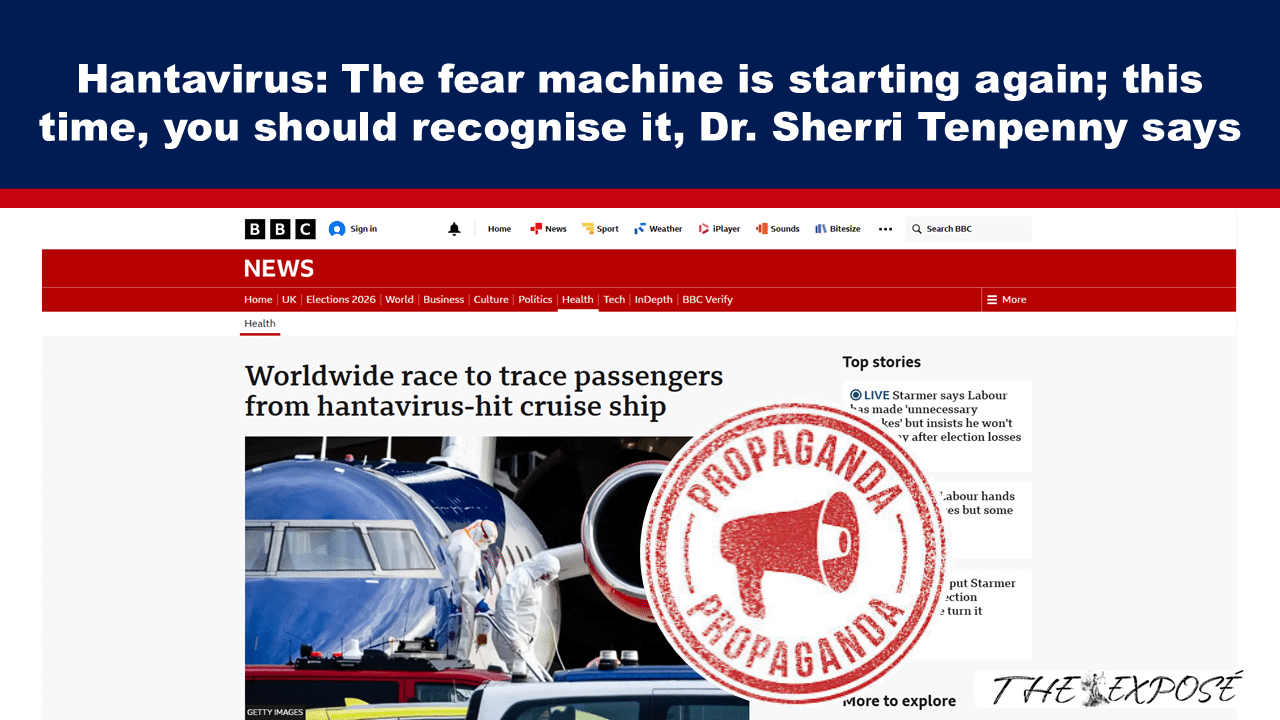
Featured image: Adapted from screenshot of ‘Worldwide race to trace passengers from hantavirus-hit cruise ship’, BBC News, 8 May 2026
The Expose Urgently Needs Your Help…
Can you please help to keep the lights on with The Expose’s honest, reliable, powerful and truthful journalism?
Your Government & Big Tech organisations
try to silence & shut down The Expose.
So we need your help to ensure
we can continue to bring you the
facts the mainstream refuses to.
The government does not fund us
to publish lies and propaganda on their
behalf like the Mainstream Media.
Instead, we rely solely on your support. So
please support us in our efforts to bring
you honest, reliable, investigative journalism
today. It’s secure, quick and easy.
Please choose your preferred method below to show your support.

Categories: Breaking News, World News
Hmm, I wonder how many sheeple will listen to the government this time around. Now be good little citizens of the world and go get your Hantavirus jab, nope, one will not due, if you live from the first jab then 6 months later you will need a second jab, and on and on it goes. I am not a good little citizen of the world, so, I will opt out of this man-made virus just like I did with covid.
that’s right, blame men!
…just joking…
Lol, yep!
The breakout is happening on a cruise ship again, where they, theoretically, could jack up the “satellite” radiation levels to produce various side effects, depending on variables like wavelength, amplitude, etc. chosen.
If we all ignore it, it will go away.
It really looks like an almost repeat of the 2020 covid19 scare and I hope that most won’t fall for this new scheme to get massively vaccinated unless most people don’t know their history!
As trusting as people are, I have a shred of faith in them. As the 2022 article “Covid poll: A pulse check of Australia as we exit the pandemic” (still available by search engine) claimed in their survey of 50,000+ people:
*Only 35 per cent out of more than 45,000 people said they were vaccinated and would make the same decision again
*Not a single person said they were unvaccinated and regret the decision
So while nobody of 50,000+ people who were uninjected claimed to regret the decision, it seems that a hefty percentage of those who got it did regret the decision. So yeah, maybe they’ll learn.
WHAT GENERAL POPULATION UNAWARE ABOUT ALL THESE SCAREMONGER NARRATIVES ABOUT VIRUS ACTUALLY REFERS TO…
“The boy who cried wolf story”
Virus outbreak lies is all about making the STORY over and over until everybody stuck with the lies shouted as false alarm until REAL outbreak happened, everybody won’t believe it; even laugh about it.
Then, the devastating outcomes will be catastrophe. Everybody unaware of what happening until is too late.
However, virus outbreak is a lie. There will be another outbreak similar to virus outbreak will be planned. The HISTORY of fake pandemic already tested and done during outbreak in Wuhan. No virus presents but mass 5G rollout was the culprit.
Water in everybody lung will be vaporized created pneumonia symptom. Everybody panic and…. the end!
JABS BIGGEST ORCHESTRATED PROPAGANDA HOAX IN HISTORY MASKS KILL PURE BLOOD 🩸
The exact BS that was Covid and the mRNA shots. How many observed that with the Covid fright storm the flu they push every year suddenly disappeared, but now magically the Pharmaceutical mafia and their agents are calling for increased flu shots. Watch the hyped Hantavirus cause panic in the same people who still wear masks while driving alone and especially in any gathering. A con that continues to kill while claiming they are saving lives, and all for the all might dollar.
This has “don’t travel” and movement control written all over it.
Matthew 24
The WHO shouts “Release the next pandemic” to the simple minded sheep that follow these criminals.
A pangolin and a rat walk into a bar, on a cruise ship…
The good news, there is a vaxxine coming.
Correction: A “Safe and Effective” vaxxine.
The Israelites took great care before diagnosing a person as having leprosy or a similar condition. If there was any doubt as to the certainty of a diagnosis, the person was to be isolated for observation (Leviticus 13:1–14:57). Once a person was diagnosed with a contagious condition, he was to be quarantined outside of the camp ‘all the days wherein the plague shall be in him.’ He was also required to wear a covering over his mouth, and to warn others by shouting, ‘Unclean, unclean!’ (Numbers 5:2–4 and Leviticus 13:45–46).
Modern hospitals also follow special isolation procedures for persons who have, or are suspected of having, contagious infections. For example, ‘strict isolation’ requires a private room with an independent air supply. The door to this room must be kept closed. Gowns, gloves and masks must be worn by all who enter the room. In addition, a sign must be placed on the patient’s door to warn others of his condition.
https://creation.com/en/articles/the-first-book-of-public-hygiene
Dr. Sam Bailey speaks about this issue in a wideo “What does the Bible say about GERMS?” Her theory is that the quarantine is ceremonial, for spiritual reasons and theorises that the Bible does not mention ‘contagion of germs’.
For example, Leviticus 14:2 is “This shall be the law of the leper in the day of his cleansing: He shall be brought unto the priest:”
So if it’s contagious, they are still brought to a priest. So that could mean that the priest was not stopped from ‘catching’ leprosy.
Leviticus 12:2 is “Speak unto the children of Israel, saying, If a woman have conceived seed, and born a man child: then she shall be unclean seven days; according to the days of the separation for her infirmity shall she be unclean.”
But women after childbirth are not generally considered to be contagious, so the uncleanness could be proposed to be spiritual.
Leviticus 14:19 is “And the priest shall offer the sin offering, and make an atonement for him that is to be cleansed from his uncleanness; and afterward he shall kill the burnt offering:”
Offering a sin offering could be inferred to indicate that the ‘uncleanness’ is spiritual.
There is a difference between hygiene from decaying matter and the theory of contagion of germs.
E.g. On those true crime TV shows, a farmer commonly finds a body on his property and calls the police up. The police come and find that the body is riddled with microbes. But I’ve never seen a policeman surmise that the microbes ended the person’s life. They surmise that the microbes took advantage of the decaying flesh, that was caused by another person ending the life of the deceased.
Gostaria de saber se já isolaram algum “vírus” inclusive este, o Hantavírus, uma vez que ninguém é capaz de mostrar à Christine Massey o isolamento de qualquer um dos falados de sempre 🤷🏻♂️