














Artificial intelligence is being introduced into schools at speed, with ministers, technology companies, and education bodies presenting it as a way to personalise learning, reduce teacher workload, and help pupils who have fallen behind. It’s true that schools in the UK are under pressure and teachers are stretched, but is AI really the answer? Children are being asked to absorb a technology whose effects on attention, memory, writing, reasoning, and confidence are still poorly understood.
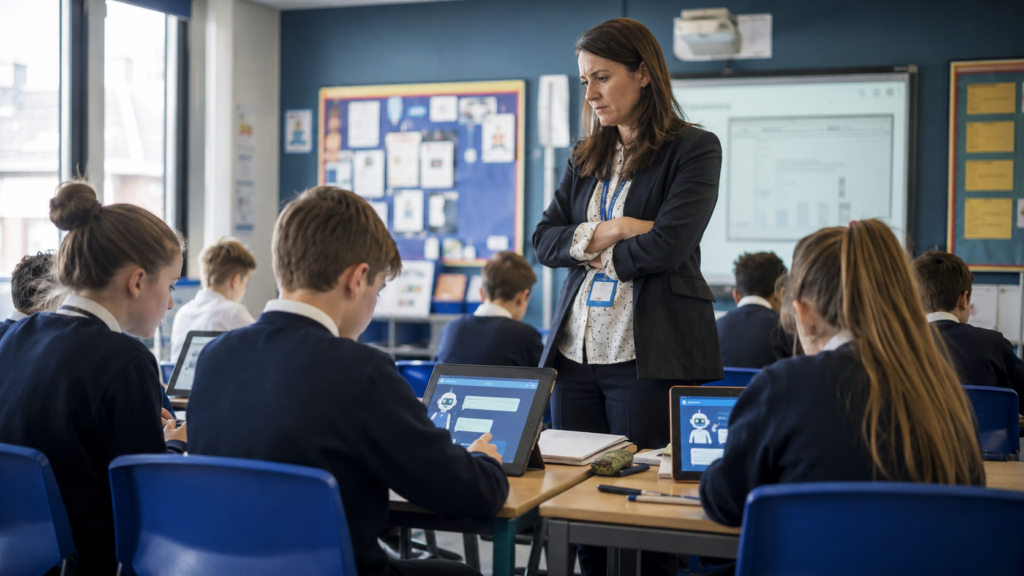
On 26 January 2026, the Department for Educated (DfE) announced plans for “safe AI tutoring tools” that could support up to 450,000 disadvantaged pupils on free school meals. The scheme is intended to begin with teacher-led co-creation in the summer term, with tools expected to be available to schools by the end of 2027. Ministers framed the policy as an attempt to make personalised one-to-one support available beyond the families who can afford private tutors. Education Secretary Bridget Phillipson said the aim was to “break the link between background and destiny”, arguing that artificial tutoring could take tailored support “from a privilege of the lucky few, to every child who needs it”.
The Department’s own language, however, shows how much remains unresolved. The same announcement stressed that AI tools must be safe, support learning, and never replace the human connection provided by teachers. Its wider guidance says generative AI can support pupils “if used safely, effectively and with the right infrastructure in place”. That’s a somewhat reassuring stipulation, but it means the safe implementation will depend heavily on training, safeguarding, governance, privacy controls, and curriculum design.
Yet while updating their standards suggests a cautious approach, it also confirms that the risks to children are not just speculation. Covering areas such as filtering, monitoring ,reporting, security, privacy, data protection, intellectual property, testing, governance, and cognitive development, the updated AI safety standards prove that ministers are not dealing with a harmless add-on. Instead, it demonstrates an awareness that this technology could totally reshape what children see, how they answer, how they think, and how their progress is assessed.
And in the midst of this “progress”, teachers are already reporting a significant change in classroom behaviour. A National Education Union survey published in April 2026 found that 66% of secondary teachers believed pupils’ critical thinking had declined because of AI use. The same survey found:
- 49% of schools have no policy whatsoever for the use of AI by either staff or students;
- 66% have no policy in place specifically for students;
- 76% of teachers are now using the technology for day-to-day work, including 61% for resource creation, 41% for lesson planning, 38% for admin tasks, and 7% for marking;
- And, alarmingly, only 14% support the government’s planned introduction of automated tutors for disadvantage pupils.
It’s therefore already being used more than ever by both pupils and staff, and it’s having a noticeable effect. So what happens when its day-to-day implementation is accelerated?
Reports on the NEU survey quoted teachers warning that pupils were losing confidence in basic thinking, writing, creativity, and even conversation. Some raised concerns that voice-to-text and automated writing tools are weakening spelling and composition. These should not be taken as minor anxieties about pupils shortcutting homework. Such concerns go to the centre of education, and totally change the slow, natural processes by which children learn to form ideas, make mistakes, revise sentences, solve problems, and speak for themselves.
Supporters of the technology, on the other hand, argue that pupils need to understand these tools because they will live and work in a world shaped by them. Therefore, it’s key for children to learn how the technology works, how it can hallucinate, how to verify its output, and make sure they do not treat it as an authority. The risk here, however, is confusing AI literacy with AI dependency. It seems that today, the tool is moving from just being something pupils are taught to question, and toward a technology that’s doing the intellectual work for them. And it’s costing children their proper development.
The government’s tutoring proposal has already met significant resistance from teachers themselves. According to the NEU survey, 49% of state school teachers opposed the plan, while only 14% supported it. One of the recurring concerns was that poorer pupils, who often need more adult support, could end up being offered automated substitutes while wealthier families can pay for human tutors. That represents a bleak outcome for a policy presented as a measure of fairness: the affluent child gets attention from a person, while the disadvantaged child is given a screen.
The safeguarding questions are just as serious. The NSPCC warned in a January 2025 report that children and young people are often among the earliest users of new technologies, including generative AI, and examined the risks for safety and wellbeing both online and offline. Its research identified risks including sexual abuse, grooming, bullying, misinformation, self-harm content, harmful advice, privacy risks, and commercial exploitation.
Initially, the main risk of pupils using artificial intelligence in the classroom seemed simpler: cheating. Children have better access to information today than ever before, and so relying on the internet to solve problems for them is easy. But the real harm is dependence. Pupils reaching for AI before trying to think, draft, calculate, remember, struggle, or fail, totally bypass the learning process. What appears to be support in one lesson becomes a habit over months and years, and by adulthood, a completely different developmental pathway.
Evidence from outside Britain points in the same direction. A 2025 study of fifth-grade children found that pupils imagined generative AI not only as a collaborator or companion, but also as a task automator that could to whom they could offload responsibilities. The children also expressed fears about over-reliance in academic settings, linking it to diminished learning, disciplinary consequences, and long-term failure.
Schools should not be treated as ordinary workplaces upgrading to modern technology. The cost of artificial intelligence being used badly on children will have severe consequences on their development, affecting patience, attention, memory, independent thought, written expression, and the ability to digest difficulties in life. AI being sloppily introduced in an office may affect productivity, but a mistake in childhood education shapes habits that follow pupils for a lifetime.
If artificial intelligence is strictly limited, used transparently, and firmly subordinated to human teaching, then there may be a world in which it is useful. However, if it’s used as a cheap sticking plaster for teacher shortages, attainment gaps, and budget pressure, then the consequences will be much harder to reverse. What we’re seeing here is not a dramatic classroom takeover, but the potential for quiet erosion of child development, leading to a lifetime of total dependence on machines.
The Expose Urgently Needs Your Help…
Can you please help to keep the lights on with The Expose’s honest, reliable, powerful and truthful journalism?
Your Government & Big Tech organisations
try to silence & shut down The Expose.
So we need your help to ensure
we can continue to bring you the
facts the mainstream refuses to.
The government does not fund us
to publish lies and propaganda on their
behalf like the Mainstream Media.
Instead, we rely solely on your support. So
please support us in our efforts to bring
you honest, reliable, investigative journalism
today. It’s secure, quick and easy.
Please choose your preferred method below to show your support.

Categories: UK News
Upfront, we voted for Trump, however we are adamantly opposed to humanoids to help kids catch up.
Melanie introduced it on the WH website.
https://www.whitehouse.gov/briefings-statements/2026/03/first-lady-melania-trump-convenes-record-45-nations-at-the-white-house-and-introduces-american-built-humanoid/
Kids need HUMANS not robots. I don’t like the psychological affect it will have on them either.
We need to get back to basics. No cell phones. No calculators. No laptops. Definitely no humanoids. I agree with the cons of this. Distance learning under COVID was another disaster.
” A National Education Union survey published in April 2026 found that 66% of secondary teachers believed pupils’ critical thinking had declined because of AI use.” Totally agree with that.
President Trump is listening to too many technocrats like JD, Thiel, Google etc..
Important points raised here. AI in education should not replace thinking, writing, or teacher guidance — it should support students only after they attempt to learn and practice themselves.
I can remember back in 2020 or early in 21 reading some manifesto written by Klaus Schwab in which he described his vision for the future of Earth’s public schools.
This was a piece of that vision.
I hope our kids will be able to recover from whatever damage is being done by these AI interactions.