














A Dutch pro-abortion organisation has placed lockboxes containing abortion pills across Malta and Gozo, directly challenging one of Europe’s last remaining pro-life countries. The campaign is being presented as a humanitarian intervention for women in crisis, but it contradicts Maltese law, medical oversight, and the democratic refusal by the country to follow the rest of the continent into abortion liberalisation. After years of trying to overturn Malta’s pro-life rules, activists have failed to change the law; so now they’re breaking it.
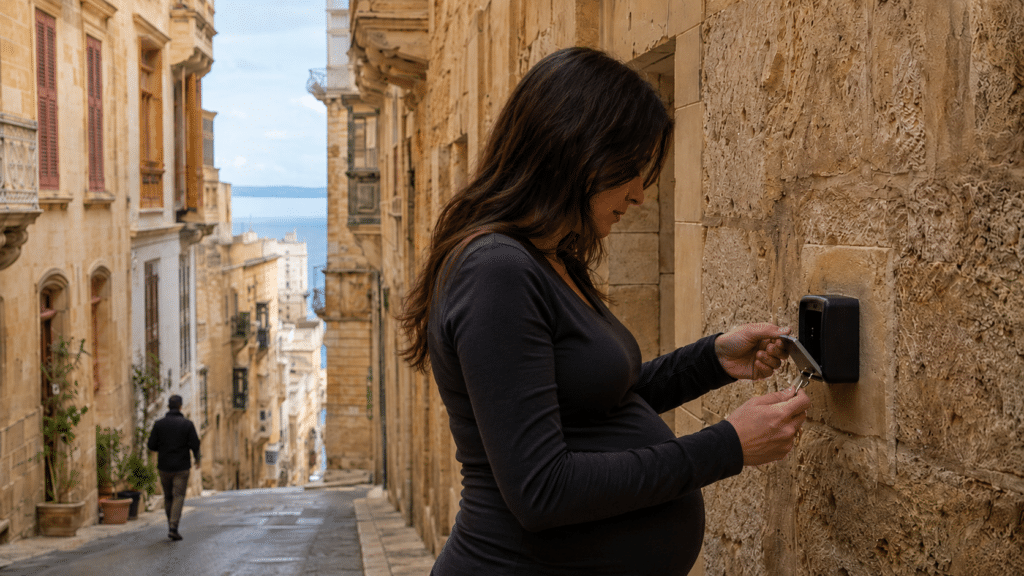
The campaign was launched by Women on Waves, a Netherlands-based organisation that has long sought to expand access to abortion in countries where it is restricted. In April, the group announced that it had placed several abortion “key safes” across Malta and Gozo containing mifepristone and misoprostol, the two drugs commonly used in chemical abortions. Women under nine weeks pregnant were invited to email the organisation to receive the location and access code.
15 black lockboxes have been fixed to sites across Malta as part of the campaign, with 16 women contacting the organisation in the first eight days. Rebecca Gomperts, the founder of Women on Waves, described Malta’s law as “archaic” and framed the lockboxes as a response to unmet demand. The language centres on rights and access, but it does not change the practical reality. Drugs are being distributed in a democratic country where abortion remains a criminal offence (except in tightly defined medical emergencies).
Malta’s abortion law is among the strictest in Europe. Under the country’s Criminal Code, procuring a miscarriage remains a criminal offence, with the 2023 amendment allowing intervention only in cases where a woman’s life is at immediate risk or where her health is in grave jeopardy that may lead to death. The change followed intense international pressure after the case of an American tourist, Andrea Prudente, who was airlifted to Spain in 2022 after being denied a termination in Malta when her waters broke during pregnancy.
For abortion campaigners, the Prudente case became the central argument for reform. For pro-life Maltese campaigners, it became evidence of how quickly a specific medical exception could be used to demand wider abortion access. The final version of the 2023 law was much tighter than activists wanted, preserving Malta’s broad protection for unborn life while permitting medical intervention in the gravest circumstances.
The lockbox campaign therefore arrives after a political defeat. Malta did not legalise abortion despite pressure, and it chose not follow the broader European trend. Instead, it retained a legal framework that treats abortion not as healthcare but as the deliberate ending of unborn life, while carving out limited space for doctors to act where the mother’s life or survival is at risk.
Despite the illegality of the operation, Women on Waves is not covering up its plans. The organisation’s own website says the lockers contain abortion pills and instructs women less than nine weeks pregnant to email the group for the location and code. Supporters describe this as a safety measure, arguing that women will seek abortions regardless of the law and that pills obtained through activist networks are preferable to desperation or isolation. The group has also said the medical abortion pills they have provided so far have been widely used and effective.
Malta has debated abortion repeatedly, and chosen not to legalise it. This isn’t a case of ignorance by the country, but rather the result of a political and cultural settlement that remains substantially pro-life. It’s a central democratic issue, and the country is more concerned with upholding its values than caving to international progressive opinion. As such, activists are not just “filling a gap” in services; they are bypassing a law they already failed to change.
Doctors for Choice Malta says taking abortion pills in Malta is illegal, although prosecutions are rare. Safe Abortion Malta, a pro-choice resource, says medical abortion can be carried out at home up to 12 weeks according to World Health Organisation guidance, but acknowledges that pills cannot be prescribed by a doctor in Malta because abortion is illegal. The practical result is a potentially unsafe shadow system: drugs supplied from abroad, advice given remotely, and emergency care, if needed, left to the Maltese health system.
A 2023 BMJ Sexual & Reproductive Health study examined women and pregnant people in Malta who accessed abortion pills online between 2017 and 2021. It found that the most common reasons for ordering pills were difficulty accessing abortion because of legal restrictions and the unavailability of abortion pills in the country. The same study described a process in which Women on Web reviewed online consultations, dispatched mifepristone and misoprostol where criteria were met, and provided follow-up by email.
The pro-choice case is that this shows women are already seeking abortions and that criminalisation only pushes the practice out of sight. The pro-life response is that this is precisely the danger: an illegal market is being normalised, the unborn child is erased from the moral equation, and the woman is increasingly left alone with an email address, a packet of pills, and the instruction to seek hospital care if something goes wrong.
The National Council of Women of Malta expressed “grave concern” over reports of the lockboxes, warning that any initiative facilitating access to abortion pills in Malta raised questions about respect for the law, public safety, vulnerable women, and unborn life. It also asked who was verifying eligibility, gestational age, coercion, medical contraindications and aftercare. The duties of legal clinics and accountability of medical professionals are non-existent when drugs are supplied by a lockbox.
While prosecutions are reported to be rare, there have been recent cases. In March 2026, a woman was given a suspended sentence after being found guilty of procuring an abortion in 2024. MaltaToday reported that the magistrate noted self-induced abortion is a crime under Maltese law regardless of the stage of pregnancy or the viability of the foetus. Prime Minister Robert Abela later said he did not believe a woman should be given a prison sentence for the offence and suggested lower penalties, while ruling out broader abortion law reform.
Malta is an outlier in the European Union, where abortion access is generally treated as a settled liberal norm. That makes it a symbol far beyond its size. To pro-choice campaigners, Malta is the last fortress to breach. To pro-life campaigners, it is evidence that a modern European state can still reject the claim that abortion is an inevitable feature of women’s healthcare.
While the moral dispute behind terminations will inevitably continue, the current method should alarm even those who favour abortion liberalisation. The fundamental attempt by activists who disagree with the law to supply drugs in hidden locations around the country is about more than just being pro-life. It also questions the activist network itself being able to unilaterally override national law, simply because it thinks democracy produced the wrong answer.
Malta’s laws may one day change. If so, it should happen through Parliament, public argument, and electoral accountability. But what we’re seeing now is a foreign organisation deciding Maltese law is illegitimate, and acting accordingly to undermine it. The lockboxes are not just containers for pills – they are a test of whether a country is still able to uphold its own laws when international activists think otherwise.
The Expose Urgently Needs Your Help…
Can you please help to keep the lights on with The Expose’s honest, reliable, powerful and truthful journalism?
Your Government & Big Tech organisations
try to silence & shut down The Expose.
So we need your help to ensure
we can continue to bring you the
facts the mainstream refuses to.
The government does not fund us
to publish lies and propaganda on their
behalf like the Mainstream Media.
Instead, we rely solely on your support. So
please support us in our efforts to bring
you honest, reliable, investigative journalism
today. It’s secure, quick and easy.
Please choose your preferred method below to show your support.

Categories: World News
Thank you for reporting on this!
In my country I have heard nothing about this until now.
Imagine just how desperate the “powers” are to depopulate when they’re stooping to this ploy and also just how much they are using and manipulating the modern day disciples of Margaret Sanger in order to have them happily carry out evil will.
I have recently read that more babies have been killed in the last 50 years via abortion than all the people killed in all the wars in recorded history
so much for the gentler sex
To actually murder life in the womb in a time when the planet is trending down in population is obviously the devil’s work. In the Georgia Guidestones the globalist want to kill off the world population to 200 million to make it more viable for their one world order control. Killing another human being for your mistake is unconscionable when the baby can be given up for adoption to couples that cannot conceive. Murder used to be against the law, but apparently not in these end times where evil is called good and good evil. – Pastor Gary Boyd