














Dr. Vincent Munster, a senior scientist at an NIH laboratory in Montana, is under an FBI criminal investigation for allegedly attempting to smuggle dozens of vials of pathogen samples from the Democratic Republic of Congo into the United States in January 2026.
At the same time, a laboratory in Colorado has confirmed a spate of 50 safety control issues between 2020 and 2023.
These two cases, unfolding hundreds of miles apart, lay bare a disturbing pattern.
Let’s not lose touch…Your Government and Big Tech are actively trying to censor the information reported by The Exposé to serve their own needs. Subscribe to our emails now to make sure you receive the latest uncensored news in your inbox…
Dr. Vincent Munster is a senior virologist at the National Institutes of Health’s (“NIH’s”) Rocky Mountain Laboratories with a background in studying coronaviruses, monkeypox, Ebola and other high-risk pathogens.
“[Rocky Mountain Laboratories] has long drawn concern for both the nature of its research and safety protocols, especially its potential role in the release of SARS-CoV-2 as a ‘partner’ in the Wuhan Institute of Virology’s 2018 DEFUSE project to create a chimeric coronavirus,” The Tennessee Star notes.
Although details have not been released as to what the vials contained that Dr. Munster and his colleague Claude Kwe Yinda were attempting to smuggle into the US, The Disinformation Chronicle reported that the samples included monkeypox (now called Mpox) virus, and White Coat Waste reported that, according to a whistle-blower, they contained viral haemorrhagic fever samples.
Viral haemorrhagic fevers (“VHFs”) are a diverse group of infectious diseases caused by several distinct families of RNA viruses. Examples of viruses classified within these families are Ebola virus, Marburg virus, Crimean-Congo haemorrhagic fever virus, Hantaviruses, Yellow fever virus and Dengue virus.
Further reading:
- Virologist Linked to Fauci Under FBI Investigation for Smuggling Dangerous Pathogens Into US, Children’s Health Defense, 6 May 2026
- NIH Whistleblower Exposes ‘Full Coverup Mode’ Over Fauci’s Bat Virus Mad Scientist Vincent Munster’s Monkey Bite Horror and Illegal African Pathogen Smuggling, FBI Criminal Probe Underway, Gateway Pundit, 6 May 2026
- Vincent Munster: Banned, Scrubbed, and Under FBI Investigation, Jim Haslam, 10 May 2026
As the Natural News article below highlights, it is not only gain-of-function (bioweapon) experiments and the staff at Rocky Mountain Laboratories, Montana, that are putting the American public at risk. Colorado State University has reported 50 safety incidents at its laboratories between 2020 and 2023.
Bio-lab corruption: Consecutive accidents at a Colorado virus lab and an NIH scientist’s smuggling scandal exposed
By Lance D. Johnson, as published by Natural News on 1 June 2026
A taxpayer-funded virus laboratory in Colorado has confirmed a spate of 50 safety control lapses between 2020 and 2023, including workers bitten by covid-infected hamsters, splashed with tuberculosis-infected mouse blood and scratched by rabid cats, yet the public was kept in the dark until a Freedom of Information Act request forced the university to release exclusive documents.
At the same time, a separate whistle-blower letter alleges that an NIH-funded scientist at Montana’s Rocky Mountain Laboratories attempted to smuggle “dozens of vials” of foreign viruses onto US soil from Africa, prompting a cover-up that HHS Secretary Robert F. Kennedy Jr. has reportedly referred to the FBI.
These two cases, unfolding hundreds of miles apart, lay bare a disturbing pattern: dangerous gain-of-function research continues behind closed doors, public trust is treated as expendable and the institutions supposed to protect Americans are importing, concealing and normalising biological risk.
Key points:
- Colorado State University recorded 50 safety incidents from 2020 to 2023, including a covid-infected hamster bite and a researcher contracting Zika virus from infected mosquitoes.
- The university’s bio-safety committee documented breaches involving viral haemorrhagic fever, tuberculosis and rabies, but did not publicly disclose them until a non-profit group requested records.
- A whistle-blower letter alleges NIH scientist Vincent Munster attempted to bring pathogen samples from the Democratic Republic of Congo into the US without proper paperwork, and that NIH officials engaged in a “full cover-up.”
- HHS Secretary Robert F. Kennedy Jr. confirmed the legitimacy of the allegations and said Munster faces an FBI investigation, with Kennedy adding, “I assume he is going to prison.”
- Sen. Tim Sheehy, R-Mont., has demanded an HHS inspector general probe into Rocky Mountain Laboratories, warning that “even small lapses could put Montana communities at risk.”
The Colorado Lab: A Spate Of Breaches Hidden From The Public
The Colorado State University (“CSU”) facility in Fort Collins, a city of roughly 168,000 people, has been a premier research site for studying bats since the 1980s and is regarded as a leading institution in infectious disease studies. Yet the documents uncovered by the Daily Mail show a string of accidents that undermine that reputation. Twelve researchers were bitten by mice carrying haemorrhagic fever. One researcher contracted Zika virus after experimenting with infected mosquitoes. Workers were splashed in the face with tuberculosis-infected mouse blood. Rabid cats scratched staff members. In nearly every case, the public was kept in the dark about potential health risks.
Dr. Bryce Nichols, commenting on the matter for the Daily Mail, noted that “dozens of laboratory accidents at CSU have become known only because of a public records request.” This lack of transparency is deeply concerning and underscores a disturbing trend in research ethics. Researchers have an ethical obligation to report any laboratory accidents that could pose risks to the public, but this does not always occur due to a combination of dishonesty and unethical behaviour. The university has attempted to deflect blame for these incidents by citing stress from the covid-19 pandemic. Yet it is worth noting that covid-19 originated in a laboratory setting similar to this one, meaning they are blaming their own unsafe and unethical practices on an event potentially caused by such behaviour.
The USDA also found faeces and decaying food accumulating in areas designated for horses, cows and sheep at the facility. Dead sheep were reportedly killed by predatory animals, raising questions about what exactly happened there. Given these circumstances, it is clear that this laboratory poses a significant risk to public health and safety.
The Montana Smuggling Case: An Alleged Cover-Up Reaches The FBI
Just as the Colorado revelations destabilised confidence in university-based pathogen research, a separate whistle-blower letter has landed on the desks of senators and federal investigators. The letter, obtained by the White Coat Waste Project and first reported by Laura Loomer, alleges that Vincent Munster, the Virus Ecology Section Chief at NIH’s Rocky Mountain Laboratories (“RML”) in Hamilton, Montana, attempted to bring “dozens of vials” containing viral haemorrhagic fever samples into the US from the Democratic Republic of Congo in January. The whistle-blower claims Munster lied to customs agents in Detroit, telling them the vials contained “science stuff” and “reagents,” but later told RML biosurety staff they were “DNA samples.”
The letter further alleges that NIH officials in Bethesda, Maryland, “did not inform the RML campus and went into full cover-up mode.” The NIH confirmed that RML recorded “theft, loss or release of a pathogen” twice in the past year, but did not initially disclose that one incident allegedly involved an employee being bitten by a lab-infected monkey, according to Justin Goodman of White Coat Waste. That employee, the whistle-blower claims, was “flown out” to avoid suspicion after being exposed to Crimean-Congo haemorrhagic fever, a highly fatal virus.
Sen. Tim Sheehy, R-Mont., has asked HHS Inspector General March Bell to immediately review “safety, security and personnel practices at RML,” warning that “even small lapses could put Montana communities at risk.” Sheehy wrote on X, “We don’t want Montana to be the next Wuhan.” Sen. Rick Scott, R-Fla., also called for answers, saying, “This is very scary, and we need to find out what happened.”
Rep. Paul Gosar, R-Ariz., told Just the News, “Secretive monkey lab accidents and virus smuggling scandals sound like something ripped straight from Anthony Fauci’s playbook, yet somehow this dangerous madness is still happening.” The NIH has not commented on the smuggling allegations beyond confirming that Munster and his colleague, Claude Kwe Yinda, were placed on leave. The FBI declined to comment.
A Pattern of Deception or a Systemic Failure?
These incidents mirror earlier controversies involving the same network of researchers. Rocky Mountain Laboratories has been a partner in the Wuhan Institute of Virology’s 2018 DEFUSE project, which proposed creating a chimeric coronavirus. Sen. Rand Paul, R-Ky., examined Munster’s connection to DEFUSE in a 2024 probe and said Munster’s involvement appeared to conflict with Fauci’s testimony that NIH was not aware of the project. Meanwhile, University of North Carolina (“UNC”) virologist Ralph Baric, another DEFUSE collaborator, is retiring from UNC while facing federal debarment proceedings. NIH removed Baric from his grants, citing an apparent “pattern of deception” involving the nature of his research and whether it was gain-of-function work.
The Colorado State University lab also collaborated with Rocky Mountain Laboratories on an NIH-funded bat laboratory whose bio-safety committee documented more than [50] lab accidents between 2020 and 2023. The two labs share personnel, funding streams and research priorities. The question now facing Congress and the public is whether these failures represent isolated mistakes or a systemic culture of concealment.
One thing is certain: the public cannot rely on these institutions to self-report. It took a Freedom of Information Act request to expose Colorado State University’s 50 incidents. It took a whistle-blower letter amplified by an activist group to trigger an FBI referral in Montana. Without persistent outside pressure, the full scope of these risks may never come to light.
Sources include:
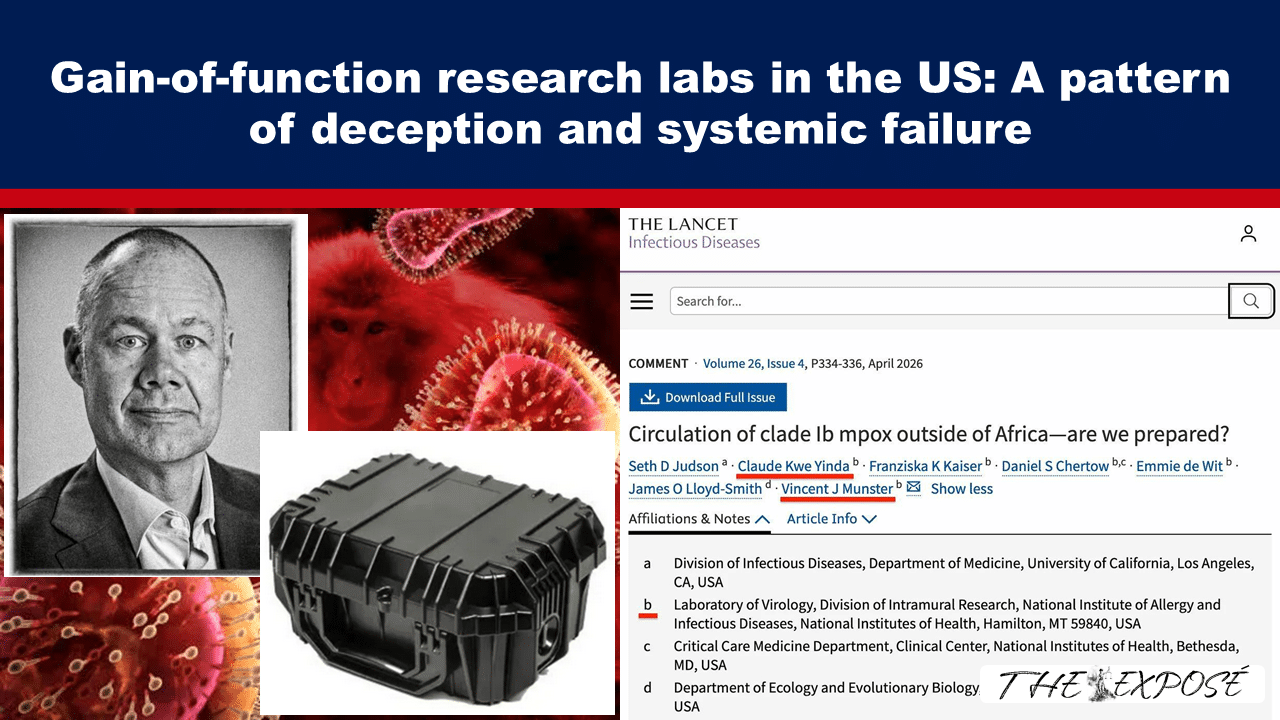
Featured image: Dr. Vincent Munster, example of a protective case to carry vials of pathogens and a study co-authored by virus smugglers Munster and Claude Kwe Yinda published in The Lancet in February 2026, noting that monkeypox is a global threat. Source: ZeroHedge
The Expose Urgently Needs Your Help…
Can you please help to keep the lights on with The Expose’s honest, reliable, powerful and truthful journalism?
Your Government & Big Tech organisations
try to silence & shut down The Expose.
So we need your help to ensure
we can continue to bring you the
facts the mainstream refuses to.
The government does not fund us
to publish lies and propaganda on their
behalf like the Mainstream Media.
Instead, we rely solely on your support. So
please support us in our efforts to bring
you honest, reliable, investigative journalism
today. It’s secure, quick and easy.
Please choose your preferred method below to show your support.

Categories: Uncategorised
https://m.youtube.com/watch?v=puIZolf5T80 space brainwashing
https://m.youtube.com/watch?v=6isYzkXlTHc resource satellite 70,s
https://m.youtube.com/watch?v=wEnRn8OEXW0 what a production
https://www.youtube-nocookie.com/embed/FFpi9Ua_pZI Who’s filming this first walk on the moon
Thank you for exposing all of these details.
I tried to warn my peers that the gov institution inside our own state was involved in the manufacture of the Fauci Flu they were all so scared of, but they ran me out for telling them the truth.
https://www.youtube-nocookie.com/embed/s_Xq9MjBSOk?t=6s Roswell residence interviews 1991 ( very interesting ending )
around the 15 to 10 minute remaining talks about early cloud seeding
https://www.youtube-nocookie.com/embed/6zR2xdYvqbI child indoctrination
https://www.youtube-nocookie.com/embed/FBeynsZANz0 liberals are caught , who,s listening ?
https://www.youtube-nocookie.com/embed/tAIc6bmm6W4 disc flight development