














Artificial intelligence (“AI”) programmes are being offered to users for free or at a low cost.
However, the costs of running AI programmes are enormous, including the costs of data centres and equipment, power plants, energy transmission lines and energy grid infrastructure.
So, there’s a gap between what AI costs and the price users pay for it.
Currently, the cost of setting up and running AI programmes is being borne by Wall Street, for example. What happens when investors in AI no longer want to bear the cost but instead want to make a profit?
In the following, Chris MacIntosh discusses three possible future scenarios for AI.
Let’s not lose touch…Your Government and Big Tech are actively trying to censor the information reported by The Exposé to serve their own needs. Subscribe to our emails now to make sure you receive the latest uncensored news in your inbox…
AI’s Coming Reality Check: When the Physics Finally Hits the Hype
By Chris MacIntosh, as published by Doug Casey’s International Man on 29 May 2026
In five years, we’ll all likely be chuckling and shaking our heads over AI. Because today, the tech feels free and limitless, doesn’t it?
People are generating endless content: images, videos, memes, code snippets, social posts. Companies are bolting AI onto products by default, the way every Fortune 500 company suddenly discovered they were “sustainable” five years ago.
There’s much deliberation on AI right now, and it splits into two main camps of thesis: the majority – those who will die on its hill of promise, convinced we’re months away from effective altruism, UBI, and sentient toasters. And the minority – usually older, more experienced types – who don’t fully understand it, but look at numbers, remember the dot-com bust, and think this rhymes. We’ll leave that debate to the dinner parties.
What interests us is something more boring. Physics. Because here’s the thing: AI isn’t free.
Every token represents electricity. Something your average developer, product manager, user, or investor gives precisely zero thought to.
Electricity means power plants, transmission lines, grid infrastructure – yes. It also means hot sheds; capital-intensive data centres and all the equipment, cooling systems, and real estate that go with them. Real things. Physical things.
We are surrounded by hype without consideration for the physics. Right now, there’s a disconnect between the physical cost of this technology and the price users pay for it.
That gap is being covered by Wall Street, venture capital, pension funds, hyperscaler balance sheets and strategic spending on “growth” (a word which here means “losses we’ve chosen to rebrand”).
The question is: what happens when that gap closes?
Scenario 1: The Industry Matures
No outright collapse, but financial discipline arrives. A novel concept in Silicon Valley. Low-value usage disappears first. “AI slop” dies because the people generating junk stop when it costs them actual money. Turns out nobody’s willing to pay real dollars to have a chatbot write their LinkedIn thought leadership posts. Tragic.
Serious users – those deriving profit or genuine productivity gains – remain. Growth slows but doesn’t stop. Graphics processing unit (“GPU”) upgrade cycles stretch from two years to three or five or seven. Valuations compress. The froth comes off but the infrastructure remains important.
The boardroom shifts from “infinite logarithmic growth” to “focus only on what’s profitable.” Less bubble burst, more long, slow leak of disappointment. A bit like Environmental, Social, and Governance (“ESG”).
Scenario 2: Energy as the Arbiter
Now overlay structurally higher energy prices. You know, the thing everyone was told wouldn’t matter because we’d all be running on solar and unicorn farts by now. If power becomes materially more expensive while capital markets tighten simultaneously, the economics get a lot harder.
Inference costs rise. Training large language models (“LLMs”) gets hella more expensive. Shareholders start feeling like they’re holding the next NFT apes. Spending slows sharply. Many AI firms disappear. Hyperscalers pull back, maybe with taxpayer assistance (they are, after all, strategically important to those in power – funny how that works).
GPU cycles extend further. Seven-plus years between major upgrades becomes normal outside the top tier. Markets correct hard. Confidence takes a long time to rebuild.
This is not the end of AI, but a reset. Users will fondly remember the “good old days” when it was free. When one could generate a movie scene and post on X about how they just ended a billion-dollar production company’s business model. Peak delusion makes for great content.
Scenario 3: AI Actually Delivers
There is also the upside case, though we admit it’s included here much like a “minority” conspicuously placed on a corporate board – a box-ticking exercise.
In this scenario, AI meaningfully increases productivity across enterprises. It reduces costs durably. It embeds itself in everything from coding to logistics to research. The sentient toaster.
Higher energy prices don’t kill demand because efficiency gains outweigh them. Hardware cycles remain short. Today’s valuations look justified in hindsight and Jensen Huang’s leather jacket gets its own wing at the Smithsonian.
For anyone familiar with us, you’ll know we think this is the most unlikely scenario. And yet it’s by far the consensus view. Which, if you’ve been paying attention to consensus views over the past decade (“inflation is transitory,” “ESG is the future,” “commercial real estate is fine”) should tell you something.
The gap between expectations and likely reality remains wide open. For Insider members, you’re familiar with the portfolio positioning and Nasdaq hedge.
What Really Matters
The key variable isn’t whether AI is impressive or useful (it is). The key variable is whether AI becomes a true profit engine or remains a subsidised cost centre dressed up in a hoodie and a TED talk.
If profitable and productivity-enhancing, current valuations are justified and the gravy train keeps chugging. If it remains mostly hype layered over weak economics, spending contracts, hardware cycles extend, and we could have an absolute humdinger of an economic “event.”
A ten-year stagnation would require something extreme: demand dropping significantly, hyperscalers becoming hyposcalers, capital markets wanting nothing to do with AI and energy remaining expensive – all at once. Stranger things have happened. Just ask anyone who bought Peloton at $170.
Almost 50 years of history show this eventually reverts to the mean … and the pendulum swings the other way.
Editor’s Note
The AI boom is just one example of a much larger shift already underway – where economics, politics, energy and culture are colliding in ways most investors are not prepared for.
That’s why we’ve prepared a special report, ‘Clash of the Systems: Thoughts on Investing at a Unique Point in Time’. In it, you’ll discover the key trends unfolding right now, the risks they pose to your money and personal freedom, and what a contrarian money manager believes you could do to stay one step ahead.
Get your free copy of ‘Clash of the Systems’ now.
About the Author
After working for many top-tier investment banks, Chris MacIntosh left the corporate world. He has since built and sold multiple million-dollar businesses, built a VC firm and become a full-time trader. He now manages money for clients of Glenorchy Capital, a macro-focused hedge fund. Chris is the founder of Capitalist Exploits, with its flagship investment subscription letter called Insider.
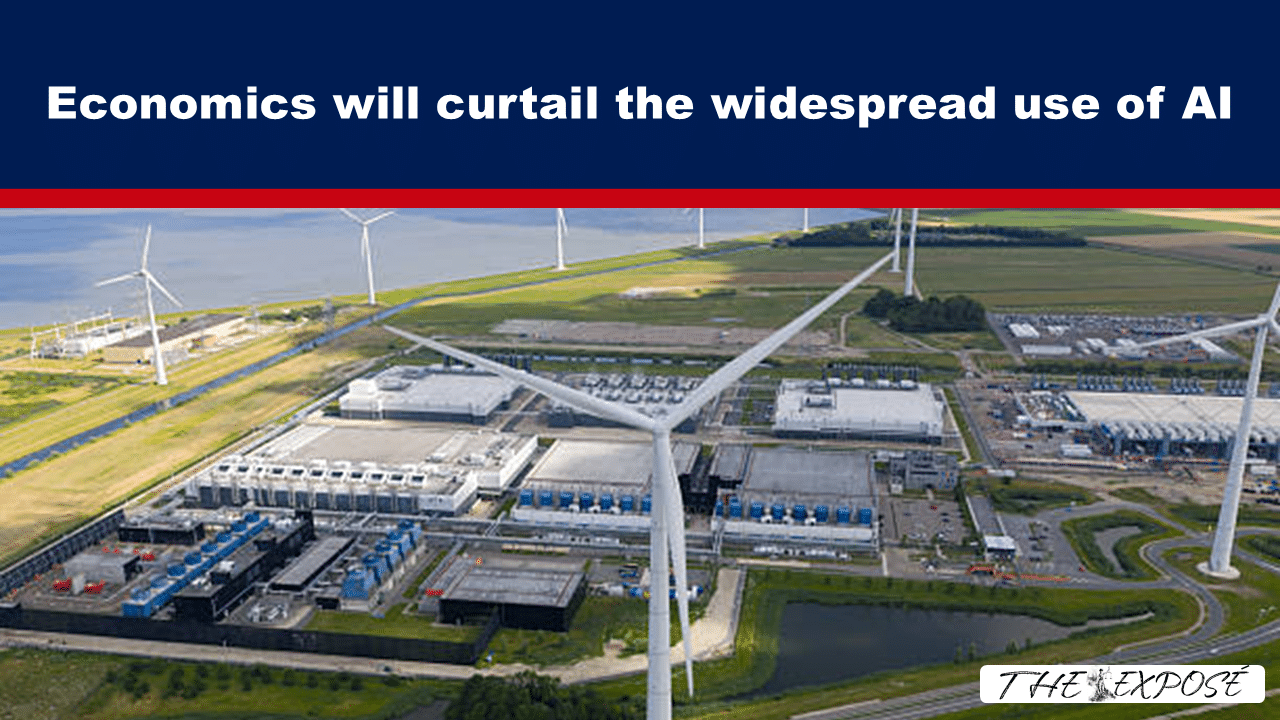
Feature image: Aerial view of a data centre in Eemshaven, The Netherlands. Source: iStock
The Expose Urgently Needs Your Help…
Can you please help to keep the lights on with The Expose’s honest, reliable, powerful and truthful journalism?
Your Government & Big Tech organisations
try to silence & shut down The Expose.
So we need your help to ensure
we can continue to bring you the
facts the mainstream refuses to.
The government does not fund us
to publish lies and propaganda on their
behalf like the Mainstream Media.
Instead, we rely solely on your support. So
please support us in our efforts to bring
you honest, reliable, investigative journalism
today. It’s secure, quick and easy.
Please choose your preferred method below to show your support.

Categories: Breaking News, Latest News, World News
There is no such thing as artificial intelligence. The word intelligence etymological implies ‘discernment.’ Its just not possible. They really should.call it something more appropriate- artificial ignorance or artificial insanity perhaps.
Ai is nothing more than a tool… An expensive tool can’t guarantee a good outcome.
It’s not the gun it’s the gunner!