














Nick Timothy, Member of Parliament for West Suffolk and Shadow Secretary of State for Justice, has reported David Lammy for unlawful discrimination.
Lammy, who is the Lord Chancellor, Secretary of State for Justice and Deputy Prime Minister, has proposed a ‘Public appointments diversity and outreach strategy’ which embeds a protected characteristics quota system for appointments within the Ministry of Justice.
Lammy’s plan is that the Ministry of Justice will hire according to race and ethnicity rather than competency and ability. In effect, Lammy wants to discriminate against competent white people because of their skin colour.
Let’s not lose touch…Your Government and Big Tech are actively trying to censor the information reported by The Exposé to serve their own needs. Subscribe to our emails now to make sure you receive the latest uncensored news in your inbox…
In December 2025, David Lammy was criticised by Amnesty International UK for attempting to reinterpret or restrict protections for people fleeing war, persecution or serious harm under Article 3 of the European Convention on Human Rights (“ECHR”).
Steve Valdez-Symonds, Amnesty International UK’s Refugee and Migrant Rights Programme Director, said: “There is a dreadful irony in our Justice Secretary working with his counterparts to remove or reduce rights on the anniversary of the Universal Declaration of Human Rights. It shows how far we have drifted from the moral resolve of the last century, when our grandparents determined that the fact we are all born free and equal must be protected in law.”
It seems Amnesty International’s criticism was not sufficient to cause Lammy, the critical social justice warrior, to pause his activism and learn about or respect human rights.
On Monday, Shadow Justice Secretary Nick Timothy reported Lammy to the Equality and Human Rights Commission (“EHRC”), the UK’s equality watchdog, for his proposed ‘Public appointments diversity and outreach strategy’ to align appointee demographics within the UK Ministry of Justice with the UK’s “economically active” (i.e. employed) population by 2028.
Related:
- David Lammy reported to equality watchdog over diversity appointment plan, GB News, 16 June 2026
- Lammy’s Ministry of Justice to Hire Without CVs and Force 90% of Interview Panels to Be “Diverse”, Guido Fawkes, 11 June 2026
Lammy’s proposal is tick-box diversity, which is discrimination, and he is embedding this discriminatory practise into the selection process for judges by choosing like-minded ideologues to make the decisions of who is hired.
Related:
- Sexual discrimination in medicine began in 1974
- Unlawful DEI discrimination policies lose momentum in the USA
- NHS DEI programme is hugely costly and disruptive
- Starmer will follow in the footsteps of Ardern’s “how to ruin a country”
Historically, the EHRC has supported Lammy’s discriminatory worldview. For example, after the Lammy Review on racial bias in the criminal justice system was published in 2017, the EHRC called for a “comprehensive race strategy.” So its understandable that people will be sceptical that the EHRC will take any notice of Mr. Timothy’s report. But for the public, at least, his letter to the EHRC is an important wake-up call.
In the UK, positive discrimination (also referred to as affirmative action, reverse discrimination or reverse racism) is unlawful. Skin colour, nationality and religions of minority groups or disabilities are not the only “protected characteristics”; being white, Christian and British are also protected characteristics.
The Equality Act 2010 protects everyone in the UK from discrimination. Protected characteristics include race, religion and sex.
Race, according to the Act, “includes colour, nationality and ethnic or national origins.” Section 50 of the Act gives examples:
- Colour includes being black or white.
- Nationality includes being a British, Australian or Swiss citizen.
- Ethnic or national origins include being from a Roma background or of Chinese heritage.
- A racial group could be “black Britons” which would encompass those people who are both black and who are British citizens.
Religion is a protected characteristic which includes “denominations or sects within a religion can be considered to be a religion or belief, such as Protestants and Catholics within Christianity,” the Act states.
Sex is also a protected characteristic and includes BOTH men and women.
Related: UK judges take identity politics to the extreme and issue sexist and racist sentencing guidelines
Excluding white people or men from a position or employment because of their skin tone or sex is unlawful.
“The Equality Act permits positive action only in narrow circumstances. It must address a documented disadvantage, different needs or disproportionately low participation. The department’s own figures show 57 per cent of its 2024 to 2025 appointments were women. That is a majority, not underrepresentation. The 12 per cent ethnic minority figure is compared against 17 per cent of the economically active population, but that is not the correct benchmark. The correct benchmark is the pool of qualified candidates, not the population as a whole,” Jim Chimirie tweeted.
Chimirie continued, “The Government’s own Equalities Office guidance is explicit. Creating schemes to benefit those with a particular protected characteristic, without evidence that the group is at a disadvantage or has different needs, is listed as an example of unlawful discrimination. So is requiring places reserved for those with particular protected characteristics on interview panels.”
When reporting Lammy to the EHCR Mr. Timothy highlighted similar. He questioned the lawfulness of Lammy’s plan, arguing it might constitute unlawful quotas or preferential treatment based on protected characteristics, rather than lawful positive action.
The following is a reproduction of Mr. Timothy’s letter to the EHCR which he posted on Twitter (now X).
Dr. Mary-Ann Stephenson, Chair of the Equality and Human Rights Commission, by email
15 June 2026
Dear Dr. Stephenson,
I recently wrote to the Justice Secretary regarding the lawfulness of the measures in the Ministry of Justice’s new “Public appointments diversity and outreach strategy.” I am writing to seek your view on the lawfulness of the measures it contains, specifically in relation to the Equality Act, and the limitations of “positive action” powers to promote diversity. I also request that you publish any legal advice taken on the lawfulness of these measures.
Are you able to confirm that if these measures do represent a potential breach of the Equality Act, or of the Public Sector Equality Duty, you will take appropriate legal action? And can you confirm that you would do this for any Government department, if it implements recruitment policies that are in breach of equalities law?
In particular, I am concerned that the recruitment policies and targets for interview panellists and public appointees may constitute indirect discrimination, contrary to s.19 of the Equality Act, through the introduction of unlawful quotas and rule-based preferences for candidates with certain protected characteristics I believe they may go beyond the “positive action” powers allowed for by s.158 and s.159 of the same Act. I set out my concerns in detail below.
The Government Equalities Office guidance on positive action makes clear that, unless actions qualify as lawful “positive action” exemptions, “taking action that deliberately and overtly advantages those with a particular protected characteristic over those without it would normally be unlawful under the [Equality] Act.”
It is also unclear whether setting targets for diversity among interview panels will necessarily improve diversity among appointees – or if so, why.
The target of 90% of panels showing “demonstrable diversity” goes beyond s.158 and 159 of the Equality Act by creating a de facto quota.
The strategy sets “an expectation that at least 90% of campaigns achieve demonstrable diversity on sift and interview panels, with panel selection informed by the current diversity of the board and any representation gaps … Any exceptions will require documented justification and quarterly senior oversight.”
The wording and case law relating to s.158 make clear that only “proportionate” measures qualify as lawful “positive action,” and that quotas are disproportionate. By imposing a rule that 90% of panels must fulfil diversity criteria, with non-compliance resulting in strict reporting and oversight measures, the department is creating a quota.
The strategy also says that panel selection will be “informed by the current diversity of the board, and any representation gaps.” This suggests that individual panel appointments will be made on the basis of a protected characteristic. S.159 makes clear this is only lawful in a strict tie-breaker scenario, where two candidates are equally qualified. It is not lawful to create a general rule favouring a protected characteristic.
In fact, the Equalities Office guidance explicitly lists “requiring places for those with particular protected characteristics are reserved on interview panels” as an example of an unlawful rule.
The 2028 “measurable reduction” target amounts to a quota and is unlawful.
The Ministry of Justice strategy sets as a target “a measurable reduction by 2028 in the representation gap for underrepresented groups compared to 2024/25 baseline data” among public appointees.
A target may be lawful if it represents a non-binding aspiration. However, if interpreted by decision-makers as a de facto quota such that individual appointments are made on grounds other than merit, beyond the limited s.159 “positive action” powers, it is unlawful.
By setting a time limit, those making decisions over appointments are effectively being asked to appoint based on the target rather than merit. A preference policy falls outside the scope of lawful “positive action” exemptions.
It is not clear that there is under-representation that would justify use of “positive action” powers.
Under the Equality Act, “positive action” measures may only be taken if (i) they seek to address a disadvantage connected with a protected characteristic (s.158(1)(a)); (ii) persons with a protected characteristic have different needs (such as disability) (s.158(1)(b)); or (iii) persons with a protected characteristic have “disproportionately low participation” (s.158(1)(c)).
According to the department’s own statistics, 57% of appointments were women in 2024-25. This is not “disproportionately low”, since it is more than half. While it is true that only 12% were from an ethnic minority background, compared to 17% of the economically active population as measured by the ONS, this is not the appropriate benchmark. Whether there is under-representation should be established not by comparison with the population as a whole but with the pool of sufficiently qualified candidates.
Equalities Office guidance lists as an example of unlawful discrimination: “creating schemes to benefit those with a particular protected characteristic, without any evidence that the group in question is at a disadvantage or has different needs”
It is not clear why addressing diversity within panels will achieve diversity among appointees.
It appears to be implied by the wording of the strategy that only a panel matching certain diversity criteria would be capable of making appointments in an unbiased way, or of achieving an appropriately diverse body of appointees.
For “positive action” to be lawful in this case, it must be designed to address “disproportionately low” representation. It is not clear that addressing the composition of panels is an effective measure for boosting diversity among appointees – or if it is, then why.
The measures risk breaching s.19 of the Equality Act by introducing indirect discrimination.
The 90% diverse panel target, the reporting and oversight requirements for non-compliance, the 2028 measurable movement target, and the incorrect demographic benchmarking to establish under-representation, all amount to unlawful indirect discrimination.
They do not conform to the strict requirements of the Equality Act’s “positive action” carve-outs, and will result in candidates being treated differently on the basis of ethnicity, gender or other characteristics.
Please can you disclose as a matter of urgency any legal advice you have taken on these measures, and explain publicly how they can be justified under sections 158 and 159 of the Equality Act? And will you disclose any advice the Commission has provided on this to the Secretary of State?
Yours sincerely,
Nick Timothy, MP for West Suffolk, Shadow Secretary of State for Justice & Shadow Lord Chancellor
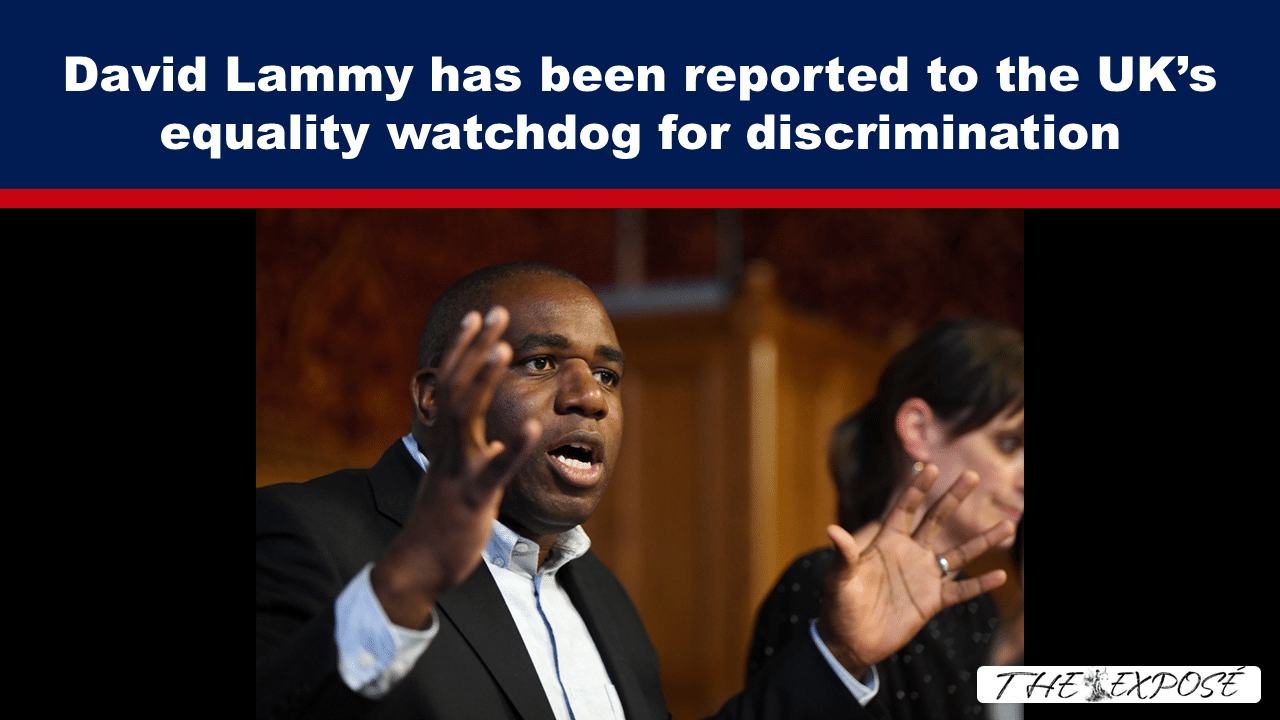
Featured image: David Lammy. Taken from ‘David Lammy: “There is no left-wing justification for Brexit”’ written by David Lammy and published by The New Statesman on 11 January 2019
The Expose Urgently Needs Your Help…
Can you please help to keep the lights on with The Expose’s honest, reliable, powerful and truthful journalism?
Your Government & Big Tech organisations
try to silence & shut down The Expose.
So we need your help to ensure
we can continue to bring you the
facts the mainstream refuses to.
The government does not fund us
to publish lies and propaganda on their
behalf like the Mainstream Media.
Instead, we rely solely on your support. So
please support us in our efforts to bring
you honest, reliable, investigative journalism
today. It’s secure, quick and easy.
Please choose your preferred method below to show your support.

Categories: Breaking News, Latest News, UK News
The UK and California seem to be following the same Marxist agenda:
California Launches Absurd Program Forcing Businesses to Prove They’re ‘Gay Enough’ for State Contracts
https://www.rvmnews.com/2026/06/california-launches-absurd-program-forcing-businesses-to-prove-theyre-gay-enough-for-state-contracts-watch/