














A recent study acknowledges that global rice production has nearly doubled in the last 50 years.
While the study notes that human ingenuity is the most important factor in this increase, it also notes that carbon dioxide is “the primary environmental factor … by enhancing photosynthesis and improving water-use efficiency.”
This should come as no surprise; higher atmospheric CO₂ concentrations allow plants to grow faster and use water more efficiently. CO2 is nature’s fertiliser.
Let’s not lose touch…Your Government and Big Tech are actively trying to censor the information reported by The Exposé to serve their own needs. Subscribe to our emails now to make sure you receive the latest uncensored news in your inbox…
Rice, CO₂ and the Climate Story the Media Keep Missing
By Anthony Watts, as published by Climate Realism on 16 June 2026
This Phys.org article, ‘Global rice production has nearly doubled over 50 years despite climate change’, reports good news that is couched in incredulity. The authors are correct to highlight this remarkable success story, and the data show that humanity has become dramatically better at feeding itself over the past half-century, even as atmospheric carbon dioxide (CO2) concentrations increased and the climate modestly warmed. What the authors miss, however, is the obvious conclusion staring them in the face: rising CO₂ and warmer temperatures have likely been part of the reason for that success.
For decades, the public has been told that climate change threatens global food production. Yet this new study from researchers at the University of Illinois reveals a striking reality: global rice production nearly doubled from the 1960s to the 2010s. That is not a story of agricultural collapse. It is a story of extraordinary human success.
The researchers conclude that improved management practices, including expanded irrigation, increased fertiliser use and better farming techniques, were the primary drivers of rising rice production. They are almost certainly right. Modern agriculture has become vastly more productive thanks to advances in technology, genetics, infrastructure and agronomy.
But there is another important factor highlighted in the study that deserves far more attention. The researchers acknowledge that rising atmospheric carbon dioxide was “the primary environmental factor contributing to increased rice production by enhancing photosynthesis and improving water-use efficiency.”
That finding should not be controversial. Carbon dioxide is not merely a greenhouse gas. It is also the fundamental building block of plant growth. Through photosynthesis, plants combine CO₂, water and sunlight to create the sugars that fuel growth and food production.
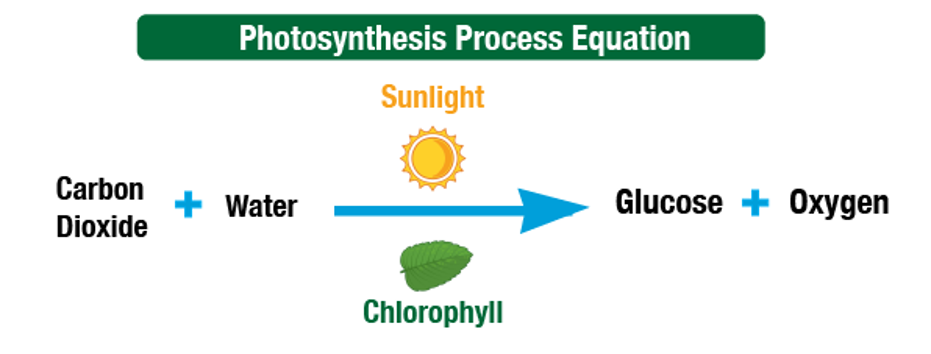
Without carbon dioxide, there would be no crops, no forests and no food chain.
For years, scientists have documented the CO₂ fertilisation effect. Higher atmospheric CO₂ concentrations generally allow plants to grow faster and use water more efficiently. Satellite observations have shown significant global greening over recent decades, with expanding vegetation across many regions of the world. Crops are part of that story.
Curiously, the study emphasises an estimated 7 per cent reduction in rice production due to climate-related factors from 2006 to 2015, while giving comparatively little attention to the fact that global rice production still nearly doubled over the broader period examined.
If climate change were the overwhelming threat to food production often portrayed in media coverage, one would not expect rice production to have increased by nearly 100 per cent over the same period. Instead, the world has seen rising yields, improved food security and the ability to feed billions more people than in previous generations.
The study demonstrates that environmental changes are not uniformly negative. In fact, the authors explicitly note that rising atmospheric CO₂ increased rice production by boosting photosynthesis and water-use efficiency. That point deserves to be front and centre, not a footnote to “despite climate change.”
The broader lesson is not that climate challenges should be ignored. Farmers have always adapted to changing conditions, whether those changes were driven by droughts, floods, temperature shifts, pests or market demands. Human ingenuity remains the most important agricultural resource.
What this study actually shows is that adaptation works. Improved farming practices have increased productivity. Better irrigation has expanded yields. New technologies have made agriculture more resilient. And rising atmospheric CO₂ has provided measurable benefits to plant growth along the way.
Taken together, those factors have produced one of the greatest agricultural success stories in human history.
Unfortunately, much of the climate discussion focuses almost exclusively on potential future harms while overlooking measurable present-day benefits. The result is a public narrative that often sounds far more pessimistic than the evidence warrants.
Rice feeds more than half the world’s population. According to this study, global rice production nearly doubled over the past 50 years and this is clearly evident in the figure below.
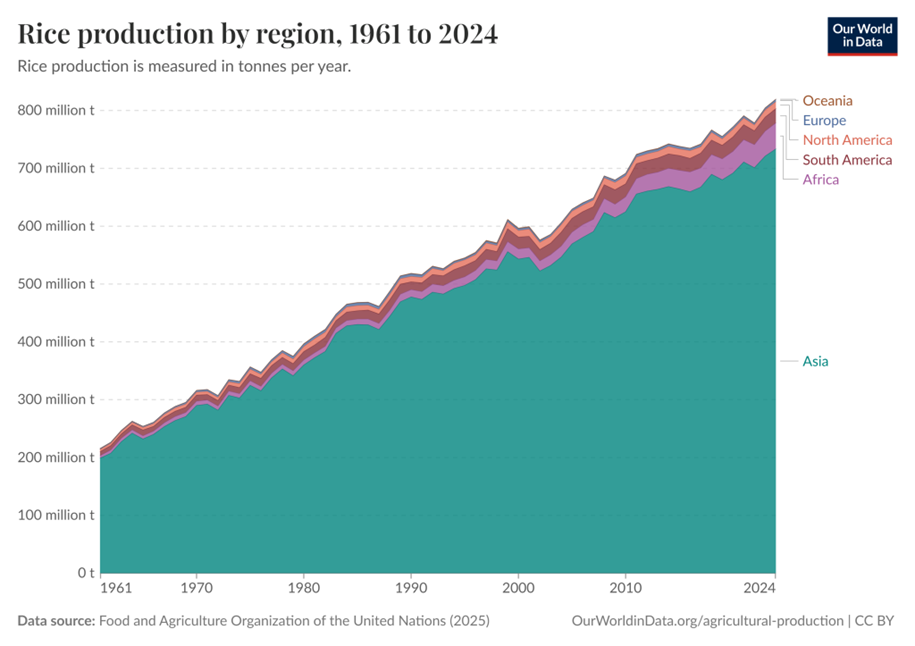
That is not evidence of a food system in decline. It is evidence of a food system that has become dramatically more productive and resilient. The researchers deserve credit for documenting that achievement. But the larger takeaway is even more significant than they acknowledge.
The combination of human innovation, agricultural modernisation and the fertilisation effect of rising atmospheric CO₂ has helped create a world that produces far more food than it did a half century ago.
That is not a climate crisis story; it is a success story.
About the Author
Anthony Watts is a senior fellow for environment and climate at The Heartland Institute. Watts has been in the weather business both in front of and behind the camera as an on-air television meteorologist since 1978, and currently does daily radio forecasts. He has created weather graphics presentation systems for television, specialised weather instrumentation and co-authored peer-reviewed papers on climate issues. He operates the most viewed website in the world on climate, the award-winning website wattsupwiththat.com.
Featured image taken from ‘Rice production milestone: India overtakes China as top global producer output hits 150 18 million tonnes’, Times of India, 4 January 2026
The Expose Urgently Needs Your Help…
Can you please help to keep the lights on with The Expose’s honest, reliable, powerful and truthful journalism?
Your Government & Big Tech organisations
try to silence & shut down The Expose.
So we need your help to ensure
we can continue to bring you the
facts the mainstream refuses to.
The government does not fund us
to publish lies and propaganda on their
behalf like the Mainstream Media.
Instead, we rely solely on your support. So
please support us in our efforts to bring
you honest, reliable, investigative journalism
today. It’s secure, quick and easy.
Please choose your preferred method below to show your support.

Categories: Breaking News, Latest News, World News
Since Rice only grows in warm tropical climates, it doesn’t make sense to consider a slightly warmer climate as bad for rice.
https://www.youtube.com/watch?v=0dZ6VklviC4
Could not post in right article.
[…] put that ridiculous idea to rest once and for all looking at Japan’s rice production. While global rice production has nearly doubled over the past 50 years through human ingenuity and the benefits of elevated atmospheric CO₂, […]
Probably no one here has heard of Masanobu Fukuoka? He was the son of a Japanese rice farmer and who trained as an agricultural scientist as a young man just prior to WWII. As someone in the food production services, and was not called up to enlist but stayed working at the agricultural laboratories. He was so fascinated with the “scientific method” that he worked himself into a near-death – but life-changing – enlightenment experience which made him realise that trying to force nature to do things is a waste of time, energy and resources, and that the best way of growing food was to work in harmony with nature as a steward and not as a domineering tyrant; and who left his career to go back to the farm and apply his understanding. He wrote two books – One Straw Revolution and The Natural Way of Farming. He noted that modern agriculture’s primary purpose is not food production but how to waste fuel. He developed a method of rice growing where he grew rice as a summer crop back-to-back with wheat as a winter crop for 40 years – without machinery, fuel or fertiliser or flooding his rice paddies to kill weeds, and only using hand tools – and he was getting yields as good as or better than conventional agriculture. He encapsulated the essence of food production into an “energy in/energy out” formula, and noted that conventional agriculture is a “nine energy units in to ten energy units out” system, where his method was a one energy unit in to the same ten energy units out. You’d think that the whole of our food production systems would be being transitioned to this method – particularly with all the drama about “climate change” – but, no; there’s no self-importance attached to being a humble farmer working with hand tools …..
Hi Chris,
I know somebody who grows rice.
She did not know what rice pudding was.
How strange is that, what else can you make with it ?