














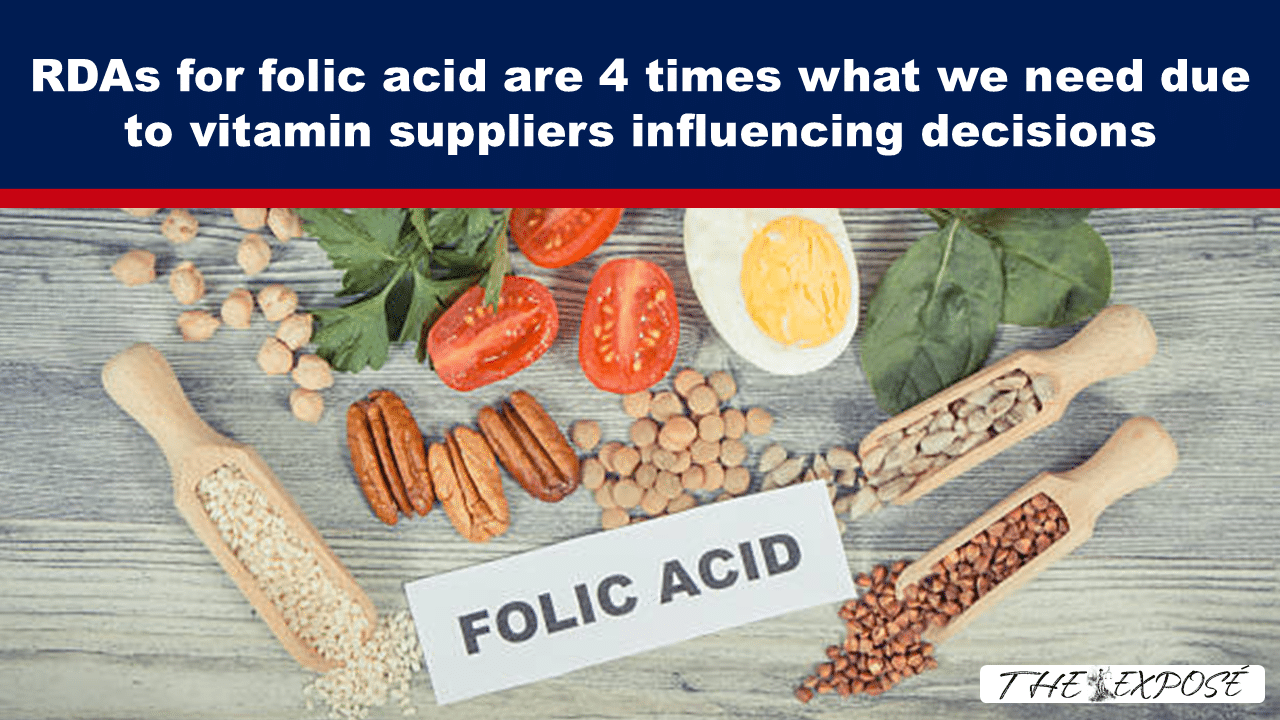
The body does not need 400 microgrammes of folate a day as supplement bottles, cereal boxes and government leaflets worldwide claim. The body only needs about a quarter of that amount.
How has the recommended daily allowance (“RDA”) increased so significantly over the years? Big Pharma and other supplement providers had their say.
Let’s not lose touch…Your Government and Big Tech are actively trying to censor the information reported by The Exposé to serve their own needs. Subscribe to our emails now to make sure you receive the latest uncensored news in your inbox…
From 13 December 2026, the UK government is mandating mass medication of the public with synthetic folic acid added to non-wholemeal wheat flour. Dr. Clare Craig has been publishing a series of articles to explain what we need to know about folic acid. The following is Part Two of her series.
What You Need To Know About Folic Acid Part Two: How 100 Micrograms Became 400
By Dr. Clare Craig, as published by Health ethics Advocacy and Research Team (“HART”) on 11 June 2026
Ask almost any doctor how much folate an adult needs to eat, and the answer will be 400 microgrammes per day. That figure is printed on supplement bottles, prenatal tablets, cereal boxes and government leaflets the world over, and it is repeated so reliably that it has taken on the authority of a biological fact.
The body does not need 400 microgrammes of folate a day. The real figure is almost exactly four times smaller, and the story of how the smaller number became the larger is a story of double-counting and industry influence on decision-making.
The First Panel
In 1989, the United States National Research Council published the tenth edition of its Recommended Dietary Allowances. Before then, the estimate of folate required had not been evidence-based but now there was funding to carry out the work to measure what the requirement was. The body loses about 50 microgrammes a day (μg/day). That is what we need. The evidence base suggested that 100 μg/day provided a substantial margin above deficiency. The eventual recommendation of 180–200 μg/day therefore represented not a demonstrated biological need for that quantity of folate but a precautionary adjustment for the assumed incomplete absorption of naturally occurring food folates.
However, while folate from animal sources is fully absorbed, folate from fruit and vegetables was reckoned at the time to only be about 50 per cent absorbed. On that basis, the panel set the allowance at 200 microgrammes for adult men and 180 for women. This doubling was to allow for the lower availability of the plant folate that made up most of the diet. Given that meat, eggs and dairy all contain folate that is fully available, it would be hard to find any diet that did not contain sufficient folate.
The Hundred-Microgramme Body
Folate is essential to life. Every cell uses it to build RNA and DNA and to switch genes on and off, and rapidly dividing tissues depend on it utterly. In those with a severe deficiency, the result can be severe anaemia and worse. Because it is so essential to every cell, the body is built to hold on tightly to the folate we have. It is not built to be at risk if we do not eat a predictable diet.
The liver alone stores somewhere between 10,000 and 30,000 microgrammes. Against a daily loss of around 100 microgrammes, that is months of reserve with no intake at all. The kidneys have receptors to actively reclaim folate to stop it from being lost in the urine. When folate runs short, those receptors increase in number so that even less escapes. In pregnancy, urinary loss also falls. The body keeps back what the baby, the placenta and the mother will need to grow. A nutrient this fundamental to cell function would be a reckless thing to waste, and it is not wasted.
The consequence is that reaching a deficient state is a challenge. It generally takes prolonged poor intake, malabsorption or alcohol dependency to produce it.
So how did we go from the 100 microgrammes that we need each day to replace losses to the claim that we need 400 microgrammes a day – an amount that no diet could ever achieve.
The Second Panel
Nine years after the first panel, in 1998, the Institute of Medicine produced the successor report. Alongside the usual US federal agencies, the 1998 panel was underwritten by a new source – the Dietary Reference Intakes Corporate Donors’ Fund. The donors were listed beneath it: Roche Vitamins, Mead Johnson Nutrition Group, Daiichi Fine Chemicals, Kemin Foods, M&M Mars, Weider Nutrition Group, and the Natural Source Vitamin E Association. Three of the seven had a direct commercial interest in the answer. Roche Vitamins was, at the time, the largest manufacturer of synthetic folic acid in the world. Daiichi Fine Chemicals also made it. Mead Johnson made infant formula, fortified with it.
In 1989, the folate allowance had been set by an independent panel of government-funded scientists. In 1998, this panel, part-funded by the manufacturers of synthetic folic acid, doubled it. They used the same reasoning that the 1989 panel had used to double the requirement from 100 microgrammes of absorbed folate to 200 microgrammes from fruits and vegetables. Only this time, they took the 200 microgrammes as if that was what the body required and doubled it to 400 microgrammes. The dose printed on every supplement bottle, every prenatal tablet, every box of fortified cereal and from December 2026, every sack of British white flour, descends from that 1998 number.
Worse, the 400 number has been translated into 400 microgrammes of folic acid which is all bioavailable. The consequence is that the daily dosing is four times higher than what the body requires and is on top of the 100 microgrammes which any diet already contains. Put plainly, the recommended dose is not topping up a small shortfall; it is the body’s entire daily requirement delivered four times over, on top of the folate already coming from ordinary food.
A 2006 study actually measured the folate absorbed from food. Their result put the figure for how much folate is absorbed from fruit and vegetables closer to 80 per cent. What we take from our food has been underestimated.
Industry had managed to hoodwink everyone into suggesting that we needed an amount four times higher than we need and, importantly, an amount that could never be achieved from any diet. The official recommended daily allowance made it look like we could not be healthy without eating industry’s supplements.
How Much Folate Is In Food
The simplest test of a recommendation is to hold it up against an ordinary plate of food. A serving of chicken liver carries 500 to 600 microgrammes of folate. A cup of cooked lentils, around 350. A cup of cooked spinach, more than 250. Asparagus, broccoli and beans all add their share. Even on the pessimistic absorption figures, a normal mixed diet routinely supplies far more folate than the body actually requires.
This is exactly why the 1981 Committee on Medical Aspects of Food Policy concluded that there was no public health problem of folate deficiency to solve. The panel argued correctly that food already supplies plenty of folate. Nobody needs a supplement.
About the Author
Dr. Clare Craig is a British Diagnostic Pathologist and medical researcher who worked in the NHS for 15 years before becoming a Consultant Pathologist in 2009. She is best known for her covid-19 research. She has worked pro bono since May 2020 to analyse covid pandemic data and distil evidence for lay audiences.
She is the author of two books: ‘Expired: Covid the untold story’ (2023) and ‘Spiked: A shot in the dark’ (2025).
Since January 2021, she has co-chaired the Health ethics Advisory and Research Team (“HART”) with Dr. Jonathan Engler, providing independent expert information on covid issues. She contributes to HART in a personal capacity.
The Expose Urgently Needs Your Help…
Can you please help to keep the lights on with The Expose’s honest, reliable, powerful and truthful journalism?
Your Government & Big Tech organisations
try to silence & shut down The Expose.
So we need your help to ensure
we can continue to bring you the
facts the mainstream refuses to.
The government does not fund us
to publish lies and propaganda on their
behalf like the Mainstream Media.
Instead, we rely solely on your support. So
please support us in our efforts to bring
you honest, reliable, investigative journalism
today. It’s secure, quick and easy.
Please choose your preferred method below to show your support.

Categories: Breaking News, Latest News, World News
Rhoda, thank you so much for this information. The evil elites are the one’s behind all this, especially Bill Gates. I don’t know if you are familiar with Billy -boy and his new farming schemes. First he is buying up farm land like it’s going out of style and he has been experimenting on corn and tomatoes and he is injecting them with mRNA. He started this back in 2021. I use no more corn or tomatoes, I even refuse to grow my own, because I don’t know what is in those seeds and plants.
Rhoda, this is for you. . She carries grace. She walks in strength, yet gentle in heart, a woman of purpose set apart. Through every trial she learns to rise, with faith that reaches beyond the skies. Her voice brings wisdom her hands bring care. . Her presence reminds the world that GOD placed something powerful there. Today I honor every woman who dared to believe, to grow, to lead, and to become.
Hi Isabel, that’s beautiful, it sent shivers down my spine as I read it. Thank you.
Oh how I wish I could be half the woman you describe – what a blessing I would then be to others.
I note your words, “Her presence reminds the world that GOD placed something powerful there.” You have inspired me to ask God that he helps me towards this goal.
May God bless you and keep you in His hands, now and forever more.
Our creator God is so wonderful, I just Love how he uses us to reach other brothers and sisters, whether it be by word or deed. He laid that little poem on my heart just for you, so run with it my sister in Yeshua. I hope you have a blessed day, and I hope to meet you in the air, very, very soon. Look up, pack up, because we are going up.
Hi Isabel, you say, “He laid that little poem on my heart just for you.” This must be why it sent shivers down my spine, i.e. the Holy Spirit was witnessing to me as I read it. Maybe God is going to make a better person of me than I could ever hope to be – Praise God!
Thank you for sharing it. I shall treasure it.
I believe that was the holy spirit that sent you shivers down your spine. God makes himself known to us when he speaks, and there is no denying when he touches us in certain ways. I am very, very happy you liked your little poem, be blessed my sister.
Just to also clarify. ‘Folic Acid’ is made in a laboratory and is completely synthetic. Folate is the natural version.
https://lpi.oregonstate.edu/mic/vitamins/folate
Just seen from your article (for which many thanks) that the bioavailability of the synthetic folic acid is higher than for naturally occurring folate – so if an individual’s intake is part synthetic s/he would need a total of less even than the original 100 mcg. You couldn’t make it up!
again i ask , what is this security varification stuff by cloudflare? i don’t understand could you explain it to me? thanks
Hi Phil Jones, I don’t know. But for the past two weeks our site has been coming under heavy, sustained bot attacks which is slowing down and peridoically crashing our site. I know our IT team is trying to find the best way to stop these happening. I’m guessing the security verification is one of the methods they’re trying. If you feel it’s necessary, please feel free to send a message to The Expose admin via the “contact us” tab and put your question to them.