














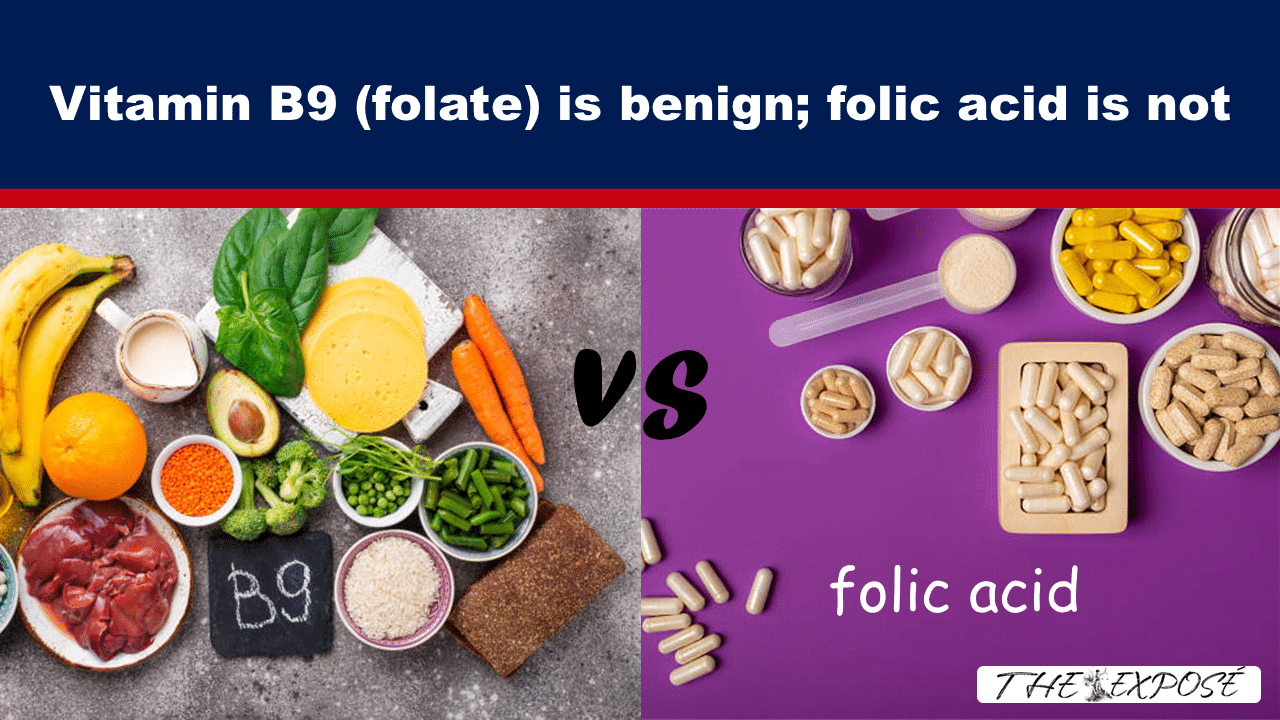
Folic acid is not the same as folate. Folate, or vitamin B9, is a naturally occurring molecule found in foods like spinach and liver, while folic acid is a synthetic, oxidised version.
The human body has difficulty converting folic acid into a usable form, leading to a buildup of unmetabolised folic acid in the blood.
The reason given for adding folic acid to flour is to protect pregnant women and their unborn children from to help prevent neural tube defects due to folate deficiency.
However, unmetabolised folic acid can block the receptor that transports folate to the brain, potentially leading to cerebral folate insufficiency, particularly in pregnant women, developing babies and young children.
“By forcing synthetic folic acid into the circulation [by e.g. adding it to flour], fortification may be producing windows of cerebral folate insufficiency in exactly the people it is meant to protect,” Dr. Clare Craig says.
Let’s not lose touch…Your Government and Big Tech are actively trying to censor the information reported by The Exposé to serve their own needs. Subscribe to our emails now to make sure you receive the latest uncensored news in your inbox…
From 13 December 2026, the UK government is mandating mass medication of the public with synthetic folic acid added to non-wholemeal wheat flour. Dr. Clare Craig has been publishing a series of articles to explain what we need to know about folic acid. The following is Part Three of her series.
What you need to know about Folic Acid Part Three: Folic Acid Is Not Folate
By Dr. Clare Craig, as published by Health ethics Advocacy and Research Team (“HART”) on 11 June 2026
In the previous article, I explained how the body only needs 100 microgrammes of folate to replace daily losses. The claimed recommended daily allowance of 400 microgrammes a day only came about once industry was involved in setting the allowance. This higher level is not achievable on any diet and makes the case for supplementation with folic acid for everyone. But it is not evidence-based.
Almost everyone believes that folic acid is simply another form of folate. One occurs in food, the other is manufactured, both end up in the same biochemical pathways – so why should it matter which one enters the body?
Folates found in spinach, lentils, liver, eggs or breast milk are chemically reduced molecules that the body can put to use straight away. The molecule being added to British flour is not. Folic acid is the oxidised, chemically stable version, built to survive storage and baking. In order to convert it into the reduced form that the body can use, it must pass through an enzyme, dihydrofolate reductase (“DHFR”), which is very inefficient and creates a bottleneck. The consequence is that the unnatural folic acid chemical circulates in the blood in its unmetabolized state for many hours.
The Human Bottleneck
In 2009, Bailey and Ayling published a careful study in the Proceedings of the National Academy of Sciences, using fresh human liver obtained at surgery or from organ donors. Human DHFR turned out to be extraordinarily slow. It processed synthetic folic acid 1,300 times more slowly than the natural folate it evolved to handle – roughly 0.08 per cent of its normal efficiency.
The comparison with the laboratory rat is worth dwelling on because the rat is the species on which most folic acid safety testing has been done. The human enzyme was, on average, 56 times slower than the rat’s at processing folic acid, with a range across individuals of 34 to 164 times slower. Different people’s livers varied fivefold in the rate at which the enzyme worked, which means an identical dose can have very different consequences in two different people.
Once the enzyme reaches full capacity or saturates, the backlog of unmetabolized folic acid (“UMFA”) starts to build. Bailey and Ayling calculated that a normal adult liver begins to saturate at around 330 microgrammes of folic acid. A single 400-microgramme tablet, or a single serving of fortified cereal, pushes it past that point in one go.
The Molecule That Shouldn’t Be There
A nationally representative US study by Pfeiffer and colleagues, drawing on the National Health and Nutrition Examination Survey, found detectable UMFA in 38 to 42 per cent of American adults even after a fast of ten hours or more. Close to half the adult population carries synthetic folic acid around in the bloodstream between meals.
The original rationale for fortification assumed that folic acid would promptly become folate. Instead, a great deal of it lingers, unconverted, and the lingering interferes directly with getting real folate to the place that needs it most.
A Receptor Built For Folate
The brain needs a steady supply of folate, and it gets it through a specialised transporter, folate receptor alpha, which concentrates folate against a gradient so that the cerebrospinal fluid normally holds two to three times more than the blood. The difficulty is that folic acid binds this receptor too – more tightly than natural folate does – and then it does not let go.
So, when blood folic acid rises, after a supplement or a bowl of fortified cereal or a sandwich made with fortified flour, the receptor becomes effectively blocked by UMFA, and the active transport of real folate into the brain stops. Cerebrospinal fluid folate falls and stays low until the liver has slowly worked through the backlog and cleared the receptor.
The irony is hard to miss. By forcing synthetic folic acid into the circulation, fortification may be producing windows of cerebral folate insufficiency in exactly the people it is meant to protect: pregnant women, developing babies and young children, during the hours when folate most needs to be reaching the developing brain. This is the most likely explanation for the awkward finding in the first article: that as folic acid use rose through the 1990s, the fall in neural tube defects slowed rather than quickened.
The Arithmetic of Pregnancy
Given the emphasis on pregnancy as a time when folate is important, it is worth us pausing to ask the most important question – how much extra folate does a pregnancy actually require? There are three aspects to consider: the folate built into the growing baby, into the placenta and into the extra blood, uterus and breasts of the mother. Using published estimates of foetal, placental and maternal folate accumulation, the total physically incorporated into new tissue across the whole of pregnancy is of the order of a few milligrammes. That works out at less than 20 microgrammes per day of pregnancy.
A woman having a normal diet plus a single 400 microgramme folic acid supplement each day for three months before pregnancy and until the baby is born would be taking in around 146 milligrammes of synthetic folic acid. The difference is stark. Add the exposure from fortified flour on top, and it becomes more extreme still. The developing baby’s folate receptors will be flooded with a molecule that binds tightly to receptors and blocks them.
Pregnancy is not the only risk babies face. Formula-fed infants receive two to five times their daily folate requirement at every feed, because infant formula is fortified with synthetic folic acid far above the natural folate content of breast milk, which sits at around 80 to 85 microgrammes per litre, almost all of it as natural methylfolate. A randomised trial that swapped natural L-methylfolate for synthetic folic acid in infant formula found markedly lower circulating UMFA and better folate status in the infants who received the natural form, with no difference in growth.
Why Synthetic, And Not Folate?
Food is all that is needed for adequate folate, including in pregnancy.
Where breastfeeding is not possible, formula does need folate. Natural L-methylfolate, the reduced, methylated form the body actually uses, the form found in orange juice, lentils and spinach. It can be added to tablets, to formula, to cereal, to flour. It needs no slow enzyme step. Why doesn’t everyone use that instead?
The answer is partly shelf life. Folic acid is cheap and almost indestructible; methylfolate is less stable, needs more care in formulation and costs a little more. Because it is less stable, there is less certainty about what dose is being given. The other difference is cost. Fortifying a loaf with the synthetic molecule costs a few pence less than fortifying it with the natural one. The difference for a tin of infant formula is the same order of magnitude.
The growing market in methylfolate supplements is itself a quiet admission of the problem. Clinicians increasingly recommend the reduced form precisely because it bypasses the bottleneck. It matters most for the large minority least able to handle the synthetic kind. In the UK and Europe, around four in ten people carry one copy of a common variant in a gene called MTHFR, leaving the enzyme that makes the body’s active, methylated folate working at reduced capacity. For them above all, being handed a synthetic precursor that must be converted before it can be used – rather than the active vitamin itself – is a poor bargain.
Back to 1875
You might think it is unlawful to add a synthetic product to organic flour. On 13 December, it becomes compulsory despite the fact that on the present evidence, nine babies are lost for every neural tube defect prevented.
The body did not evolve to handle 400 microgrammes of oxidised synthetic folic acid per serving. The enzyme that converts it cannot keep up with the doses being delivered. The receptor that carries folate to the brain is blocked by the surplus. Infants are being fed several times their requirement at every feed. And the NHS warns that whole categories of people must avoid folic acid altogether: those on methotrexate, those with undiagnosed B12 deficiency, those with certain cancers and kidney conditions.
In 1875, Parliament made it a criminal offence to put anything into bread that was injurious to health. That principle has never been repealed. It has simply been ignored.
Please sign THIS petition to Parliament to stop the addition of folic acid to UK flour.
To find out more about folic acid, read THIS website or listen to the interviews HERE and HERE.
About the Author
Dr. Clare Craig is a British Diagnostic Pathologist and medical researcher who worked in the NHS for 15 years before becoming a Consultant Pathologist in 2009. She is best known for her covid-19 research. She has worked pro bono since May 2020 to analyse covid pandemic data and distil evidence for lay audiences.
She is the author of two books: ‘Expired: Covid the untold story’ (2023) and ‘Spiked: A shot in the dark’ (2025).
Since January 2021, she has co-chaired the Health ethics Advisory and Research Team (“HART”) with Dr. Jonathan Engler, providing independent expert information on covid issues. She contributes to HART in a personal capacity.
The Expose Urgently Needs Your Help…
Can you please help to keep the lights on with The Expose’s honest, reliable, powerful and truthful journalism?
Your Government & Big Tech organisations
try to silence & shut down The Expose.
So we need your help to ensure
we can continue to bring you the
facts the mainstream refuses to.
The government does not fund us
to publish lies and propaganda on their
behalf like the Mainstream Media.
Instead, we rely solely on your support. So
please support us in our efforts to bring
you honest, reliable, investigative journalism
today. It’s secure, quick and easy.
Please choose your preferred method below to show your support.

Categories: Breaking News, Latest News, UK News
Thank you for this article. I hope this important information gets shared far and wide.
Dr John Campbell interviews Dr. Clare Craig
“They are contaminating our food”
https://www.youtube.com/watch?v=YVotKAXsLCE
40% of the population have some form of MTHFR – a genetic aberration that means they lack the enzyme to process folate. Adding synthetic folate to this is a disaster. The whole process of methylation is severely compromised and there are about 70 known conditions that are linked to this.