














UK power grid costs are set to soar even higher. Grid integration costs are already forecast to triple from £8 billion to £25 billion by 2030/31. Now, the government-owned National Energy System Operator (“NESO”) is asking for another £89 billion, beyond 2030, to spend on the grid for “transmission costs.”
The main driver of the increase in transmission costs is offshore wind, David Turver says. All these costs are added to consumers’ electricity bills; in other words, we are paying for it either directly on our household energy bills or indirectly through the cost of the goods and services we buy.
This madness needs to stop before net zero zealots completely destroy British industry and reduce the population to poverty.
Let’s not lose touch…Your Government and Big Tech are actively trying to censor the information reported by The Exposé to serve their own needs. Subscribe to our emails now to make sure you receive the latest uncensored news in your inbox…
Grid Costs Set to Soar Even Higher
By David Turver, 5 July 2026
Regular readers of Eigen Values will remember our recent article documenting the forecast rise in subsidies and grid integration costs from £19.8 billion in 2024/25 to over £40bn in 2030/31. Of this total, grid integration costs more than triple from £8 billion in 2024/25 to £25 billion in 2030/31. Grid integration costs consist of backup from the Capacity Market (“CM”) and grid balancing costs, plus the cost of running the high voltage transmission network.
The Low Carbon Contract Company (“LCCC”) has published its forecast showing CM costs are set to soar. NESO has recently published the costs of grid balancing for 2025/26 and has also recently made an announcement that indicates that transmission costs are set to rise further beyond 2030, as they called for a further £89 billion of spending on the grid beyond 2030.
All this extra spending will increase the cost of running the grid, pushing electricity prices even higher, meaning higher bills for consumers and businesses, pushing up the cost of living and damaging industrial competitiveness. Time to dig into what is happening in more detail.
Capacity Market
As shown in Figure 1, the annual costs of the Capacity Market have been rising sharply in recent years.
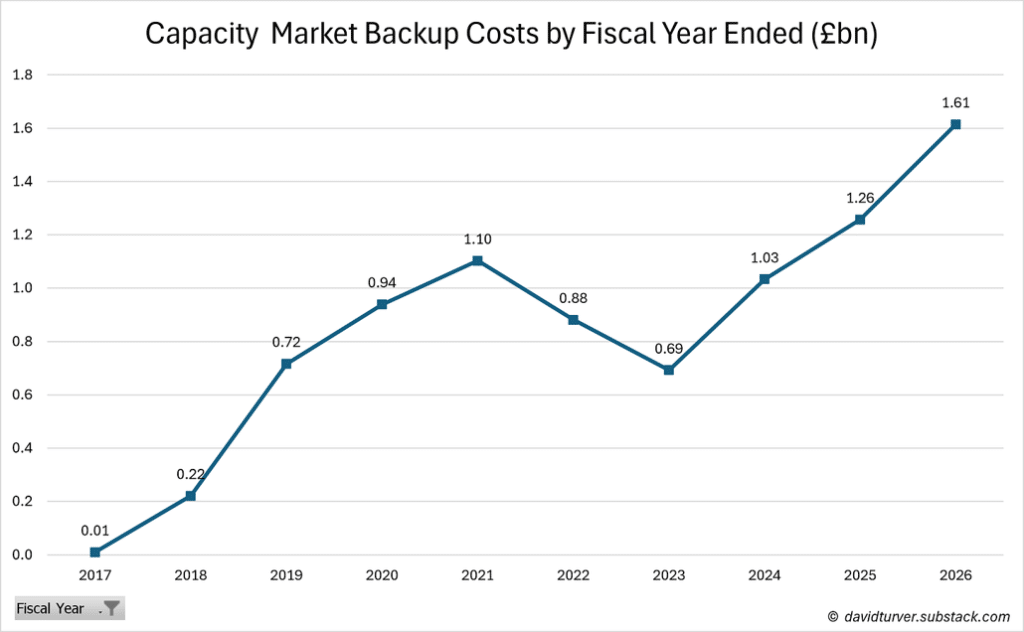
In the fiscal year ended March 2017, the cost of the capacity market was less than £10 million. Costs rose sharply to £1.1 billion in 2021 before falling in 2022 and 2023. Since then, costs have more than doubled from £0.69 billion in 2023 to over £1.6 billion in the year ended March 2026.
Unfortunately, these costs are set to rise further, as shown in Figure 2.
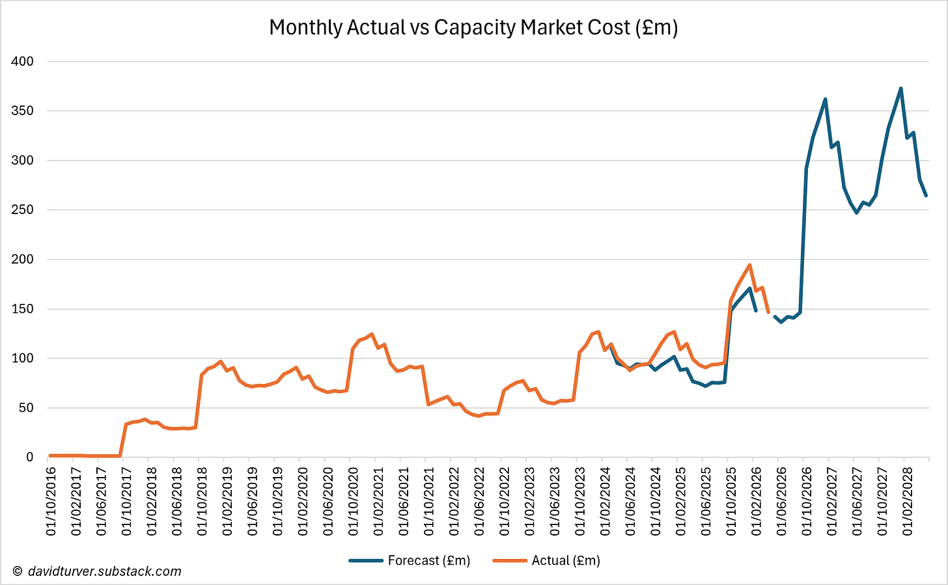
Actual monthly costs (orange line) were running at around £50 million from October 2021 before rising to about £100 million in October 2023, before jumping to around £150 million per month in October 2025. The forecast (blue line) shows monthly costs are set to more than double to a £250-370 million range from October 2026. Also note that for the periods where the actual and forecast overlap, the actuals tend to be higher than the prior forecast, so actual future costs may well be higher than forecast. Capacity Market costs are recovered through electricity bills, so we can expect this component of the price cap to rise sharply later this year.
Grid Balancing Costs
NESO is late in producing its full annual balancing report for 2025/26. Nevertheless, they do publish monthly figures, so it is possible to construct a dataset for that year. Figure 3 shows the trend of the last 12 months for each of the months on the x-axis.
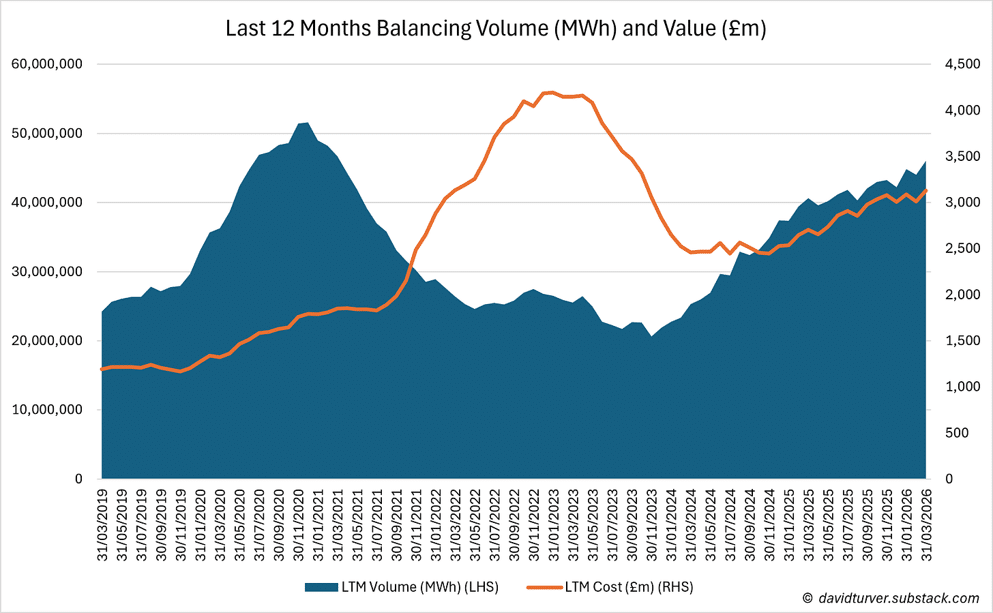
For the year-ended March 2026, the total cost of running the balancing system was over £3.1 billion, up from £2.7 billion in the prior year. The trend is very clearly upwards since the end of 2024. The total balancing volume is also up, reaching over 46m MWh (46TWh), and volume has been rising sharply since October 2023. Unfortunately, NESO projects the cost of grid balancing is set to soar to £6.4-£8.3 billion by 2030, before falling back in later years, as shown in Figure 4.
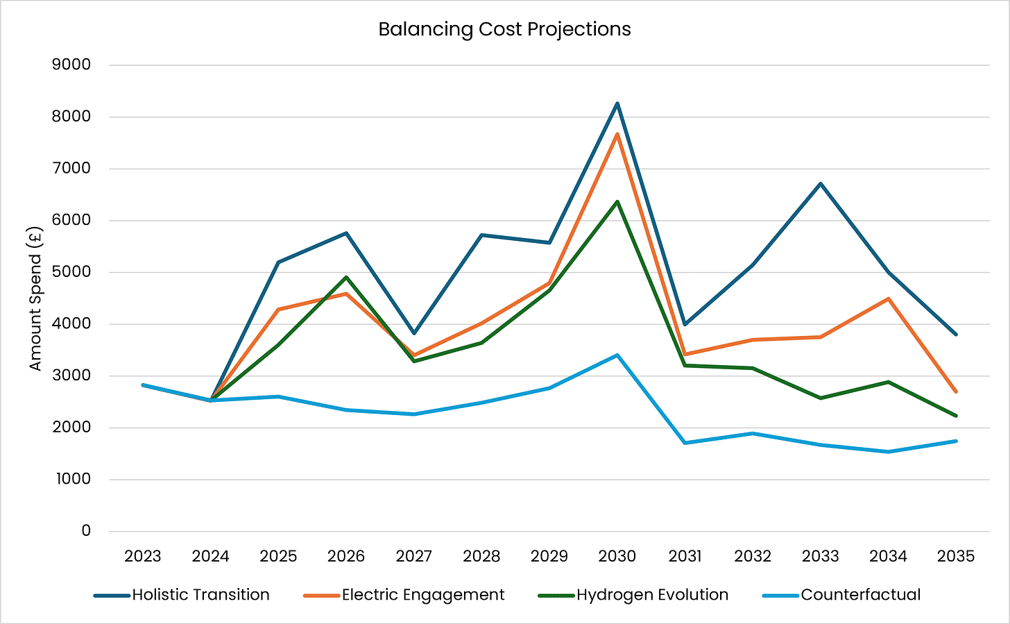
The one ray of hope is that balancing costs in 2025/26 were not as high as NESO’s projection, but nevertheless, they are still projecting costs to rise much higher in later years. Again, the costs of grid balancing are recovered through electricity bills, so we can expect this component of the price cap to continue to rise over the coming years.
Transmission Costs
NESO forecasts that transmission charges will more than triple from £4.2 billion in 2024/25 to over £13.6 billion in 2031. Their recent Electricity Transmission Update called for “a total of £89bn of network investment beyond 2030.” This means that the cost of the transmission network will continue to rise sharply beyond 2030. As shown in Figure 5, most of the extra grid lines are offshore links, and a significant amount of the existing network is offshore links too.
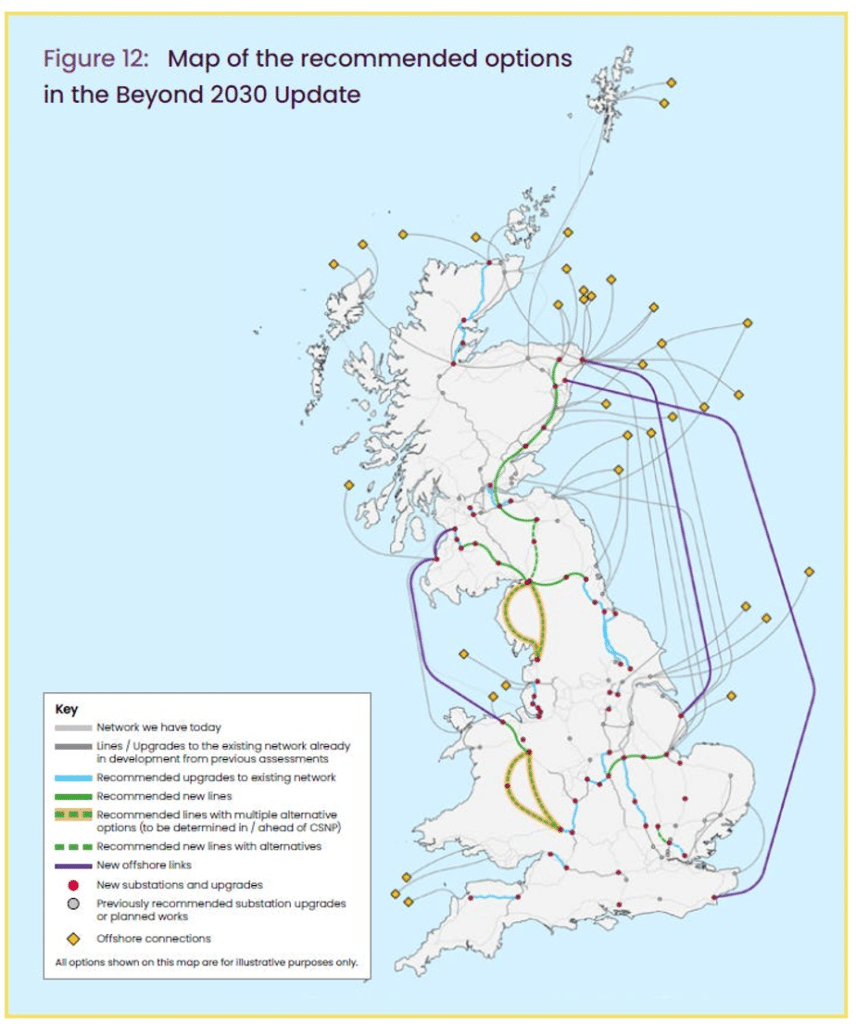
We can safely say the main driver of the increase in transmission costs is offshore wind. These costs should be borne by and attributed to the technologies driving the cost. Of course, transmission charges are recovered through electricity bills, so we can expect prices to continue to rise beyond 2030.
Conclusions
We already have the most expensive industrial electricity prices in the developed world. With rising subsidies and grid integration costs out to 2030, electricity prices are set to rise even higher. Even then, there will be no respite because NESO is asking to spend an extra £89 billion on the grid beyond 2030.
This is clearly unsustainable and must be stopped. In order to take 10p/kWh off electricity costs, a grid delivering 300TWh per year would need to cut costs by £30billion/year. Taking this amount of cost out of subsidies and grid integration would take the total £40 billion/year forecast for 2030 down to £10 billion/year, roughly the total in 2017. This is the scale of cost-cutting that is required to make UK electricity costs more competitive.
An incoming right-of-centre government will need to take swift and brutal action to save what is left of British Industry. Emergency powers are going to be needed to return to a rational energy policy. Laws need to be repealed, subsidies removed, contracts broken and assets left stranded. Stay tuned to [Eigen Values’] Substack over the coming weeks for ideas on how this might be achieved.
About the Author
David Turver is a British retired consultant, chief information officer and project management professional. He publishes articles on a Substack page titled ‘Eigen Values’ where he writes about contentious issues such as climate, energy and net zero. You can subscribe to and follow his Substack page, ‘Eigen Values’, HERE.
Featured image taken from ‘New publicly owned National Energy System Operator to pave the way to a clean energy future’, Press Release UK Government, 13 September 2024

The Expose Urgently Needs Your Help…
Can you please help to keep the lights on with The Expose’s honest, reliable, powerful and truthful journalism?
Your Government & Big Tech organisations
try to silence & shut down The Expose.
So we need your help to ensure
we can continue to bring you the
facts the mainstream refuses to.
The government does not fund us
to publish lies and propaganda on their
behalf like the Mainstream Media.
Instead, we rely solely on your support. So
please support us in our efforts to bring
you honest, reliable, investigative journalism
today. It’s secure, quick and easy.
Please choose your preferred method below to show your support.

Categories: Breaking News, Latest News, UK News
Oh my goodness, I am afraid this too will become global. We Americans feel your pain, we too are suffering from all the madness that is happening around the globe.
Hi Isabel,
You are correct again.
The UK is being destroyed from within, just like the US is being destroyed from within.
The people at the top keep forcing the lies about Global warming onto us.
They have destroyed our Coal mining industry, our Steel making industry, and our Electricity generating industry.
It all seems like a PLAN.
Yep, a plan from all the elites to all of us useless eaters. Just think when the elites do us all in, who will they turn to when they need a new automobile, home, housekeeping, gardeners, cooks?????? We know they are too lazy to do their own whatever it is they they need done. Now to all you folks who want t to come down on my Grammer, just remember I only try to get my point across. I am not a writer, nor am I good with Grammer. My profession is with animals.