














A Stanford professor has organised a statement calling on policymakers and technology leaders to build policies and institutions to address the rapid rollout of AI because it will disrupt economies.
Less than a week before, his work was cited in the UN’s first global report assessing artificial intelligence capabilities, risks and impacts. A report which reads like the UN is attempting to take control of the global narrative using AI.
But that’s not all. The professor’s institution at Stanford is a partner in projects involving human augmentation using AI and neuroscience.
Let’s not lose touch…Your Government and Big Tech are actively trying to censor the information reported by The Exposé to serve their own needs. Subscribe to our emails now to make sure you receive the latest uncensored news in your inbox…
Quartz published an article yesterday titled ‘Economists are coming around to the idea that AI really is killing jobs’, describing a statement released the day before by economists and researchers titled ‘We Must Act Now’. The statement warns that AI “could bring risks, including large-scale job displacement.”
It sounds as if these researchers and economists are finally talking sense. But the title of Quartz’s article is misleading, and the statement is a front. The giveaway is in the first paragraph of Quartz’s article:
More than 200 economists and researchers, including 15 Nobel laureates, released a joint statement on Monday warning that artificial intelligence could reshape the economy at a speed and scale exceeding the Industrial Revolution, and calling on policymakers and technology leaders to begin building policies and institutions to address the disruption. [Emphasis added]
“To begin building policies and institutions” is the key phrase; the rest is activism and fluffy language to say what they are doing without actually saying what they are doing. What the statement actually means is that policymakers and technology companies should create institutions to “govern” or control AI.
It’s not coincidental that last week, on 6 July, the United Nations (“UN”) held a “Global Dialogue on AI Governance.” Tim Hinchcliffe concluded that, rather than safeguarding information integrity as claimed, the UN is seeking to use AI to control the narrative globally: whatever they say goes, and everything else should be censored as misinformation or disinformation.
So, we dug a little deeper into who was involved in the UN’s “Global Dialogue” to see if there was a connection between the economists and researchers’ statement and the UN’s agenda.
The UN Reports
In 2023, as part of the United Nations Secretary-General’s ‘Roadmap for Digital Cooperation’, a High-level Advisory Body on Artificial Intelligence was formed “to undertake analysis and advance recommendations for the international governance of artificial intelligence.”
In September 2024, the Advisory Body released a report titled ‘Governing AI for Humanity’. This report informed the “Global Dialogue” held on 6 July 2026. Erik Brynjolfsson’s work on generative AI at work and productivity was cited in the Advisory Body’s report. Remember Brynjolfsson’s name, as it comes up again.
A few days before the “Global Dialogue,” on 1 July 2026, a the UN released a report titled ‘Preliminary Report of the Independent International Scientific Panel on AI’ (“Preliminary Report”). This report provides the first global “scientific” assessment of artificial intelligence capabilities, risks and impacts.
One of the sources used in the Preliminary Report was Stanford Institute for Human-Centred AI (“HAI”), from which the report used 3 papers/articles, and another was the Stanford Digital Economy Lab, from which the report used 1 paper/article. Additionally, the report used material from the Stanford Digital Repository, which “supports management of scholarly information resources of enduring value to Stanford University.”
Two of the Stanford entities used as sources, HAI and the Digital Economy Lab, have at least one person in common: Erik Brynjolfsson.
A biography for Brynjolfsson states:
Erik Brynjolfsson is the Jerry Yang and Akiko Yamazaki Professor and Senior Fellow at the Stanford Institute for Human-Centred AI (HAI), and Director of the Stanford Digital Economy Lab. He also is the Ralph Landau Senior Fellow at the Stanford Institute for Economic Policy Research (SIEPR), Professor by Courtesy at the Stanford Graduate School of Business and Stanford Department of Economics, and a Research Associate at the National Bureau of Economic Research (NBER).
Conducting a search in the text of the Preliminary Report for “Brynjolfsson” reveals that HAI and the Stanford Digital Economy Lab are not the only sources used that originate from or are affiliated with Brynjolfsson. Brynjolfsson’s name, specifically, appears 8 times in the list of sources:
- Brynjolfsson, E., & Mitchell, T. (2017). What can machine learning do? Workforce implications. Science, 358(6370), 1530–1534. https://doi.org/10.1126/science.aap8062
- McElheran, K., Yang, M.-J., Kroff, Z., & Brynjolfsson, E. (2024). The rise of industrial AI in America: Microfoundations of the productivity J-curve(s) (NBER Working Paper No. 32937). National Bureau of Economic Research.
- Brynjolfsson, E., Chandar, B., & Chen, R. (2025). Canaries in the coal mine? Six facts about the recent employment effects of artificial intelligence. Stanford Digital Economy Lab.
- Brynjolfsson, E., Li, D., & Raymond, L. (2025). Generative AI at work. Quarterly Journal of Economics.
- McElheran, K., Yang, M.-J., Kroff, Z., & Brynjolfsson, E. (2024). The rise of industrial AI in America: Microfoundations of the productivity J-curve(s) (NBER Working Paper No. 32937).
- Brynjolfsson, E., Rock, D., & Syverson, C. (2017). Artificial intelligence and the modern productivity paradox: A clash of expectations and statistics. NBER Working Paper No. 24001
- Brynjolfsson, E., & Hitt, L. M. (2000). Beyond computation: Information technology, organisational transformation and business performance. Journal of Economic Perspectives, 14(4), 23–48. https://doi.org/10.1257/jep.14.4.2
- Brynjolfsson, E., Rock, D., & Syverson, C. (2021). The productivity J-curve: How intangibles complement general purpose technologies. American Economic Journal: Macroeconomics, 13(1), 333-372.
We haven’t followed the source references to see how the report used these materials. But Brynjolfsson’s involvement in the UN’s reports is relevant because, as Quartz noted:
The statement’s significance lies partly in who signed it. Erik Brynjolfsson, a Stanford economist who helped organise the effort, said there has been “a notable change in the profession,” according to The New York Times.
So, Brynjolfsson’s work is cited in the 2023 report to inform the UN’s “Global Dialogue,” it is cited again in the Preliminary Report and, a week later, a statement “calling on policymakers and technology leaders to begin building policies and institutions” – organised by Brynjolfsson – is released. Coincidence?
Quartz names two others that The New York Times deemed worthy of noting:
Among those who put their names to the document are Daron Acemoglu and Simon Johnson – both MIT professors and 2024 Nobel economics laureates – whose earlier public scepticism about AI’s disruptive potential made their participation particularly striking, according to the Times.
Like Brynjolfsson, Daron Acemoglu’s work was cited in the Preliminary Report.
It would be interesting to check each of the “more than 200” signatories to Brynjolfsson’s statement and see how many of them have works cited in the UN’s Preliminary Report.
MIT, Stanford and the Committee of 300
MIT, which Quartz noted is where Acemoglu and Johnson hold professorships, is an acronym for the Massachusetts Institute of Technology. In the UN’s Preliminary Report, the MIT FutureTech’s AI Risk Repository/Incident Tracker is noted as one of two “independent AI incident databases” being maintained to track “how a system behaves after release, with real users, real tasks and real environments.”
Source material was also taken from MIT for the UN’s report, namely:
- Boine, C. (2023). Emotional attachment to AI companions and European law. MIT Case Studies in Social and Ethical Responsibilities of Computing (Winter 2023). https://doi.org/10.21428/2c646de5.db67ec7f
- MIT AI Risk Initiative. (2025). AI risk mitigation database and draft taxonomy. https://airisk.mit.edu/ai-riskmitigations
As with Brynjolfsson’s work, we have not followed through on these citations in the report to see what the UN was drawing from them or for what purpose. We merely want to demonstrate that MIT is among those that the UN turns to inform its decisions.
In his 1991 book ‘Conspirators’ Hierarchy: Story of the Committee of 300’, Dr. John Coleman wrote, “the Massachusetts Institute of Technology (MIT) [is] one of the premier The Committee of 300’s research-institutes.”
“The first Club of Rome’s ‘global planning contract’ went to the Massachusetts Institute of Technology (MIT),” he said.
At the end of the book Dr. Coleman lists MIT as one of the many institutions that is directly under the influence of the Committee of 300. “This major institute is not generally recognised as being a part of Tavistock USA. Most people look upon it as a purely American institution, but that is far from being the case,” he said and noted that one of MIT’s clients was the Institute for Defence Analysis (“IDA”).
“So vast is the reach of IDA that it would take hundreds of pages to describe the activities in which it is engaged, and IDA is fully described in my book on the role played by Institutions and Foundations in committing treason against the United States of America, which will be published early in 1992,” Dr. Coleman said.
In addition to The Committee of 300, Dr. Coleman wrote: ‘Diplomacy by Deception’ (1993), ‘One World Order: Socialist Dictatorship’ (2003), ‘The Tavistock Institute of Human Relations’ (2006) and ‘The Rothschild Dynasty’ (2006).
The upcoming book Dr. Coleman was referring to must have been ‘Diplomacy by Deception’ which is described as “an excellent companion book to the The Committee of 300 by the same author.” The opening chapter is titled ‘The Threat of the United Nations’.
On Sunday, we published an article focusing on the work of Stanford Research Institute (“SRI”), which began as part of Stanford University and then formally separated from the University in 1970. In our article, we provided an excerpt from Dr. Coleman’s book.
According to Dr. Coleman, SRI is also controlled and owned by the Committee of 300, under the umbrella of the Tavistock Institute of Human Relations, a British non-profit headquartered in London.
Read more: Changing images of man: Who funds and controls SRI International?
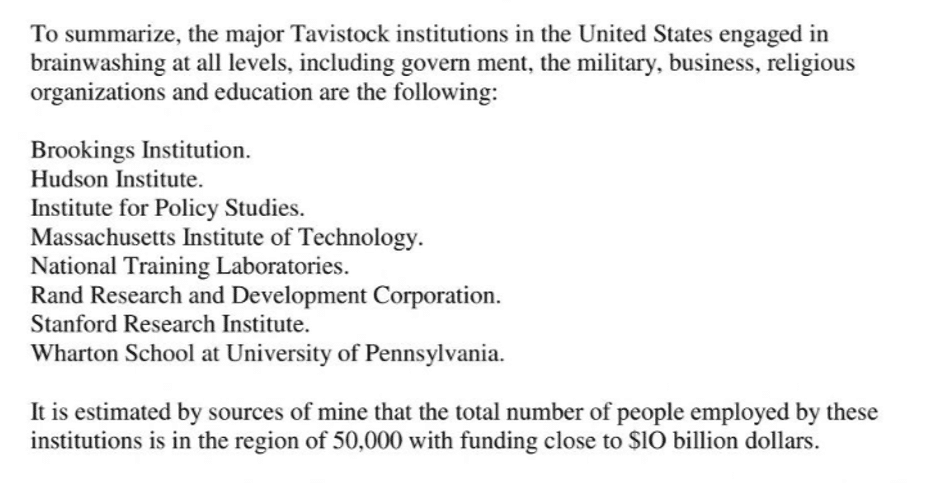
Dr. Coleman provided a list summarising “the major Tavistock institutions in the United States engaged in brainwashing at all levels”; MIT is among them:
Stanford and Human Augmentation
HAI is part of Stanford University and has no known/declared collaboration or affiliation with SRI, apart from both institutions coming under the Tavistock umbrella, according to Dr. Coleman. However, the two institutions’ work seems to be along similar lines, which makes one wonder if the historical ties, being Stanford University, have been completely cut.
Speaking of an SRI project codenamed SHAKY, Dr. Coleman wrote, “The massive electronic-brain in SHAKY was capable of carrying out many commands … Twenty eight scientists worked on what is called ‘Human Augmentation’ … By the 1980’s, 60% of SRI’s contracts were devoted to ‘Futurism’ with both military and civilian applications.”
In comparison, Stanford HAI’s “vision for the future is led by the commitment to promote human-centred uses of AI,” its website states. “In support of these goals, our research falls into three key focus areas: Human Impact, Augment Human Capabilities, and Intelligence.”
What do they mean by “Augment Human Capabilities”?
A summary on HAI’s about page explains: “AI has the potential to replace people in their jobs. But AI also has the potential to educate, train, and augment people, making them better at their tasks and activities,” a summary of “Augment Human Capabilities.”
It sounds fairly benevolent until we scan the “Major Milestones” at the bottom of HAI’s “about” page.
In 2023, HAI partnered with Wu Tsai Centre to fund research into AI and neuroscience.

Yale University’s Wu Tsai Institute is dedicated to understanding human cognition and exploring human potential through interdisciplinary inquiry.
“From the smallest building blocks of the brain to powerful algorithms of the mind, cognition is the source of all human knowledge and endeavours. Understanding it is the moonshot that brings us together,” the Wu Tsai Institute states.
And its latest blog, dated 6 June, is titled ‘A brain-computer interface that works with, not against, the brain’.
What kind of augmenting human capabilities does that sound like? Like the fluffy language of HAI trying to save people’s jobs kind? Or like human augmentation of the Fourth Industrial Revolution kind?
We have a right to know since Erik Brynjolfsson, a Professor and Senior Fellow at the Stanford Institute for Human-Centred AI (“HAI”) is informing the UN about “governing” AI globally, and then nudging policymakers and technology leaders towards “building policies and institutions” related to “governing” AI.
On a personal level, Brynjolfsson is not the only one who should be investigated for conflicts of interest. He is likely to be just one member of a small group, trapped in groupthink or enjoying the financial benefits a little too much, doing the same.
Related:
- Fourth Industrial Revolution will lead to fusion of physical, digital and biological identities – Schwab (2019)
- Schwab’s WEF is now pushing to implant Tracking Microchips in Humans as part of The Great Reset agenda
- Kissinger speaks from the grave: To avoid AI wiping out humans, people should be biologically engineered to work better with AI
- The founders of Bitcoin were transhumanists
- Human Augmentation Will Be the Death of Humanity
- Gene Therapy and Human Cyborgs: We Are Being Played Before We Even Know What the Playing Field Looks Like
Featured image: Erik Brynjolfsson, Stanford academic and author, explains how AI and people can complement each other. Source: The Financial Times
The Expose Urgently Needs Your Help…
Can you please help to keep the lights on with The Expose’s honest, reliable, powerful and truthful journalism?
Your Government & Big Tech organisations
try to silence & shut down The Expose.
So we need your help to ensure
we can continue to bring you the
facts the mainstream refuses to.
The government does not fund us
to publish lies and propaganda on their
behalf like the Mainstream Media.
Instead, we rely solely on your support. So
please support us in our efforts to bring
you honest, reliable, investigative journalism
today. It’s secure, quick and easy.
Please choose your preferred method below to show your support.

Categories: Breaking News, Latest News, World News
The Stanford economists are correct – that we need new institutions for the Fourth Wave AI era of a “laborless-value-added-economy”. But I believe Stanford’s economists are missing the central economic question: How do we objectively measure AI-generated wealth?
The Fourth Wave is the first economic era in which intelligence itself is becoming a measurable factor of production. The challenge is therefore not merely protecting jobs or regulating AI—it is developing objective methods for measuring, verifying, and settling the new wealth created by autonomous cognition.
Electricity, GPUs, data centers, and capital are necessary inputs, but they are not economic value. Value arises only when those physical resources produce independently verifiable increases in productive order.
Before we can decide how AI-generated wealth should be taxed, redistributed, or governed, we must first answer a more fundamental question:
How do we objectively measure AI-generated wealth?
Until economics develops institutions capable of distinguishing computation that merely consumes resources from cognition that demonstrably creates new economic order, we will continue debating distribution without first establishing a scientifically grounded measure of production.
That, in my view, is one of the defining institutional challenges of the Fourth Wave economy.