












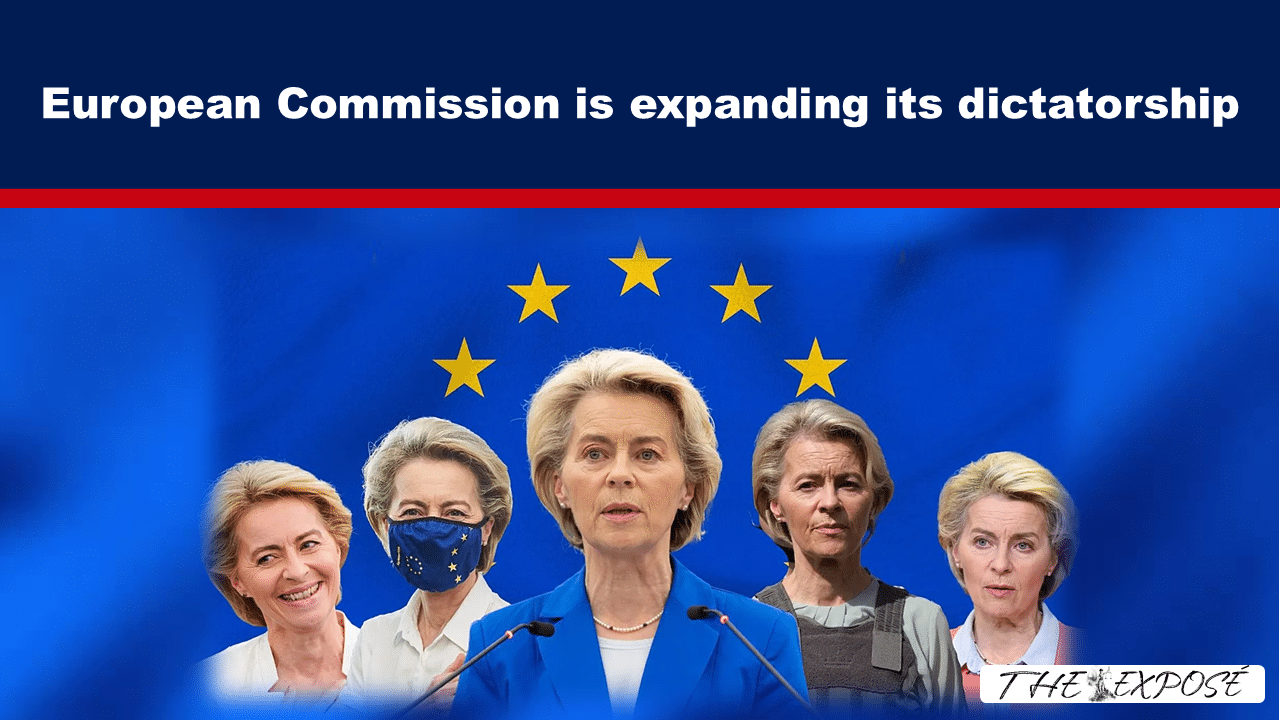
The European Commission has been gaining power at the expense of not only the Member States but also other European Union (“EU”) institutions.
One area where the Commission has been taking assertive steps is foreign policy. It has created its own parallel roles to the EU High Representative’s mandate for defence, space and the Middle East.
The EU High Representative is appointed by the European Council, which comprises the heads of state or government of all EU member states. It follows that the Representative’s mandate is given/approved by EU countries.
Usurping the EU High Representative’s role is nothing short of a power grab by Ursula von der Leyen and her European Commission.
Let’s not lose touch…Your Government and Big Tech are actively trying to censor the information reported by The Exposé to serve their own needs. Subscribe to our emails now to make sure you receive the latest uncensored news in your inbox…
The European Commission’s Power Grab
By Lili Zemplényi, as published by the Hungarian Conservative
According to Article 15 of the Treaty of the European Union: “The European Council shall provide the Union with the necessary impetus for its development and shall define the general political directions and priorities thereof.” While the Treaties originally intended the European Council – the forum of the Heads of State or Government of the Member States – to be the primary decision-making body of the European Union, in recent years the European Commission has taken the lead.
The European Commission’s growing power – at the expense of the Member States’ competences – is well documented. Thomas Fazi of MCC Brussels claimed more than a year ago that, “We have witnessed a game-changing transfer of sovereignty from the national to the supranational level, at the expense of democratic control and accountability.”
It is less recognised, however, that throughout this process not only the capitals have lost power, but some EU institutions as well. Most recently, the EU’s diplomatic corps – the High Representative and the European External Action Service – has been losing ground to the European Commission, which now appears intent on emerging as the EU’s foreign policy chief.
Officially, it is the EU High Representative for Foreign Affairs and Security Policy, currently Kaja Kallas, who “conducts the EU’s common foreign and security policy” and represents the EU in the world of diplomacy. Recently, however, the European Commission has taken increasingly assertive steps into this domain.
In 2024, the Commission introduced a new post, the EU Commissioner for Defence and Space, currently Andrius Kubilius, whose responsibilities overlap with those of the High Representative in security and defence matters. Last year, the Commission also established a Directorate-General for the Middle East, North Africa and the Gulf, further strengthening its capacity to intervene in foreign policy issues.
Ursula von der Leyen additionally sought to establish an intelligence cell under her direct supervision – a move reportedly opposed by Kallas, as it would have significantly reduced the High Representative’s room for manoeuvre.
The Commission’s appetite for creating parallel roles to the EU High Representative’s mandate has inevitably resulted in rivalry. The corruption scandal that shook the European External Action Service (“EEAS”) was widely interpreted as part of the intensifying institutional conflict between the High Representative and the Commission.
The EEAS – the EU’s diplomatic body – operates under the supervision of the High Representative, though it has never been entirely free from the Commission’s influence. In December, three officials associated with the EEAS were briefly detained on suspicion of involvement in a fraud case linked to EU-funded training programmes for junior diplomats.
Notably, figures mentioned in connection with the case – including former EU chief diplomat and Commission Vice-President Federica Mogherini and Director-General Stefano Sannino – were widely regarded as close affiliates of Ursula von der Leyen, a coincidence that further fuelled perceptions of intra-institutional rivalry rather than merely administrative failure.
Further reading: Mogherini Fraud Probe Threatens to Damage von Der Leyen above All, Hungarian Conservative, 3 December 2025
The removal of some of its affiliates did not discourage the European Commission from pursuing greater power in the field of foreign policy. The Commission’s recent legal initiative, the European Democracy Shield, also appears to weaken the functions of the EEAS and, by extension, those of the EU High Representative.
For years, the EEAS has run a project called ‘EU vs Disinfo’, aimed at “countering disinformation” – an objective that closely mirrors that of the Commission’s Democracy Shield initiative.
First, it is important to note that both the EEAS project and the Democracy Shield have been criticised as EU instruments of censorship, accused of monitoring, controlling and cataloguing unwanted online content. Second, the Commission’s effort to hollow out the EEAS’s existing project by creating a parallel, but better-resourced, mechanism is a clear indication of the Commission’s expanding role – and growing dominance – in the field of EU foreign policy.
Last weekend, the escalation of the conflict in Tehran highlighted the rivalry between the European Commission President and the EU High Representative. The European Commission and European Council Presidents issued a joint statement on the matter, while the High Representative released an independent statement on the clashes in the Middle East. The press releases were finalised without consultation between Kaja Kallas and Ursula von der Leyen. This lack of dialogue – or, if not worse, the apparent unwillingness to engage – clearly exposes the internal tensions between the High Representative and the Commission.
While the European Commission’s power grab is often romanticised as a way to enhance the EU’s capacity to respond to crises, in reality, it represents a form of centralisation that undermines Member States’ competences and weakens democracy. Member States’ veto rights, the European Council’s now hollowed leading role and the institutional balance between Commission President and High Representative were designed to ensure checks and balances within the EU. The Commission’s growing appetite to seize power across multiple fields is eroding the institutional balance enshrined in the Treaties.
Related articles from the Hungarian Conservative:
- EU Parliament Greenlights €90 Billion Loan to Support Ukraine
- US House Judiciary Report Exposes EU Commission Interference in Eight Elections
About the Author
Lili Zemplényi is a graduate of University College London (UCL). Currently, she is completing her MA at the Higher School of Economics. Previously, she worked as an intern at the Hungarian Academy of Sciences, Institute for Political Science.
Featured image adapted from ‘EU Commission: The 11 moments that defined Ursula von der Leyen’s presidency’, Euro News, 15 July 2024
The Expose Urgently Needs Your Help…
Can you please help to keep the lights on with The Expose’s honest, reliable, powerful and truthful journalism?
Your Government & Big Tech organisations
try to silence & shut down The Expose.
So we need your help to ensure
we can continue to bring you the
facts the mainstream refuses to.
The government does not fund us
to publish lies and propaganda on their
behalf like the Mainstream Media.
Instead, we rely solely on your support. So
please support us in our efforts to bring
you honest, reliable, investigative journalism
today. It’s secure, quick and easy.
Please choose your preferred method below to show your support.

Categories: Breaking News, World News
Ursula is far more dangerous and evil than most people realize. She is at the very head of the beast. The one in The Holy Bible. Thank you so much for covering this. I will share this. God bless you.
The beast, like Hydra, has many heads. Myth tells us we must cut every one off and cauterize the stumps so they can’t regrow.
And now these idiots are looking for a supply of oil from Russia! Because their bullshit green Co2 free dream is exposed and doesn’t work. After they closed down their nuclear and coal fired generators.
To all those Remainers… We told you so.
EU and EU Commission needs to be dismantled
Sounds like the EUSSR is tearing itself apart. The left always eats itself. I voted leave…
Governments have betrayed themselves and their people by joining trans-border organizations ruled by globalists elected only by each other. I didn’t vote for a UN or for an EU, nor for a Soros or Schwab or van der Leyden. They should suffer the fate they are trying to impose on us.
I’d rather be a free and independent cave man than a transhuman unisex slave under them.
[…] The European Commission has been gaining power at the expense of not only the Member States but also other European Union (“EU”) institutions. One area where the Commission has been taking assertive steps is foreign policy. It has created its own parallel roles to the EU High Representative’s mandate for defence, space and the Middle East.Read More: https://expose-news.com/2026/03/04/european-commission-dictatorship-expands […]