














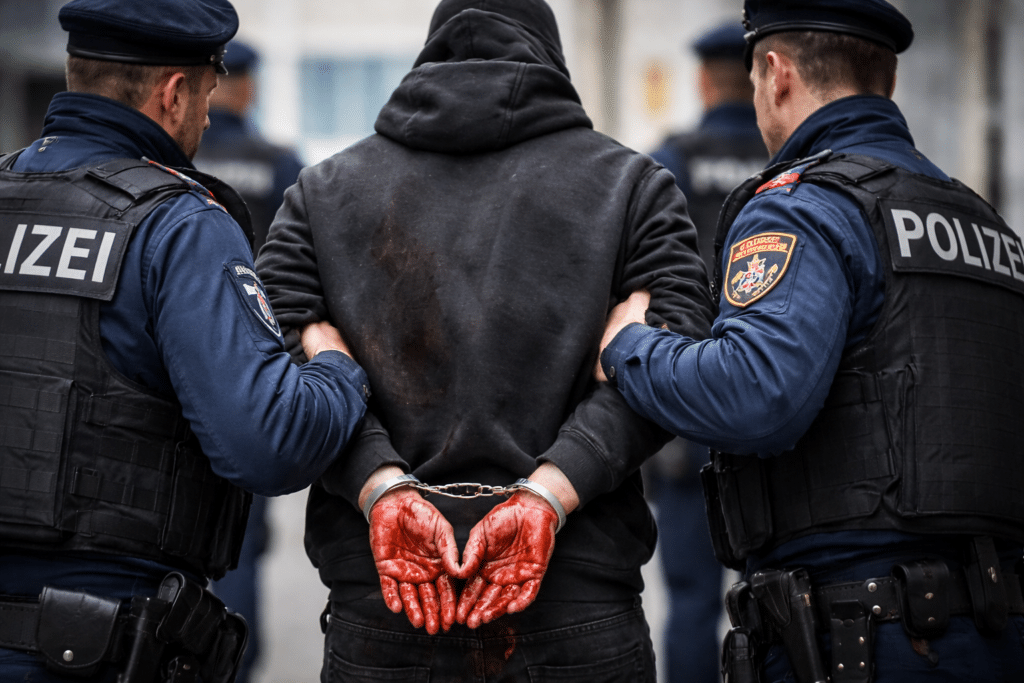
On Tuesday 7 April, a 23-year-old Afghan national was arrested for stabbing a man in the neck and shoulder in Austria. Local police are investigating the suspect on suspicion of attempted murder. The 32-year-old victim suffered multiple stab wounds that were later treated at Amstetten State Hospital, and police say the motive is currently unknown. This latest incident follows last month’s knife attack by a Moroccan man, and the horrific 2025 knife attack by a Syrian which killed a 14-year-old boy.
These are just some of the latest violent crimes committed in Austria by foreign nationals and highlight a concerning trend: while foreign citizens make up approximately one fifth of the country’s population, Interior Ministry figures indicate that non-Austrians made up half of 2025’s rape suspects. That discrepancy has become central to the country’s argument over migration, crime and public safety – and it goes far beyond Austria’s borders.
The Knife Attack in Pöchlarn, Austria is Yet Another Case
Reporting on Tuesday’s attack says the 23-year-old Afghan suspect used a folding knife on the 32-year-old victim before being arrested near a supermarket shortly afterwards and taken to St. Pölten prison. The motive was reported to be unknown, but Austrian reporting said the Afghan suspect was believed to have been intoxicated at the time.
This is not the first high-profile knife case in Austria to focus attention on a foreign national suspect. In February 2025, a 23-year-old Syrian asylum seeker killed a 14-year-old boy and injured five others in Villach. The suspect was arrested after the attack and one victim, a teenage boy, died at the scene. Austrian officials later said the suspect had radicalised rapidly online and had sworn allegiance to Islamic State.
Cases like these exert political force because they accumulate. Every government prefers to describe each incident as separate and fact-specific. Voters tend to read them as part of a broader pattern, especially when the same kinds of cases keep colliding with official crime data that already show disproportionate representation by foreign nationals in serious offences.
Foreign Nationals Commit More Rapes in Austria Than Ever Before
The strongest numbers in Austria’s current debate concern rape. Multiple reports show that foreign nationals accounted for 36.3% of rape suspects in 2015 and 46.9% in 2025. In absolute terms, the number of Austrian suspects rose from 438 to 609 over that period, an increase of 39%, while the number of foreign suspects rose from 250 to 537, an increase of 115%. Those are not marginal changes. They represent a marked shift in the composition of suspects over a decade.
Statistics Austria says foreign citizens accounted for 20.5% of the country’s population on 1 January 2026. In rape-suspect statistics, their share is nearly half. That is the comparison that now sits behind almost every serious Austrian argument about migration and crime. It is also why the issue has become harder to deflect with generic language about cohesion or tolerance.
The nationality breakdown deepens the controversy. According to the same Interior Ministry figures, Syrian suspects rose from just three in 2015 to 101 in 2025, making Syrians the largest foreign-national group among rape suspects. Afghans account for roughly 50 cases a year, while suspects from Turkey and Romania also appear regularly. The Interior Ministry has also said asylum seekers account for around 66 to 69 rape-suspect cases annually, though it does not separately record those granted asylum or subsidiary protection.
Austria’s Interior Ministry does not record “migration background” as a separate category. People with Austrian citizenship are counted as Austrian regardless of birthplace or parental origin. That means the foreign-national figures exclude naturalised citizens and count only non-citizens. Politically, that is an important detail because it means the official “foreign” category is narrower than the broader migration-background category often discussed in public debate.
The Pattern Continues Beyond Austria
The same broad question has surfaced elsewhere in Europe after a succession of attacks involving asylum seekers or recently arrived migrants. Earlier this year in Germany, a deadly stabbing in a park, carried out by an Afghan asylum seeker, intensified the migration debate ahead of the federal election. In August 2024, a Syrian man suspected of links to Islamic State was accused of carrying out the Solingen festival stabbing that killed three people and wounded eight, prompting Berlin to tighten asylum and security rules.
In April 2024, Germany’s government said overall crime had risen by 5.5% in the previous year and that the number of suspects with foreign backgrounds had risen by 13.5%. That announcement came with promises of faster deportations and tougher enforcement, reflecting the same political dilemma visible in Austria: governments trying to reassure the public while also acknowledging that the numbers have shifted in ways difficult to ignore.
In France, the Annecy knife attack – committed by a Syrian national – left four toddlers and two pensioners wounded. In the UK in 2024, a 70-year-old man was killed by a Moroccan national, Ahmed Alid, “in revenge for Gaza”. Alid also said he would have killed more people if he had had a machine gun or more weapons.
Meanwhile, Official Rhetoric Denies a Pattern
Governments and institutions often answer high-profile attacks with cautious language, identifying technicalities and emphasising that they be judged on a case-by-case basis. After the Annecy playground stabbings in France, authorities stressed that there was “no indication that terrorism was the assailant’s motivation”, and asylum experts were quoted urging caution against drawing broader conclusions from the suspect’s circumstances. In Germany, a more statistical form has been adopted, with a February 2025 report by the Ifo Institute finding “no correlation” at district level between a higher share of foreigners and higher local crime rates, despite violent migrant-linked attacks becoming central to election campaigns.
At EU level, the language is typically more managerial. When the European Commission proposed in 2025 that member states should be allowed to deport rejected asylum seekers to third countries with which they had no prior connection, migration commissioner Magnus Brunner said the measure would help governments process claims “more efficiently” while “fully respecting the EU’s values and fundamental rights”.
In short, the EU’s reflex to the issue is not to address structural security issues tied to mass migration, but rather to discuss administrative pressure, procedural reform, and value compliance. Across the continent, the public increasingly hears one thing from officials and sees another on the streets. The result is a widening gap between what voters know they are seeing, and the ways in which governments are willing to describe it.
Final Thought
Austria’s latest stabbing will be decided on its own evidence, but the public reaction to it is being shaped by something broader and more durable than one criminal investigation. When foreign citizens account for 20.5% of the population and 46.9% of rape suspects, and when similar attacks in France, Germany and the UK keep colliding with official efforts to narrow the frame, the argument moves beyond headlines and into the realm of political trust.
Europe’s voters are being asked to accept that there is no larger pattern, or at least no pattern they should name too directly, even as the figures and the case record continue to accumulate. Can our governments really go on insisting that what the public sees so clearly is not what it appears to be?
The Expose Urgently Needs Your Help…
Can you please help to keep the lights on with The Expose’s honest, reliable, powerful and truthful journalism?
Your Government & Big Tech organisations
try to silence & shut down The Expose.
So we need your help to ensure
we can continue to bring you the
facts the mainstream refuses to.
The government does not fund us
to publish lies and propaganda on their
behalf like the Mainstream Media.
Instead, we rely solely on your support. So
please support us in our efforts to bring
you honest, reliable, investigative journalism
today. It’s secure, quick and easy.
Please choose your preferred method below to show your support.

Categories: World News
You stupid MF’s are slow to come to the conclusion, your leaders have betrayed you and want you dead as you are not subservient to them, wake the hell up people. Deport every last one of these degenerates.
The motive is unknown? Who are you kidding? It’s a Muslim attempting to kill a non Muslim. Get these murderers out of western countries.
https://www.youtube-nocookie.com/embed/xhB0FHWlUe8 fight or leave