














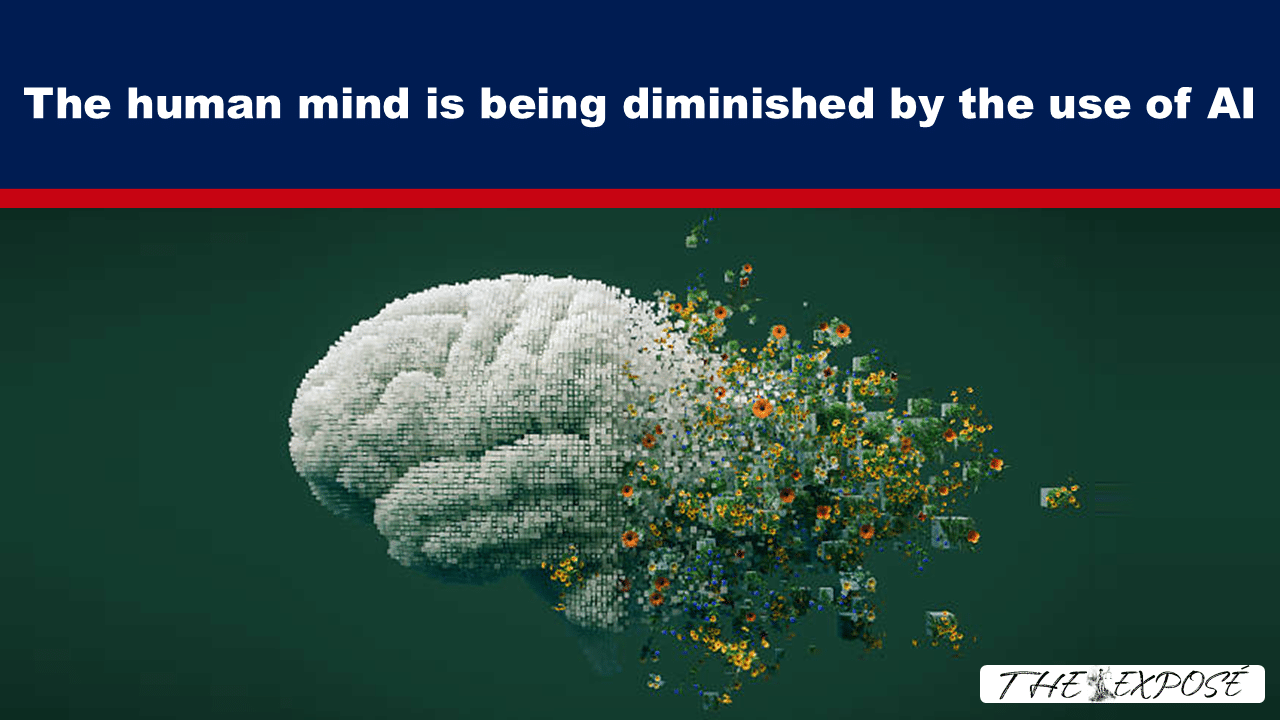
The human mind has a long history of innovative achievements. But its potential is being neglected in the age of technology, with luxury beliefs and AI being forced upon society by elites.
Our brains have abilities that are more powerful than any supercomputer or AI program, Dr. Hatchard explains. However, his solution is as dangerous to the human mind as is AI.
Dr. Hatchard suggests Transcendental Meditation (“TM”) is the solution, even going as far as suggesting it be introduced into New Zealand’s schools. But TM is a Hindu religious practise which centres around specific, personalised chants given by a Yogi.
Although chants are not inherently indoctrination, they can easily be used by cult leaders, authoritarian governments and other nefarious actors to brainwash people.
For humans to flourish, rather than Dr. Hatchard’s suggestion of seeking a higher level of consciousness, we need people to think for themselves and teach their children to do the same.
Let’s not lose touch…Your Government and Big Tech are actively trying to censor the information reported by The Exposé to serve their own needs. Subscribe to our emails now to make sure you receive the latest uncensored news in your inbox…
The Strange World of Luxury Beliefs, Artificial Intelligence and the NZ Economy
By Dr. Guy Hatchard, 29 May 2026
The human mind is truly amazing. Its history of innovative achievement stretches back far further in time than we imagined. The colossal and intricate megalithic structures excavated at Göbeklitepe in Turkey, and associated sites covering an entire region, were built 12,000 years ago, predating the earliest imagined beginning of complex social cooperation and agriculture. A 59,000-year-old neanderthal tooth found in a Siberian cave shows evidence of dentistry. 400,000-year-old fire pits found in Suffolk, UK, predate the supposed emergence of modern humans from Africa. Genetic research on ancient human remains has found that the human genes thought to be most associated with the development of speech and tool use are at least 1 million years old and probably more than 5 million years old.
Throughout this long history, cultural ideas, social patterns and spiritual practices have been honoured, which we should be anxious to protect as we rush headlong into the age of technology. Last week, Jack Clark, co-founder of the artificial intelligence (“AI”) giant Anthropic, told a gathering at Oxford University, “He wanted to encourage humanity to prepare for a technology that would soon be more capable than all of us collectively.”We politely disagree. In this article, we take a deep dive and explain how we should be doing more to nourish and develop our greatest resource – our consciousness.
Sadly, modern times abound with those who like to scoff at tradition and spiritual wisdom. “Luxury beliefs” are toxic ideas that some leading elites are trying to force upon us, when they themselves are so rich that they are insulated from any consequences of what they urge us to believe. The term has been coined by Rob Henderson, working at Yale University, who has defined them as ideas and opinions that confer status and cede control to the leading classes but often inflict real costs on the mass of those less privileged. For example, the idea that we should all be living in little boxes crowded together in cities when those developing them live in country mansions. An idea that makes little sense in beautiful New Zealand (“NZ”) with an abundance of space and opportunity, but one that seems to have been embraced by those planning our future.
I had a little chuckle yesterday when I read an article in The Washington Post entitled ‘The next Darwin moment has arrived’. The author, John MacCormick, who is a professor of computer science educated at the Universities of Auckland, Cambridge and Oxford, echoes many of the absurd claims of the leading billionaire gurus of AI who are dreaming that computer programs can now emulate the entire range of human thought, including creativity and intuition.
I laughed not just because Google AI once again failed to correctly tell me when the next full moon occurs, but because of the blinkered nature of a statement in the article:
“Life itself was once thought to have a unique quality that distinguishes it from inanimate matter. This theory, known as vitalism, died out in the early 20th century and today has no scientific credibility: Modern biochemistry has revealed that all life can be explained in terms of physics and chemistry.”
Actually, I am afraid that AI might lead us to neglect our brains, thus draining the last drop of vitality out of life. Moreover, contrary to MacCormick’s claim, no biotechnologist, physicist or chemist working today knows exactly or even roughly how our DNA supports the expression of human consciousness.
At this point, the rapid rollout of AI seems inevitable; it is already happening. So, what can we do to counter machines that seem set to control our lives? There is a lot of talk about protecting children from the effects of AI-driven social media. The UK Telegraph reports the terrifying rise of schoolboys as young as 12 making AI girlfriends that are driven by chatbots. You can ask just how they will view girls as they grow up? We can also ask, is it just possible that adults need protecting too? The sad truth is that computers are so pervasive and easily adapted, while people themselves are of so many opinions that no legislation has a chance of working.
The answer lies in the full development of our human potential. In our recent Substack articles ‘The Sacred Cell and Conscious Genes’ and ‘The Structure of Consciousness’, we explain how our nervous system supports the expression of a connected, self-referral property which lies at the heart of the universe. Through the exploration of our consciousness, we can tap into the cosmic power that drives the process of evolution. We have latent abilities that are not yet developed, just waiting to be unfolded. Meditation can unfold a super coherence that is evident in EEG brain wave measurements , which suggest an increasing harmony with coherent quantum states that characterise the laws of nature. Meditation can harness these laws to support our life. The measured result is more intelligence, creativity and well-being. In other words, the brain has abilities that are more powerful than any imagined supercomputer or AI programme, because it can interface directly with the natural law that governs the universe.
Note from The Exposé: “Natural law” is a term that means different things to different people. In a previous article by Dr. Hatchard, which we republished under the title ‘Proposed US bill places genetic engineering under the direct control of NATO’, we questioned what he meant when using the term “natural law.” We concluded that he is using the term according to a quasi-religious, quasi-scientific belief that Natural Moral Law and collective consciousness are connected in such a way that, its proponents believe, collective consciousness is not merely social but moral and evolutionary, reflecting a deeper, shared moral order. The fundamental flaw with this concept is that science is not a religion and religion is not a science. In the previous article, we concluded that Dr. Hatchard is following a religious belief masquerading as philosophy and/or science. While reading this article, we recommend our readers bear this in mind to enable them to separate the religion from the science.
The human brain is a remarkable organ; its trillion cells support the expression of human consciousness. These cells have more interconnections than there are atoms in the universe, yet it is all contained within a space roughly the size of a litre of milk. In contrast, to begin to mimic some of the most basic thinking properties of humans, even one modern AI data processing centre covers the size of 3,800 football pitches. These processing centres are so energy hungry that they are pushing the price of electricity up all over the world, and they run so hot that they need millions of gallons of water every day for cooling. This is depleting the planet’s supply and competing with basic human needs.
This week, following similar closures around the country, two sawmills are threatened with closure in Kaitaia, largely because of the rising cost of power. Both our NZ electricity producers and the saw mills themselves are owned by overseas interests, which gives the lie to the luxury belief that free trade and the global economy are always going to benefit NZ. Fiscal projections calculated at overseas computer terminals are dictating closure and the loss of Kaitaia’s employment lifeline because AI doesn’t have a Kiwi soul. Essential NZ infrastructure needs to be owned by Kiwis; overseas interests don’t care about us and probably never will.
Whilst AI can carry out some repetitive calculations and investigate complex permutations, which might be a good thing, it is also replacing rewarding creative professions, including graphic designers, animators, video producers, fashion photographers and many other skilled jobs. Too many of the new jobs being created by AI will increasingly revolve around maintaining data centres. These are filled with endless banks of computer machines that, as they grow older, will need a lot of technicians to keep them “alive” through painstaking and crushingly boring repetitive repair work. In this way, AI is not all roses; it threatens to turn humans into slaves of machines.
Contrast this with the human brain, each of its trillion cells is automatically repairing itself tens of thousands of times a day without the need of a technician, just three meals a day is sufficient. Each day, our consciousness naturally cycles through rhythms of waking, dreaming and sleeping without which it would fall apart. Unknown to John MacCormick, science has verified the existence of a fourth major state of consciousness – transcendence – which has long been recognised by many cultural and spiritual traditions around the world. This is an expanded state of consciousness, in which the mind is completely awake but silent, like an arrow drawn back on a bow full of potential but unmoving, about to zoom forth. In this cosmic ground state of consciousness, the essential truth of life is realised and future boundless achievement unfolds.
Transcendental Meditation (“TM”) is a silent, mantra-based meditation technique developed in the 1950s by Indian Hindu teacher Maharishi Mahesh Yogi.
In 1972, the Maharishi announced his “world plan” for a new human future, which became the foundation for the World Plan Executive Council, the international organisation that guided the spread of Transcendental Meditation worldwide. He also founded Maharishi International University (now Maharishi University of Management) in Iowa and other campuses globally, established the transnational political party called the Natural Law Party in the 1990s and created the Global Country of World Peace in 2000, a world government organisation that aims to promote transcendental meditation, education and the construction of “buildings for peace” in the world’s major cities.
Claims that TM is not a religion are debatable. It is rooted in Hindu traditions (specifically Advaita Vedanta) and uses Sanskrit mantras. Critics, including some Christian organisations and legal scholars, argue it is a form of Hindu meditation disguised with scientific language. “The similarities between the practice of transcendental meditation and the practice of religious prayer rituals cannot be denied,” Got Questions points out. And Apologetics Index says, “For many, nearly everything about TM seems religious – especially devotees’ gathering daily in a sacred place before a portrait of a leader addressed as ‘his holiness’.”
TM is practised for 15–20 minutes twice daily while sitting comfortably with eyes closed. It is taught exclusively by certified teachers through a standardised course, during which students receive a specific mantra – a sound or word without meaning – chosen for them.
Although chanting is not inherently brainwashing, it can be misused as a tool for mind control and indoctrination in specific high-demand groups, cults or authoritarian contexts.
“Repetitive chanting may make some people more ready and willing to adopt suggestions from others, especially when there is psychological stress or emotional buildup,” Skeptic Meditations warned in its article ‘Chanting: Brainwash, Indoctrination and Groupthink?’.
In an article published on LinkedIn titled ‘Brainwashing and Dark Psychology’, Indian data scientist Tejas Malpani noted that chanting a similar statement over and over again is a good way of controlling a person and obtaining blind obedience.
List Verse noted that “in cults the persistent repetition of short intonations is designed to become mind-numbing, eliminating logical thinking and inducing a trance state … hypnosis through chanting is a tool used by cult leaders to erode critical thinking abilities rather than for meditative purposes.”
Colleen Russell, a survivor of what she calls a “high demand group,” said that the group leader used chanting to relax the mind and focus the group’s energy. “But it was misused, as I now realise, because the focus during chanting was on the image of the cult leader … We were instructed to chant if we felt upset, for instance. The same if we were having a hard time.” This led to an inability to critically think through problems, a core life skill, as well as an inability to process and sift through emotions. It also created a sense of euphoria when thinking of their leader, positioning him as the answer to all of their problems.
In summary, repetitive chanting can induce a trance-like state or altered consciousness, which lowers critical thinking and increases suggestibility. This makes people more receptive to new ideas or doctrines without rational analysis. Additionally, chanting creates a strong sense of oneness and group identity. In negative contexts, this can lead to groupthink. And the practice of chanting releases neurochemicals like endorphins and oxytocin, creating feelings of euphoria and bonding. Manipulative leaders can exploit this by associating these positive feelings with the leader or ideology, fostering dependency and loyalty.
Be careful what you chant. Protect your mind as well as your body.
We are suggesting that our education system add this fourth state of consciousness to the daily routine, which can be achieved through a short period of meditation. Studies show the results can be outstanding, including increased academic achievement and improved well-being.
Note from The Exposé: The “fourth state” Dr. Hatchard refers to is the fourth of the seven levels of consciousness identified by the Maharishi. His suggestion that this be exploited in schools is dangerous. On the other hand, governments and Globalists would love Dr. Hatchard’s idea; it will give them and others following cult-like ideology carte blanche, without oversight, to indoctrinate, and even brainwash, children from a very young age through the education system.
What children need to be taught at school is how to think, not what to think. Besides, Dr. Hatchard’s suggestion may already be happening. Read ‘Chanting in school: brainwashing or useful memory tool?’ published by The Telegraph on 23 November 2013.]
The luxury belief that AI is the new Darwin is drawing the wool over our eyes. Sadly, AI is stuck with the process of data mining of stored information. Given the ever-evolving nature of the universe, this can amount to leafing through yesterday’s trash of failed ideas. Contrast the burgeoning, destructive military applications of AI systems with the tireless work of Gandhi or Mandela, who peacefully brought freedom to their nations, or the deep compassion for all creation exhibited by St Francis of Assisi. No computer could replace their timeless wisdom.
So don’t give up on your brain, it is our best friend and most powerful computer, the fountainhead of joy and accomplishment and, crucially, it has a vast reserve of untapped potential. An article in the UK Times headlines ‘Universities ‘are surrendering’ in the fight against AI cheating’. It reports that universities are giving up and waving the white flag – students can now write an essay without reading a book and get an A grade. So, is AI preparing a generation to swallow an illusion of knowledge? The UK Telegraph echoes this fear with an article demanding an AI “kill switch” to defend against “catastrophe.” It imagines a time when AI takes over and makes a terrible mistake. Don’t be fooled, if an AI kill switch is needed, it will already be too late. The first real crisis that today’s graduates face will sink them as they search in vain for the right button to press. We need to start developing the amazing resource we already have – our own unbounded consciousness.
About the Author
Guy Hatchard, PhD, is a New Zealander who was formerly a senior manager at Genetic ID, a global food testing and safety company (now known as FoodChain ID).
You can subscribe to Dr. Hatchard’s websites, HatchardReport.com and GLOBE.GLOBAL, for regular updates by email. GLOBE.GLOBAL is a website dedicated to providing information about the dangers of biotechnology. You can also follow Dr. Hatchard on Twitter HERE, Facebook HERE and Substack HERE.

Categories: Breaking News, World News
https://m.youtube.com/watch?v=oBDX_dPvq4A Wi Fi surveillance
Your are so right, Rhoda. Chants can be a form of self-hypnosis. When a person believes he is getting in touch with the universe, so to speak, it is the accompanying emotions which convince him that whatever message he is receiving is eternal truth. Whoever is assigning the chants can word them with facts or fantasies as he pleases and the chanters will convince themselves that they are true.
Chanting can be very beautiful, ethereal. But it must be accompanied by rational study of what the words actually mean. As in so many other areas of life, beauty can be misleading.
Hi Worrywart, thank you. Its not only chanting verbally that is a form of self-indoctrination. I believe repeating mantras on social media or in comments below articles etc is having the same effect. I wish people were more careful about what they are brainwashing themselves with by typing the same messages over and over again.
Hello Rhoda,
I assume the oft repeated mantra “viruses do not exist” may be but one of the chants you are referring to?
There are many under the banner of Christianity doing ‘Christian’ yoga classes in our day-you can’t Christianise eastern mysticism!
Hi Islander, yes “free Palestine” and “there are no viruses” are two of the chants that I think some people are brainwashing themselves with.
You say, “you can’t Christianise eastern mysticism!” You are absolutely correct!
Have you looked into how they ‘isolate’ a virus? It made me suspicious to say the least, and I am an MoD trained chemist, I then looked into the experiments in the 60s and 70s where they tried to infect people with the colds and flu. They couldn’t do it. Applying Kochs postulate made the failure even more apparent. Remember that viral theory dates back to 1892….think of the world of medicine in 1892….contamination springs to mind….or conmen
..I found it very hard to get my head around thete being no viruses, and then I thought about Barry George getting the blame for killing Jill Dando, and realised how easy it is to fool people…Jimmy Saville did it for years…and the CIA smuggling cocaine into America to fund illegal wars….Bluebirds Nicaragua was where they made it…weapons of mass destruction in Iraq….a lie…the magic bullet….Gulf of Tonkin false flag….convid of course….all these massive lies which influence world events…yet people call them conspiracy theories…the elite dont care about us they want control and a virus that you cant see or touch is a good way to do it. You have closed your mind to the possibility that it is made up because everyone hates being wrong…I used to be an atheist but now I’m more open to the suggestion of creation….but it wasn’t for humans…our timeline is small, though perhaps not as small as we have been led to believe…sorry bit of a ramble..
Hi Reverend Scott, the viruses are in the vaccines. They always have been. That is why the vaccines cause the disease they claim to be vaccinating/protecting against. Since the late 1700s, injecting people with virus vaccines while telling them it is for their own good has been the crime.
Yes there is more than one mechanism of harm from the vaccines. And yes they use use cover stories all the time to cover up various crimes. They will use whatever cover story sounds plausible and they think they can get away with, and a viral infection is an easy cover story for nefarious incidents. But using viruses as a cover story to an unrelated event does not prove that viruses do not exist. Just as using a war in Ukraine as a cover story to test out new weapons does not mean that guns, bombs and other weapons of war do not exist.
More than 30,000 virus isolates are known and classified. Changing the definition of what “isolation” means according to “the science” to suit a narrative does not change what is actually happening.
Some viruses are beneficial, e.g. those in our gut microbiome – the vast majority (about 29,980, at a guess) are completely harmless, beneficial to or have no effect on humans. Only a handful (about 7/8) can infect humans (without the aid of an injection) – and most of these cause the common cold. Where the crime comes in is developing bioweapons from viruses, adding viruses/bioweapons to vaccines and injecting them into people. If you understand what is happening, you can shorten their crimes against humanity to “virus = vaccine.” This has been the case since about 1790 when Edward Jenner developed the concept of a virus vaccine in the form of a smallpox vaccine.
The “no virus” PsyOp is being spread by the same actors who brought us the covid PsyOp. They control both sides of the narrative. Why would they propagate “no virus” propaganda? Among other things to avoid prosecution for the vaccine related crimes and bioweapon (gain-of-function) research. They are pulling the wool over your eyes so that you don’t search out and expose the perpetrators, this allows them to continue with their anti-human and anti-nature programme.
Very funny Rhoda,
Your statement…..“free Palestine” and “there are no viruses” are two of the chants that I think some people are brainwashing themselves with….???????
Free “OPPRESSED” Palestinians are hope and wish of human with soul & empathy. Only soulless human supports mass killing innocent people. Just like the elites mass killing population to justify survival of the selective.
I am very disappointing with your “mantra chants”.
How about your “CHANT” a virus exist..?? We are purely STATING the FACTS & you should do your own research & investigation to provide a concrete proof to counter any arguments. Not throwing tantrum!
We are not brainwashed… you are!!
We, with sane brain, functional brain logic at full capacity to demonstrate UNBIASED critical thinking on pseudoscience.
WHEN SCIENCE ARE CHALLENGE TO PROVIDE SCIENTIFIC PROOF FAILED, IT CALLED PSEUDOSCIENCE.
Mark Twain Quote:
“Never argue with stupid people, they will drag you down to their level and beat you with experience.”
“It’s Easier To Fool People Than To Convince Them That They’ve Been Fooled”
perhaps not cutting and pasting is the way to sharpen your own understanding by argument
I have absolutely no interest in AI. Maybe it is because I know what it is. I know AI will be the image of the beast .
I’m not sure what to make of Hatchard and don’t have the time to study just what he is saying. But there is a certain sense in which I agree with him about seeking higher consciousness, however treacherous that may be. To put it bluntly we, humanity, must now convince ourselves that the spiritual exists right here and now.
For religion to come under the rubrik of science we need to regain perception of it. Let me come at it backwards. What do you need to think for yourself: 1) you must stand up straight. A being such as a dog cannot possibly think. Try rummaging your face around a bowl of Rice Krispies while trying to say your times tables. It is impossible. No the head needs to be still in order to think. Therefore you need to stand upright on 2 feet. 2) all perception of gods and angels and evil spirits must be denied you. Without this you _know things are caused by spiritual beings. 3) You must have memory, for thinking is the relating of percepts and all perception is gathered into memory. (“He who cannot draw on 3,000 years is living from hand to mouth,” Goethe.)
The calculator and computer have already destroyed arithmetic ability. Have a look at the Civil Service Entrance Exams from the 1890s and you will see immediately what I mean. AI (hate that term, Language Model is better) will destroy memory in the long term. We will come to rely on it as long as we do not seek the spiritual. But image reading the Book of Judgment for yourself, the living testimony of everything that has ever happened. In the East it is called the Akashic Chronicle but it is quite the same thing.
You are of your father the devil.
When I asked AI a deep question on radiation it used a counter argument and asking would I like to copy so I could convince others? Not intelligence in itself but trying to re-enforce a narrative.
Ai is the devils work as he tries to be a creator like God. Fallen angels gave us hybrids called Nephilim that became cannibals before the flood. God said as it was in the days of Noah so shall it be in the latter days. Ai is trying to take the soul of man. But because of the holy spirit in us it will not happen now. When the holy spirit leaves the planet in the rapture it is then nothing will hold back the evil that is coming. Take on the full armor of God to protect yourself. – Pastor Gary Boyd
AI has destroyed our sense of truth in everything. AI is archonic and accelerating the dehumanization, devolution, and enslavement of humanity. AI is Anti Intelligence. The more you use, listen to, and engage with AI, the less human you become.