














Andy Burnham, the Labour candidate for the Makerfield by-election, supports giving migrants immediate access to Britain’s welfare state and social housing.
In the past, when not on the campaign trail, he has called for the abolition of the “no recourse to public funds” policy, which prevents migrants from accessing welfare immediately.
If Burnham were to become Prime Minister, his policy could allow over 3.3 million migrants to access the welfare state without having to wait for settlement, putting a significant burden on the British taxpayer.
Let’s not lose touch…Your Government and Big Tech are actively trying to censor the information reported by The Exposé to serve their own needs. Subscribe to our emails now to make sure you receive the latest uncensored news in your inbox…
Andy Burnham Voiced Support For Migrants To Have Immediate Access To Welfare And Social Housing
By Centre For Migration Control, 27 May 2026
The Labour candidate for Makerfield, and the potential future Prime Minister of Britain, Andy Burnham, has consistently voiced support for a policy that would allow migrants immediate access to Britain’s welfare state and social housing.
During his tenure as Mayor of Greater Manchester, Andy Burnham has repeatedly urged ministers to “abolish the no recourse to public funds policy,” a measure that has been standard on temporary visas since 1980 and prevents migrants from immediately accessing Britain’s welfare state.
This is not an inconsequential statement. It is the setting out of a radical policy proposal that is akin to the border policies of the Green Party, which also call for the “abolition” of No Recourse to Public Funds (“NRPF”).
On Burnham’s mayoral website is a news item from 2019, in which he explicitly calls for a commitment from party leaders to “abolish the no recourse to public funds policy,” something echoed in 2023 when he called for Tory ministers to “end NRPF.” He also called for asylum seekers to be given the right to work, something that would be a huge pull factor and only exacerbate the small boats crisis.
In a 2019 letter to the former Prime Minister Boris Johnson, Burnham claimed NRPF conditions “legitimised destitution in UK law.” The alternative view is that NRPF conditions put in place a rudimentary requirement that migrants who have elected to move to our country do not become immediate burdens.
He insisted that the government cannot tackle homelessness and maintain NRPF conditions, claiming “the two are incompatible.” The mayor does not seem to have considered the idea that a foreign national unable to support themselves should return to their country of origin.
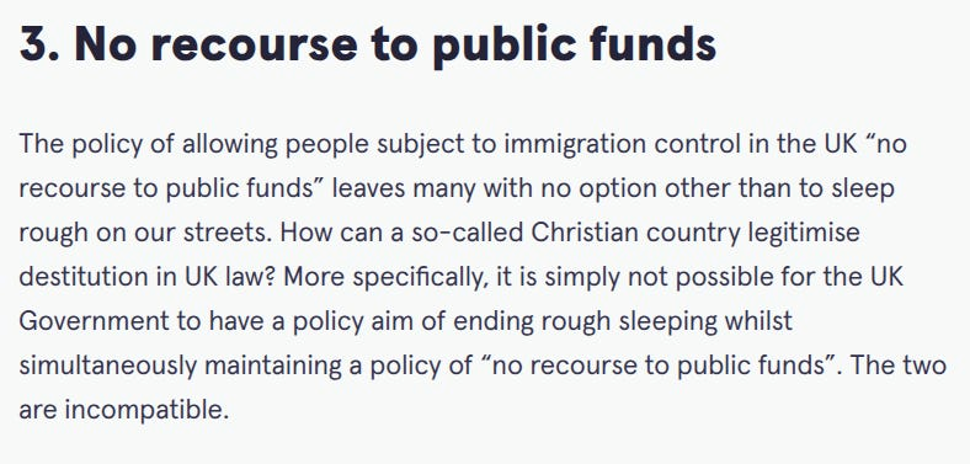
Such was Burnham’s commitment to his policy of scrapping NRPF that he launched a pilot programme in Manchester: “The Living Income Campaign.” The intention of this scheme – which it is hoped could be rolled out nationally – is to top up the incomes of those living with NRPF conditions “to a level that guarantees they can meet their basic needs.” Whilst this pilot deploys charitable funds to achieve proof of concept, the intent is to strengthen the case for migrants with NRPF conditions to have immediate access to state support.
Were Burnham to enact this vision in Number 10, those arriving in Britain on work, study and family visas would not have to be granted Indefinite Leave to Remain – usually obtainable after five years of residency – to access the full British welfare state. They would have immediate access.
NRPF exists to prevent migrants from becoming immediate burdens on the British taxpayer and, as the Home Office itself puts it, to ensure the country’s “finite resources are protected for British citizens and those who have lawfully settled here on a permanent basis.”
There are already legitimate criticisms about whether this position is itself too lenient, and whether foreign nationals should actually receive payouts from the British state at all. Over 2 million foreign nationals claimed benefits last year and 400,000 foreign national households were in social housing.
Indeed, even the Labour government has published plans to further tighten current settlement rules and extend the period before a migrant can claim settlement (whether they are sufficient is a question for another day).
That Burnham has called so explicitly for access to Britain’s welfare state to be liberalised, not tightened, is perhaps an indication of the direction that he would take Britain were he to win Makerfield and become Prime Minister.
Scrapping NRPF would be a marked departure from the current government, which has articulated that “it is a well-established principle that migrants coming to the UK should be able to maintain and support themselves and their families without creating a burden on the welfare system … there are no plans to remove that condition.”
Indeed, there are only a relatively small number of applications, and approvals, for NRPF conditions to be lifted every year, indicating that even the British state recognises it is a condition which must not be eroded. In 2025, there were 3,540 applications for the lifting of NRPF conditions, resulting in 1,954 acceptances.
There are also questions as to whether the removal of NRPF limitations would allow people who arrive in Britain illegally via small boat and then submit an asylum claim to also have full access. Indeed, as pointed out by the Migration Observatory, those in Britain illegally (estimated to be a population in the region of one million) are also subject to NRPF. Would such a move entitle these people to public funds?
Implications of Abolishing NRPF
The Immigration and Asylum Act 1999 makes it clear that people subject to immigration control are not to have access to public funds, which include: housing support, universal credit, disability payments, council tax reduction, tax credits and state pension credits.
There are no official figures on the number of people in Britain who have an NRPF condition on their visa. However, data released by the Home Office for December 2025 allows us to see the number of people in Britain who have arrived since 2008 and are on a visa that typically comes with NRPF conditions.
This shows there are well over 3.3 million migrants, of whom over 2 million arrived between 2023 and 2025, who could potentially benefit from Burnham’s NRPF policy. In other words, were Burnham to become Prime Minister, the Boriswave would not have to wait for settlement before being given access to the welfare state.
In the last twelve months of available data, 611,000 people arrived in Britain on visas that would typically have been issued with NRPF conditions. Without NRPF protections in place, meagre as they are, future cohorts of hundreds of thousands of migrants would be able to access welfare with almost no impediment.
About the Author
The Centre for Migration Control is a think tank committed to controlling and reducing immigration to the UK. It is “at the forefront of the fight to end the system of mass migration that is reducing quality of life and undermining national cohesion.”
Featured image: Andy Burnham, taken from ‘Will Belfast attack cost Burnham the by-election?’, The Telegraph, 10 June 2026
The Expose Urgently Needs Your Help…
Can you please help to keep the lights on with The Expose’s honest, reliable, powerful and truthful journalism?
Your Government & Big Tech organisations
try to silence & shut down The Expose.
So we need your help to ensure
we can continue to bring you the
facts the mainstream refuses to.
The government does not fund us
to publish lies and propaganda on their
behalf like the Mainstream Media.
Instead, we rely solely on your support. So
please support us in our efforts to bring
you honest, reliable, investigative journalism
today. It’s secure, quick and easy.
Please choose your preferred method below to show your support.

Categories: Breaking News, Latest News, UK News
No surprises here then. Not a single one of our career politicians are worth voting for. Even if there was one, it still wouldn’t change anything, when they get into power, (if they’re allowed to by the globalist cartel), they just toe the globalist line like all the others, puppets of the globalists, the lot of them.
Burnham is controlled by the same entities that control Starmer. If he is elected as prime Minister if and when the current one finally vanishes into ignominy then the UK will go further into the cess pit it currently finds itself. Burnham will be far worse that Starmer bringing about policies that will increasingly diminish real English, Welsh and Irish peoples rights. His record is abominable especially concerning rape gangs that have avoided arrest, prosecution and immediate deportation. If there is anything that can be done to stop him then it should.
So why did they create the problem in the first place? Well we know why, but the issue now is how does the nation respond? To these politicians that have sold us out to fill their pockets.