














The Democratic Republic of Congo (“DRC”) is requesting over $1.4 billion in funding for its Ebola situation. Before the money is handed over, serious questions must be asked about corruption and profiteering.
The DRC has a history of losing $10-15 billion annually to fraud and government corruption. Furthermore, the previous Ebola outbreak in 2018-2020 created an “Ebola business” with inflated contracts and kickbacks.
The accuracy of the current Ebola case numbers and speed-of-spread claims should be questioned – they may be exaggerated or even fabricated to solicit the billions of dollars in aid.
Let’s not lose touch…Your Government and Big Tech are actively trying to censor the information reported by The Exposé to serve their own needs. Subscribe to our emails now to make sure you receive the latest uncensored news in your inbox…
Congo’s ‘Ebola Business’ and $15 Billion Annual Fraud
By Jon Fleetwood, 26 June 2026
As the United States moves toward requesting more than $1.4 billion in additional funding for the Democratic Republic of Congo’s Ebola situation, two serious questions about fraud must be asked from the start.
The first is how much of the money that arrives will be lost to corruption and profiteering inside the response.
The second, more critical question is how much fraud is being committed to secure that funding in the first place, including whether official case numbers, death counts and claims of rapid spread are being inflated or manipulated to justify the large sums being requested.
That question is especially significant, given that the US Military has confirmed in peer-review that Ebola PCR tests – used to “confirm” infection counts – produce contradictory results on the same human samples.
Moreover, the genetic sequence order of PCR primers and probes are neither verified by the manufacturer nor by the person administering the test, raising questions about accuracy and how easily the tests can give false readings or be manipulated (see my X/Grok conversation about this).
Congo’s recent history makes both questions unavoidable.
Since American taxpayers are the ones ultimately being asked to fund it, don’t they deserve direct and honest answers?
The US State Department has already announced more than $270 million in direct Ebola response funding.
The CDC has already activated $107 million in emergency funding for Ebola response.
All of this, while the US is funding gain-of-function experiments making mutant Ebola resistant to drugs.
A Country Losing $10–15 Billion a Year to Fraud
In 2015, President Joseph Kabila’s anti-corruption adviser stated publicly that Congo was losing $10 to $15 billion per year to fraud, evasion and leaks – an amount close to twice the national budget at the time. He said the problem existed at some of the highest levels of government.
This systemic corruption has continued for years.
The ‘Ebola Business’ Precedent
During the purported 2018–2020 Ebola outbreak, the flow of hundreds of millions of dollars created what many on the ground openly called the “Ebola business.”
Investigations documented inflated contracts, kickbacks, exaggerated per diems paid to security forces and other schemes.
Some communities and responders believed certain actors had a financial incentive to prolong the crisis because it kept the money coming.
Attacks on health workers were partly fuelled by this perception.
A UN-commissioned review warned that these practices would damage future aid efforts.
The Current Numbers and the Funding Request
Authorities are currently reporting a major Ebola outbreak. They claim it is spreading quickly, with official figures citing well over 1,000 confirmed cases and hundreds of deaths since mid-May. These numbers are being used to justify urgent, large-scale international funding, including the more than $1.4 billion now being sought from Congress.
The central question is: How much can these numbers be trusted?
When a country has a documented history of losing $10 to $15 billion annually to fraud and when the previous Ebola response produced a clear “Ebola business” in which financial incentives existed to keep the crisis active, it is logical to ask whether the current case counts and speed-of-spread claims are fully accurate – or whether they are being exaggerated to attract billions in new aid.
No independent investigation has yet proven that the 2026 numbers are fabricated or significantly inflated. At the same time, no transparent, independent verification has been made public that would eliminate reasonable doubt in an environment where fraud has long been systemic and where large funding creates powerful incentives.
The Two Questions That Demand Answers
- How much of the requested funding is being lost to kickbacks, inflated contracts and profiteering once it reaches Congo?
- How much of the official outbreak narrative – including the case numbers being used to justify the money – is itself the product of fraud designed to secure that funding?
These are not minor concerns.
They go to the heart of whether the scale of the crisis and the amount of funding being requested rest on reliable information or on the same patterns of manipulation seen in the past.
Until there is strong, independent verification of the numbers and robust safeguards against both types of fraud, scepticism about how much of Congo’s Ebola figures are real – and how much is being shaped to secure funding – is not only justified but necessary.
The history of the “Ebola business” and $10–15 billion in annual fraud makes anything less a serious failure of oversight.
Further reading from Jon Fleetwood:
- Mutant Drug-Resistant Ebola Created by U.S., China, U.K., Germany Just Before Africa Outbreak: Journal ‘npj Viruses’
- The PCR Black Box: Positive Tests Rely on Unverified Primers That Could Be Wrong
- U.S. Updates 5 Ebola Preparedness Programs in January 2026 After 2-Year Silence—Just Months Before Congo Outbreak
- U.S. Military Confirms Ebola PCR Tests Produce Contradictory Results on the Same Human Samples: ‘Scientific Reports’ Journal
- Ebola Vaccine That ‘Sheds’ in 31% of Vaccinated Given to Colorado Healthcare Workers Just Down the Road from New Bat Lab
About the Author
Jon Fleetwood is an American investigative journalist, author and independent analyst known for his work on health policy, biotechnology and political narratives. He publishes articles on his Substack page ‘Jon Fleetwood’.
He is the author of ‘An American Revival: Why American Christianity Is Failing & How to Fix It’ and co-author of ‘What We’re Afraid to Ask: 365 Days of Healing for Adult Survivors of Childhood Abuse’.
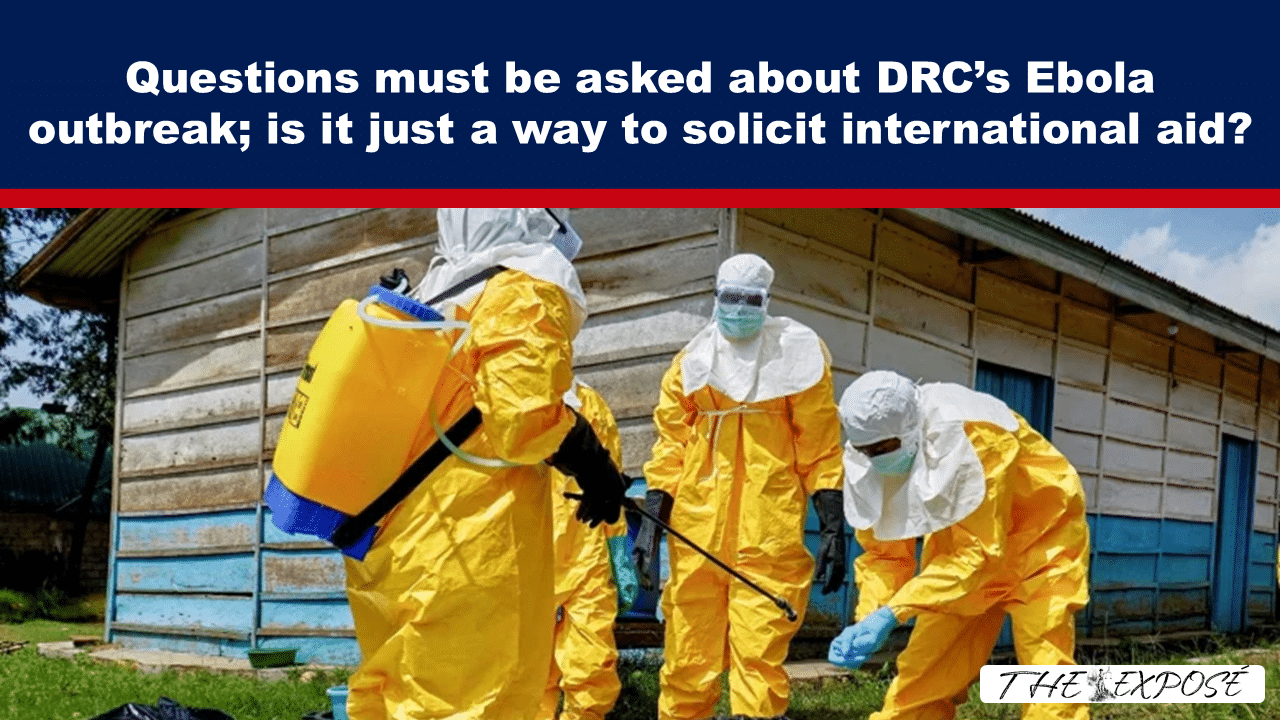
Featured image taken from ‘Response to Ebola Outbreak in Democratic Republic of Congo (DRC) and Uganda’, World Bank, 18 June 2026
The Expose Urgently Needs Your Help…
Can you please help to keep the lights on with The Expose’s honest, reliable, powerful and truthful journalism?
Your Government & Big Tech organisations
try to silence & shut down The Expose.
So we need your help to ensure
we can continue to bring you the
facts the mainstream refuses to.
The government does not fund us
to publish lies and propaganda on their
behalf like the Mainstream Media.
Instead, we rely solely on your support. So
please support us in our efforts to bring
you honest, reliable, investigative journalism
today. It’s secure, quick and easy.
Please choose your preferred method below to show your support.

Categories: Breaking News, Latest News, World News
I suggest looking into the earlier OTRAG activity in the Congo.
Ebola doesn’t even exist – people without access to clean water and nutritious food are further sickened by arsenic from lithium mines. Their sickness is further exacerbated by colonialists experimental vaccines and treatments. Please do a deeper dive into this situation.
Evidently Ebola does exist, as indeed do all the so-called viruses (according to THE POWERS THAT BE: Romans 13:1).
These are the powers that are running the show. Nevertheless, I agree with your take on this…
Mother Nature is the most dependable force and always will produce end results which are better than human intervention.
In the beginning God created the heaven and the earth.
Genesis 1:1.
And this, but a mere 6000 years ago.
Don’t be deceived, there is NO mother nature.
Where do you think god and the gods/aliens evolved from? Nothing comes from nothing (Parmenides) and no one can bring themselves into existence out of it which means that matter and energy have always been here in one form or another. That is where all forms of life come from, not some Jewish messiah or other biblical/ holy books diatribe. Parents let their children go and become adults on their own and the same with god fantasies if they are mature thinking human beings, Yoda. NO Mother nature my ass, grow up and smell the billions of years the universe(s) have been around which you can’t because you’re limited by this small planets evolution and alien interference if you can figure that out by reading hundreds of books on the subject.
Hi Steve Vasseur, Islander will respond in his own time. But in the meantime …
Jesus is not “some Jewish messiah or other biblical/ holy books diatribe.” He is your saviour as well as mine. The difference between you and me, for example, is that I have accepted him as my personal saviour, and you have not. You haven’t yet realised what you’re missing out on – but one day, whether you like it or not, you will come to that realisation. I hope it is sooner rather than later, while you still have a choice.
You go girl, you are on fire for our Lord. You my dear are a warrior, go get them.
You write “Where do you think god…evolved from?”
The Thrice Holy Almighty God of Abraham, Isaac and Jacob didn’t evolve from any place; He is the eternal self existent One who has no beginning or ending, He revealed Himself to Moses (and by extension to all humanity); I AM THAT I AM; Exodus 3:14.
The abiding Word of God is a revelation; I can’t adequately explain God to you (if I could, I would be God!) -I can only be His witness through Jesus Christ, nothing more, nothing less.
The 2000 year old New Testament clearly states that even back then, despite all the many attested miracles performed by the Lord Jesus and His apostles, not all believed! How can this be?
BTW, we don’t live on a planet-the earth is geocentric, not heliocentric.
AMEN!
Actually we are at the very end of the 6,000 year, soon we will enter God’s sabbath rest which will be the millennial reign of Yeshua on this earth. Look up, pack up, because we are going up!
You mean Father God is the most dependable force, because he is you know. In fact he control mother nature.
https://www.youtube-nocookie.com/embed/BqCTPQ7bliA Oxcart program ( didn’t have the knowledge for a moon landing )
Ebola was a man made CDC plot which used Africans as their guinea pigs decades ago, not a word the WHO says should be taken as the truth.