














Noelia Ramos, a 25-year-old paraplegic woman, was euthanised in Spain on 26 March 2026, despite not having a terminal illness.
The doctor who oversaw the euthanasia procedure also acted as a transplant coordinator, creating a conflict of interest in that she had an institutional interest in obtaining Noelia’s organs.
But that’s not all. Since November 2025, the killer doctor has been under investigation for a legal complaint made about her for falsifying documents and abuse of power to alter the decision-making process about Noelia’s euthanasia.
Let’s not lose touch…Your Government and Big Tech are actively trying to censor the information reported by The Exposé to serve their own needs. Subscribe to our emails now to make sure you receive the latest uncensored news in your inbox…
It Takes A Lot To Shock Me, But The Euthanasia Of Noelia Ramos Has Left Me Reeling
By Jonathan Engler, 12 April 2026
For those who don’t know, a 25-year-old woman called Noelia Ramos was euthanised in Spain on 26 March 2026.
Many disputed claims are being made about the circumstances around this, and in the media, the story is being framed (by all sides, it has to be said) politically and ideologically, with little regard to the truth.
This post is a classic example:
To be honest, I don’t have the resources to research each point being made, but the undisputed parts of the story make for distressing enough reading.
I am not going to recount those here, other than to point out that it certainly seems to be undisputed that:
- Noelia was under the care of the state when she was gang-raped twice.
- After the second incident, she attempted to commit suicide by jumping out of a window and through a spinal cord injury she sustained, she became paraplegic.
- Noelia did NOT have a terminal illness.
- Videos are circulating of her condition physically improving somewhat as she attempts – and manages – a few steps on crutches (see HERE, for example).
Beyond those facts, all other claimed facts look coloured by portrayal through an ideological lens, apart from one – to me, startling – piece of information which emerged in the days after the procedure:
The text of the X post (translated) reads:
“The responsible doctor with whom Noelia signed her euthanasia request was not her family doctor nor her psychiatrist; she was the TRANSPLANT COORDINATOR.
Sanchismo1 turns everything it touches to sh*t. I hope more than one person ends up in prison over this case.”
The text of the image from El Mundo2 reads:
[Main Headline]
Christian Lawyers sues the doctor who processed Noelia’s euthanasia for being the transplant coordinator.
[Sub-headline]
The organisation accuses the doctor of “an alleged crime of malfeasance and conflict of interest.”
In drilling into this a little further, I found out that the doctor referred to above (together with one other person) was already the subject of some sort of lawsuit or complaint, as reported in November 2025 by another Spanish mainstream newspaper:
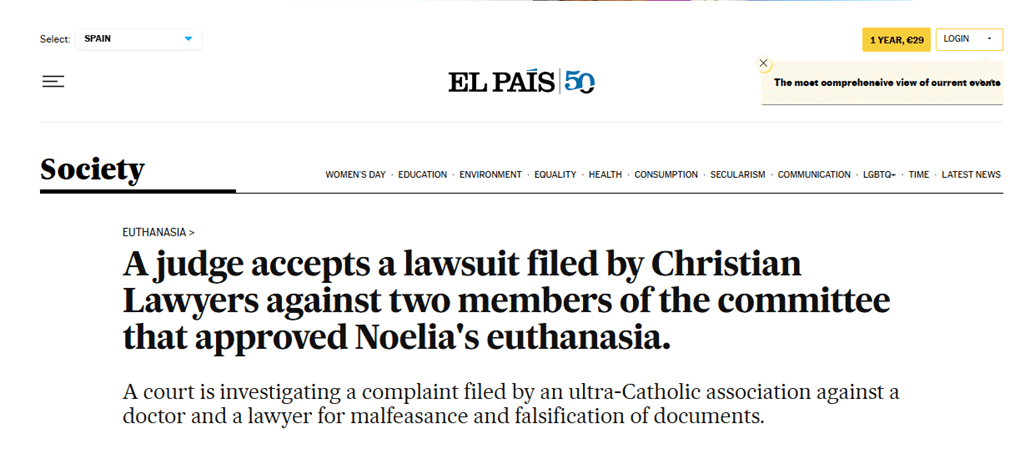
The article (machine-translated) reads:
The ultraconservative Catholic platform Christian Lawyers has succeeded in getting the courts to investigate two members of the committee that approved the euthanasia of Noelia, a 24-year-old paraplegic woman who requested assisted dying.
A ruling by Barcelona’s Court of Instruction Number 20 has accepted the lawsuit filed by the association for the alleged crimes of falsifying public documents and abuse of power, and has ordered preliminary proceedings against the defendants, who will have to give statements in Administrative Court Number 12. The judge does not explain the reason for the investigation, simply requesting the “clarification” of the facts.
Christian Lawyers argues that two members of the Catalan Guarantee and Evaluation Commission raised their alleged disagreement in order to bring the case before the commission, where it was decided that assisted dying could be practised. On social media, the association’s president, Polonia Castellanos, stated: “We are going to do everything possible to prevent [euthanasia] from taking place,” after concluding that the two professionals, listed as alternate members, “falsified” the report.
The truth is that these two experts, who were responsible for making a decision, forced the case to be resolved by the full commission, which voted unanimously in favour of assisted dying, with all 19 members voting in favour. Their objective was none other than to further strengthen the guarantees of the process, according to sources familiar with the events. The lawsuit was filed against six members of the commission, but the open investigation is focused on only two of them.
Noelia suffers from “severe dependency, chronic and debilitating pain and suffering” after attempting suicide by jumping from a fifth-floor window in 2022, according to the commission’s report. She herself stated at the trial that “every day is horrible and painful.” But the case remains mired in legal proceedings after the body responsible for ensuring the proper application of the law validated euthanasia in July 2024, a decision that was subsequently challenged in court. An initial court ruling allowed the procedure, setting it for August 2, 2024, before it was halted by an appeal filed by Christian Lawyers, representing her father.
The High Court of Justice of Catalonia (TSJC) upheld the sentence last September, but that judicial decision is also awaiting a final ruling from the Supreme Court. The case falls within the bounds of the law, but the TSJC gave the father the option to appeal, and Christian Lawyers, who represent him, announced their intention to do so. The Supreme Court’s decision will not only affect the case of the young woman Noelia, but could also legitimise similar requests from other parents. This case is the first to go to trial in Spain concerning the provision of assisted dying.
Fast forward to 31 March, when Abogados Cristianos filed a further complaint, as reported here:
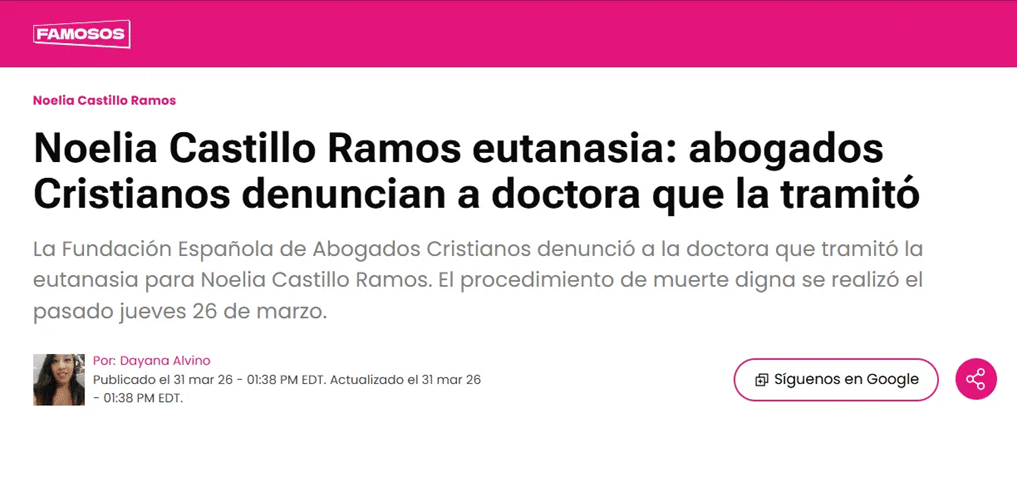
The English translation reads:
Noelia Castillo Ramos Euthanasia: Christian Lawyers Sue Doctor Who Processed It
The Spanish Foundation of Christian Lawyers has filed a complaint against the doctor who processed the euthanasia for Noelia Castillo Ramos. The “death with dignity” procedure took place last Thursday, 26 March.
What is the doctor who processed Noelia Castillo Ramos’s euthanasia accused of? The organisation filed its lawsuit in a Barcelona court, accusing the responsible physician of alleged malfeasance (prevarication). They are targeting the specialist because she “simultaneously served as a transplant coordinator” at the Consorci Sanitari Alt Penedès-Garraf.
“This dual role creates a structural and insurmountable conflict of interest, as the same professional tasked with assessing whether the patient’s death should proceed had a direct institutional interest in obtaining organs,” they stated in a press release.
They argue that the expert “handwrote the euthanasia request,” including a point stating that the young woman allegedly “wished to be an organ and tissue donor.” However, the organisation believes it was not Noelia who recorded this, but the doctor herself. Furthermore, they emphasise that the doctor was not the one who usually treated the young woman.
“Noelia revoked the organ donation listed in the initial request at the last moment,” they added, which they consider evidence of irregularities. Finally, they noted that Noelia postponed the procedure by one hour to spend more time with her family, which they believe demonstrates “fluctuations in her will.”
It is quite astonishing to me that someone involved in the euthanasia procedure should also act as a transplant co-ordinator. Even if the proposed reason for this is that it was a small hospital and overlapping roles are inevitable, surely steps could be taken to bring in people from other regions to create separation of decision-making in such critical and thorny matters.
I accept that the person concerned may not have benefited personally from being both transplant coordinator and having involvement in the euthanasia. However, the point about separation of powers (in any context) is not just about the receipt of tangible benefits; they are there to also (supposedly) protect against the undue influence of certain ideological beliefs.
The eyebrow-raising, however, doesn’t end with this matter, though.
It also turns out that at the time of the euthanasia, the complaint being investigated since November 2025 was actually ongoing and unresolved, as implied by this article on the website of RTVE3:
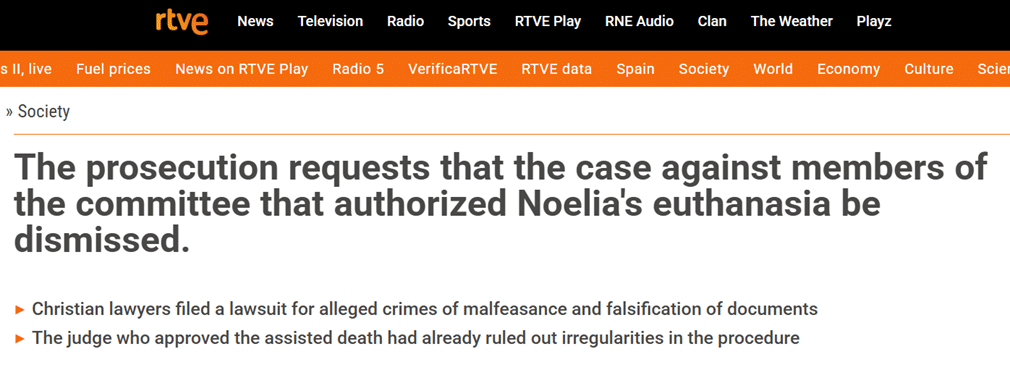
The translation reads:
The Barcelona Prosecutor’s Office has requested the dismissal of the case against two members of the Healthcare Ethics Committee who authorised the euthanasia of Noelia, the 25-year-old woman from Barcelona who suffered from paraplegia and who finally received assisted death last Thursday, sources from the Public Ministry have informed Europa Press.
The Prosecutor’s Office has requested it from the head of the Court of Instruction number 20 of Barcelona, who is investigating both professionals (a doctor and a lawyer) against whom the Spanish Foundation of Christian Lawyers filed a complaint for alleged crimes of prevarication and falsification of a public document.
According to the complaint, both allegedly admitted in court that they simulated a non-existent disagreement to force the decision to be submitted to the plenary session of the Comissió de Garantia i Avaluació de Catalunya (CGAC), “ thus altering the legally established procedure and administratively shielding the authorisation.”
The Court of Instruction number 20 accepted the complaint for processing in order to obtain the judgment issued by the Administrative Court 12 of Barcelona, which upheld the euthanasia of the young woman and dismissed any irregularities. “This request for testimonies could only be made by accepting the complaint for processing, so that the request for the aforementioned documentation would have legal backing,” so that, once received, it could be forwarded to the Public Prosecutor’s Office to report on the criminal relevance of the facts, as stated in a ruling issued on March 26.
“No evidence of a crime”
The head of the Administrative Court number 12 of Barcelona, who supported Noelia’s euthanasia in a resolution that was later endorsed by the Superior Court of Justice of Catalonia (TSJC), has already ruled out irregularities in the procedure: “No indication of a crime is seen in the actions of the professionals.”
The judge stated that the report from the medical-legal duo indicated, in the lawyer’s comments, that the patient’s suffering generated “doubts” as to whether it could be considered serious, chronic and disabling, as indicated by the Organic Law for the Regulation of Euthanasia (LORE), and therefore issued an unfavourable report.
The members of the duo explained during the trial that, since it was a complex case, they decided that the matter should be brought before the full court, and the judge understood that their actions did not invalidate the proceedings, “since it gives the decision greater guarantees” given that the decision was then taken by all the members of the CGEC, which were 19, and was adopted unanimously.
Obviously, as someone who has zero knowledge of Spanish law or judicial procedures, it’s difficult to get to the nub of what has actually happened here.
Regardless of the merits of the November 2025 complaint, it still seems weird to me that the doctor, whilst still the subject of an ongoing and unresolved complaint, simply carried on pushing the process forward to its ultimate conclusion while wearing the same multiple hats, and now that it is over, the prosecutor seeks to dismiss the case?
The above is just the latest in an increasing number of instances where people have undergone euthanasia for non-terminal and/or psychiatric reasons. Noelia was obviously very young, but a case was recently reported for a teenager:
The circumstances around the case are detailed on pages 47 – 49 of the 2024 report of the Regional Euthanasia Review Committee, which can be found HERE. In that report, the individual is described as follows:
A young man aged between 16 and 18 had been diagnosed around four-and-a-half years before his death with an autism spectrum disorder with anxiety and mood-related problems.
While reading that document, I was surprised to learn that, as of 2024, euthanasia accounted for 5.8% of all deaths in the Netherlands.
The disparity in public discourse is striking; while Canada’s rate is roughly the same and frequently draws heavy criticism, the Netherlands is rarely mentioned in this context.
One other phrase from the report (in the foreword, page 3) caught my attention. While noting a 10% year-on-year increase, the authors state:
At present, all that can be said is that there is no reason to assume that the gradual increase seen in recent years will soon come to a halt.
No concern about this was expressed; in fact, they seem proud of it, and comfortable with an ever-increasing proportion of deaths in their country involving a state-sanctioned medical procedure. I find that illustrative of a disturbing ideology on several levels.
In the UK, the slippery slope argument was cited as a reason for the dangers of introducing a bill which, on its face, would not have permitted the above type of case, which (currently) seems anathema, even to many supporters of assisted dying legislation in the UK.
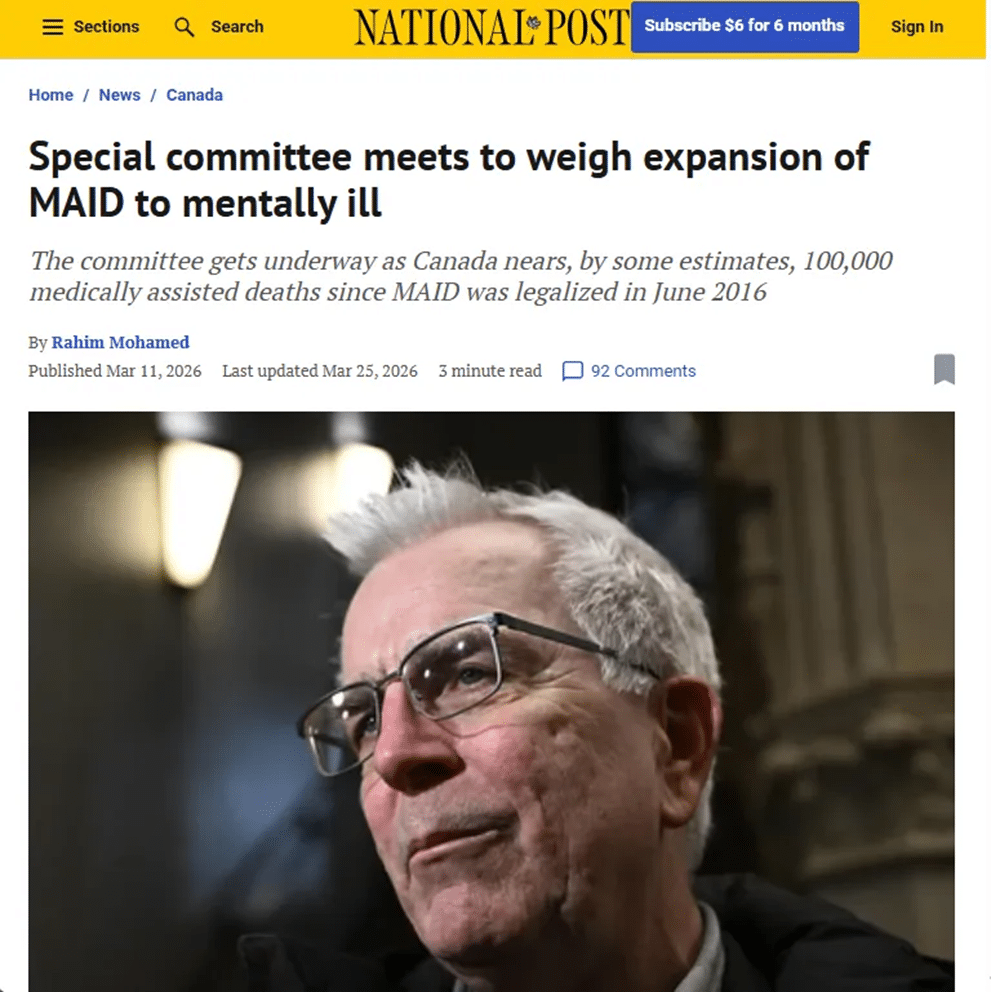
Proponents of the bill responded emphasising safeguards against such “mission creep”, but – as can be seen with Canada – the scope of this legislation inevitably ends up being expanded, and never contracted.
One of the under-appreciated features of the very act of introducing assisted dying legislation is that it instils ideological and attitudinal societal changes, so that what was previously unthinkable moves into the realm of being debateable, and then it becomes a “right”, usually based on arguments over “equality.”
Finally, if you haven’t already, I suggest you read my piece: ‘What connects the UK’s new “assisted dying” law with the Nazi’s “Aktion 4” euthanasia programme?’
This piece contains a link to a short (14-minute) AI-generated “deep dive” which does an excellent job of distilling my arguments.
Notes:
- 1 Referring to the Prime Minister, for whom the Euthanasia law was a flagship project.
- 2 El Mundo – a centre / centre-right leaning publication – is one of Spain’s three “newspapers of record” (along with El País and ABC). Historically, it is known for high-impact investigative journalism.
- 3 Spain’s national public broadcaster.
About the Author
Jonathan Engler, MB ChB DipPharmMed LLB, is a British healthcare entrepreneur who is medically and legally qualified. He initially trained in medicine, moving into the pharmaceutical sector where he worked on an international programme for a heart failure drug, designing and analysing clinical trials. He then established a business which became a world leader in using IT to coordinate and automate several clinical trial processes. Having sold that business, Jonathan then retrained as a barrister, where he worked for a few years before moving back into business.
He publishes articles on a Substack page, ‘Jonathan’s Substack’, which you can subscribe to and follow HERE.
The Expose Urgently Needs Your Help…
Can you please help to keep the lights on with The Expose’s honest, reliable, powerful and truthful journalism?
Your Government & Big Tech organisations
try to silence & shut down The Expose.
So we need your help to ensure
we can continue to bring you the
facts the mainstream refuses to.
The government does not fund us
to publish lies and propaganda on their
behalf like the Mainstream Media.
Instead, we rely solely on your support. So
please support us in our efforts to bring
you honest, reliable, investigative journalism
today. It’s secure, quick and easy.
Please choose your preferred method below to show your support.

Categories: Breaking News, World News
That is so evil.
Thank you for bringing attention to this.