













A dispute over the treatment of journalists in Kazakhstan has drawn international attention this month after six press-freedom and human-rights organisations urged President Kassym-Jomart Tokayev to drop criminal charges against several reporters and overhaul parts of the country’s media law. The immediate facts are specific to Kazakhstan: journalists under house arrest, prosecutions linked to “false information,” and a strong appeal from watchdog groups. The questions raised by the case, however, are not unique to Central Asia. They go to a larger free speech issue now visible in many countries, as we investigate how far governments can go in regulating speech, information and access before legitimate oversight begins to narrow the space for independent reporting.
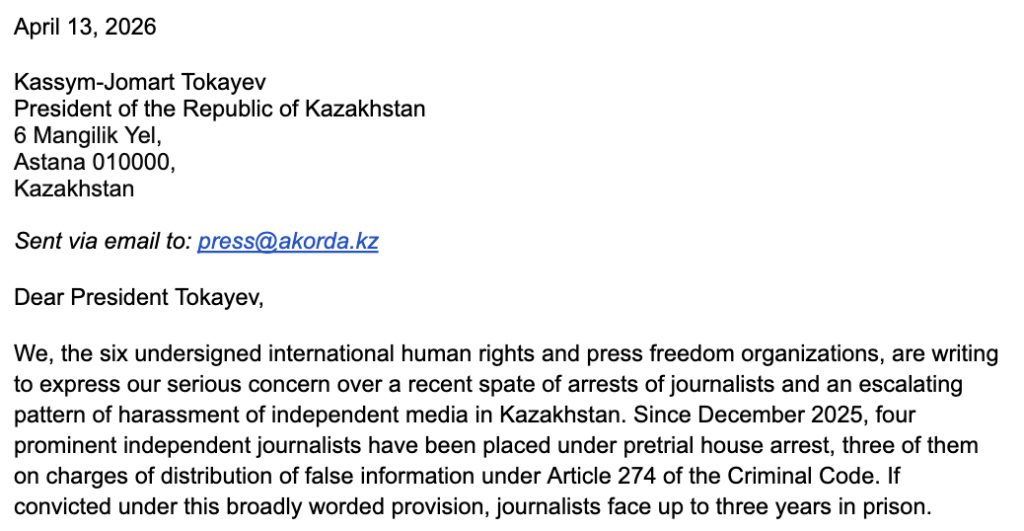
The current controversy centres on a joint letter sent on April 13 by six organisations led by the Committee to Protect Journalists. According to the Associated Press, the groups said they were alarmed by a series of journalist arrests and by what they described as mounting pressure on independent media. They urged Tokayev to ensure that journalists prosecuted for their work are released and that the charges against them are dropped. Gulnara Bazhkenova, Amir Kasenov, Aset Matayev and Botagoz Omarova are reportedly among those under house arrest while awaiting trial.
The letter signed by the Committee to Protect Journalists (CPJ) and five other bodies outlines the specific claims. It says that since December 2025, four prominent independent journalists have been placed under pretrial house arrest, three of them on charges of distributing false information under Article 274 of Kazakhstan’s criminal code. If convicted under that provision, the letter notes, they could face prison terms of up to three years. The signatories argue that these cases sit alongside other forms of pressure, including blocked outlets and restrictions affecting journalists working for Radio Azattyk, the Kazakh service of Radio Free Europe/Radio Liberty.
The allegations differ by case. According to the letter:
- Gulnara Bazhkenova was charged after claims she made during a YouTube news show alleging that a government minister had been involved in corruption and other serious crimes, although the letter says the formal charges are reportedly tied to other material and may have been retaliatory;
- Amir Kasenov of KazTAG was placed under house arrest after charges stemming from a complaint by financial-services company Freedom Finance, whose lead shareholder Timur Turlov accused the outlet of running an “information campaign” against him;
- Aset Matayev, the agency’s director, was originally also charged on false-information grounds in the same KazTAG-related dispute before those charges were later dropped and replaced by a separate hooliganism case after an alleged assault incident;
- and Botagoz Omarova was reportedly charged over a post on her Telegram channel about claims that a company building a stable on orders from the presidential office had failed to pay subcontractors.
That legal setting is central to understanding why the case has resonated internationally. Reporters Without Borders says Kazakhstan’s constitution formally prohibits censorship, but adds that “knowingly spreading false information” remains a criminal matter even after defamation was decriminalised. RSF also says the 2024 reform to the media law strengthened state control over the press and allows the foreign ministry to deny accreditation on broadly defined national-security grounds. Human Rights Watch, in separate reporting last year, criticised the refusal to renew accreditation for Radio Azattyk journalists and described it as a clear blow to independent media.
The immediate Kazakhstan story, then, is straightforward enough. Press-freedom groups say the country’s laws leave too much room for criminal cases against critical reporting and that recent prosecutions fit a larger pattern of pressure on independent outlets. The authorities have not, in the reporting cited here, set out a detailed public response to the latest letter. What is clear is that the dispute is not simply about one headline or one newsroom. It concerns the terms on which journalists are allowed to work, and the extent to which legal provisions aimed at falsehood or security can be applied to reporting that powerful interests dislike.
That is one reason Kazakhstan has become a useful case study. It shows how free speech conflicts increasingly develop through legal process and administrative control rather than through explicit censorship orders of the old kind. Governments do not need to close every publication or ban every critic outright. Pressure can be exerted through criminal complaints, court-supervised restrictions, licensing and accreditation systems, and laws written in terms that may first sound reasonable but are broad enough to become politically consequential in application. Kazakhstan is not the only country where that tension is now visible.
In France and Italy, a different argument is now unfolding around proposed antisemitism legislation. Reuters reported this week that lawmakers in both countries are considering new legal measures in response to rising antisemitic incidents since the Gaza war. Supporters say the proposals are needed to address a real increase in anti-Jewish hatred. Critics, including rights groups, academics and U.N.-linked voices cited by Reuters, argue that the laws risk blurring the line between antisemitism and certain forms of criticism of Israel.
France’s proposed measure would target, among other things, calls for Israel’s destruction and comparisons between Israel and Nazi Germany, while Italy’s bill would place the IHRA definition of antisemitism into law. The context is clearly different from Kazakhstan, but the underlying policy dilemma is recognisable: how broadly can a state define harmful speech without also constraining political expression?
Elsewhere, governments are extending control over online access through a different route. We recently covered the continued push by countries across Europe to restrict children’s use of social media. Such measures are being advanced in the language of child safety rather than speech control. Even so, they expand the technical infrastructure through which access to digital space can be regulated and verified. In democratic states, these systems are typically presented as narrow and proportionate. But once they are in place, their use will inevitably widen.
Romania has offered another version of the same underlying problem, this time around elections and online influence. The European Commission previously opened proceedings against TikTok over suspected failures connected to Romania’s presidential election. It was also claimed that the European Union itself had barred candidate Călin Georgescu from the rerun, clarifying that Romania’s own election authority had made that decision. The Romanian case is not about journalism prosecutions in the Kazakh sense, but it shows how quickly disputes over manipulation, platform power and electoral legitimacy can draw regulators into active supervision of political communication.
Kazakhstan’s media-law disputes belong to its own political context. France and Italy are dealing with antisemitism legislation. European governments are arguing over child safety online. Romania’s authorities are grappling with election integrity and platform conduct. Yet they all point toward a broader shift in governance. Speech is increasingly being treated not only as a liberty that needs protection, but as a domain that requires management, classification and technical enforcement. That shift is producing different legal tools in different places, but it raises a common question: once those tools are normalised, how confidently can governments promise that they will remain confined to their original purpose?

Categories: World News