














The UK’s energy taxes make its industrial electricity the most expensive in the world. This is causing the closure of public sports and leisure facilities, and, more notably, together with the Government’s other Net Zero policies, causing investment in AI and data centres to locate in countries other than the UK.
The AI industry, along with Net Zero, is an industry that the UK government frequently claims will create employment and grow the UK economy.
Related: OpenAI pauses UK data centre deal over energy costs and regulation, BBC, 9 April 2026
Let’s not lose touch…Your Government and Big Tech are actively trying to censor the information reported by The Exposé to serve their own needs. Subscribe to our emails now to make sure you receive the latest uncensored news in your inbox…
On 1 April, the Great British Business Council (“GBBC”), a newly formed think tank, published a paper titled ‘Premeditated Industrial Destruction: How the UK Destroyed Its Industry and A Plan To Reverse This’.
The paper is authored by economist Catherine McBride, retired engineer and consultant David Turver and public relations consultant Brian Monteith. It demonstrates how the Government’s Net Zero policies are destroying the foundations of the UK economy and provides recommendations on how Net Zero could be reversed.
Because this paper is important in revealing some home truths, we are reproducing it in a series of articles, more manageable chunks if you will, so that, hopefully, more will read it, or at least read part of it. We have made some minor edits for readability purposes. For those who choose to read the paper in one sitting, you can do so HERE.
Chapter 7: Businesses beyond industry
By Great British Business Council, 1 April 2026
Leisure and sport
It is not just industry that is being devastated by the UK’s self-inflicted high energy costs – sports, leisure and events venues also consume large amounts of energy and have had to consider their viability over the last few years. These businesses generally do not qualify as Energy Intensive Industries for discounted Emissions Trading Scheme (“ETS”) charges, but they will be subsidising the ETS costs of the industries that do qualify.
Ice Rinks and Curling Centres
Ice rinks across the UK are closing and others are threatened with closure due to massive and “unprecedented” increases in the energy costs of maintaining their ice floors. Ice rinks are heavily energy-intensive due to their size and use of refrigeration, lighting and dehumidification.
The Plymouth Pavilions Ice Rink, a local fixture for some thirty years, closed on 1 January 2023 after it was branded as “wholly unsustainable” due to high energy costs. The Ayr ice rink – home to 550 skating members and forty curling clubs – closed permanently in September 2023 after 50 years of operation. Its annual energy costs doubled to £153,000, with another £150,000 required. Its daily energy bill rose from £419 to £880; finding an additional £461 a day, every day, just couldn’t be done.
Even in London, the ice rink at the Sobell Leisure Centre in Islington did not reopen after being closed during the pandemic. Its high energy costs, which accounted for 70% of the centre’s total electricity consumption, were given as the main reason.
Inverness Ice Centre has had to close its ice rink for three months of the year since 2023 due to spiralling energy costs of refrigerating its ice floor. The cost of operating its refrigeration plant more than doubled, from £12,000 to £30,000 per month. Inverness went ice-free from April to July outside the curling season and instead hosted a whisky festival, boxing, music and videoed football events to cut costs and raise income.
Other Scottish rinks, such as Aberdeen, Perth, Forfar and Elgin, have experienced the same difficulties and have had to adjust their annual opening schedules. In 2023, Scottish Ice Rink Association president Mike Ferguson said his Forfar business’s monthly gas bill was set to rise from £2,000 to £14,500, while in April 2025, Curl Aberdeen reported its energy costs had rocketed by £160,000 a year. Perth City Council has recommended merging two leisure centres into a new venue without an ice rink. The cost of energy for ice rinks remains an existential threat to curling and skating, which have traditionally been Team GB’s most successful Winter Olympic sports.
Swimming pools
Rising energy costs have forced many swimming pools to implement drastic measures, including permanent closures, temporary winter shutdowns and temperature reductions to remain viable.
Over 65 public pools closed in the UK between 2019 and 2022, either temporarily or permanently, due to a combination of rising energy costs, staff shortages, and chemical supply issues. Industry bodies like Community Leisure UK warned in 2023 that up to half of the UK’s community pools could face closure or service cuts without sustained government intervention. Swim Wales also warned that 150 of 500 pools faced a similar threat of closure.
Some leisure operators reported their annual energy bills tripling or more; for example, Freedom Leisure saw its nationwide energy costs rise from £8 million to £20 million, while individual sites have seen annual costs jump from £180,000 to over £600,000.
To offset costs, approximately 15% of UK councils have permanently or temporarily lowered pool temperatures, typically by about one degree. Other facilities have reduced opening hours or closed energy-intensive features, such as saunas.
Examples include Batley Baths in West Yorkshire, which was permanently closed due to soaring energy and operational costs, and New Forest District Council, which closed saunas across several leisure centres to save on energy costs.
The nationwide problem caused the UK Government to introduce a £63 million investment fund to help pools manage immediate energy pressures and transition to “more energy-efficient systems” like heat pumps and solar panels. The Energy Bill Relief Scheme was introduced to provide temporary wholesale price discounts for non-domestic users, including pools.
Chapter 8: New industries the UK will miss out on due to its high industrial energy costs
By Great British Business Council, 1 April 2026
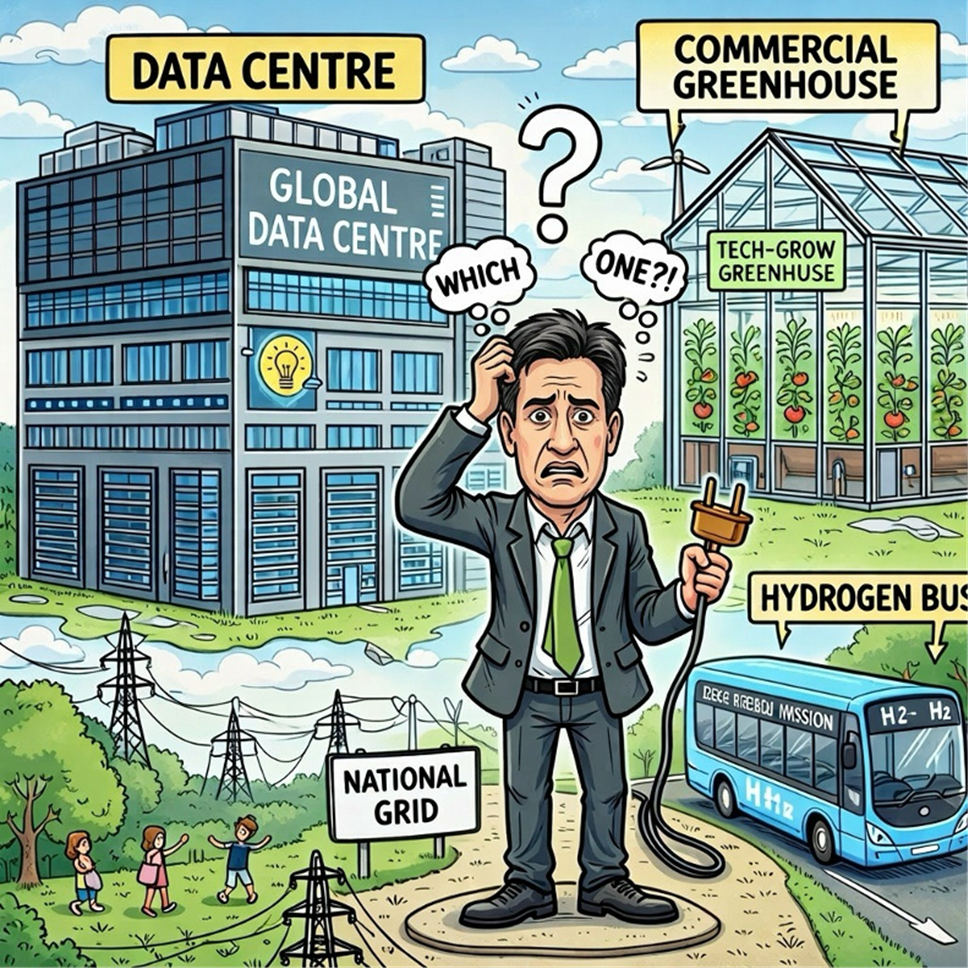
AI, Data centres and cloud computing
The Labour government has placed significant faith in the development of green jobs in the AI and data centre industries. However, these industries require dispatchable power from gas, biomass and nuclear sources. And they need it now. Unfortunately, the UK plans to add another 50 GW of intermittent offshore wind by 2030 and 70 GW of intermittent solar and onshore wind; these will not produce the dispatchable, constant power required by AI and data centres. The UK will need to increase gas production to meet the required energy demand.
The construction of data centres also requires large amounts of cement and steel. The American Cement Association predicts the US will need 1 million metric tonnes of cement by 2028 just for AI data centres. While a single hyperscale AI data centre requires up to 20,000 tonnes of Steel.
The full deployment of pledged AI investment in the UK hinges on critical infrastructure upgrades, especially in energy supply, energy costs and energy connections.
The UK AI Energy Council projects a 20-fold increase in compute capacity over the next 5 years. Typical data centres can consume up to 100 MW per site, equivalent to powering 75,000 homes. Microsoft’s planned supercomputer alone will use 23,000 NVIDIA GPUs, requiring hundreds of megawatts of sustained power. In March 2024, it was announced that Amazon had bought a 960MW data centre that is powered by an adjacent nuclear power station. Microsoft has also announced that it has struck a deal with US utility Constellation to restart the 835MW Three Mile Island (“TMI”) Unit 1 nuclear power plant to power its data centres. In late 2024, Sam Altman of ChatGPT proposed building massive 5GW AI data centres. To give an idea of scale, each of these data centres would consume about 1.5 times the output of the Hinkley Point C nuclear power plant under construction.
Technology industry leaders, such as Jensen Huang, President, co-founder and CEO of Nvidia, have warned that UK electricity prices are the highest in Europe and that natural gas turbines will be required alongside nuclear power to meet energy demand. The UK’s ban on fracking, reluctance to develop new oil and gas fields in the North Sea and reliance on imported gas are likely to constrain short-term energy availability, while the UK’s energy taxes make its industrial electricity the most expensive in the world. The UK must also upgrade its grid connection process to enable the rapid onboarding of high-demand data centres and reform planning laws and grid access rules to accelerate deployment. Microsoft cited the UK’s stable and open regulatory environment as a key factor in its investment decision – but also warned that planning and energy reforms must continue. Regulatory stability in the oil and gas sector is also necessary for investment in this area to increase.
This massive investment in AI and data centres is happening at a time when the UK is mandating that all new car purchases be electric and that electric heat pumps are used for domestic heating. Grid connection bottlenecks are delaying critical infrastructure: more than 600 GW of proposed renewable energy generation projects are awaiting grid connection. The National Energy System Operator (“NESO”) believes this backlog can be reduced to viable projects aligned with the UK’s national priorities, including data centres, electric vehicle (“EV”) charging hubs and heat pump clusters. The National Grid also requires an annual investment of £18.4 billion for infrastructure expansion, transmission, distribution, new interconnectors, substations and digital grid upgrades, along with planning reforms for new nuclear and, possibly, new gas turbines.
The US-UK Tech Prosperity Deal agreed last year includes: a £150 billion Tech Prosperity Deal; a civil Nuclear Cooperation covering a partnership between the UK’s Centrica and X-energy to build advanced modular reactors in the UK; Defence technology and cybersecurity covering AI command centres, cyber resilience and Quantum Encryption Trials; and, an additional £10 billion investment in liquefied natural gas (“LNG”) contracts, semiconductor R&D, fabulous investment pledges and pharmaceutical licensing and distribution for biotechnology therapies.
The pledged new investments will require an additional 770 MW of steady, reliable dispatchable electricity, which can only be provided by gas turbines, biomass or nuclear plants. The annual energy consumption of these projects will be 6.75 TWh, roughly 5.2% of the UK’s 2025 dispatchable electricity output, estimated at around 130 TWh. This represents a significant portion of the UK’s grid’s firm capacity. It highlights why project investors are considering on-site generation, SMRs and dedicated power purchase agreements to secure their electricity supply.
In addition to the newly announced investments, the projected electricity demand from projects already in planning or under construction exceeds 540 MW, with an annual consumption of 5.6 TWh, representing approximately 4.3% of the UK’s dispatchable electricity production.
Hydrogen-powered equipment and buses (“H3”)
The UK’s Heavy machinery manufacturer, JCB and the UK bus manufacturer Wrightbus have both invested in the production of hydrogen-powered vehicles. Hydrogen is widely regarded as a superior solution for heavy vehicles than lithium battery technology. While this is commendable, the UK currently produces very little hydrogen, and almost none of it is low-emission.
The UK’s Wrightbus Hydroliner buses run on hydrogen and are in use in London, Belfast and Birmingham. They were also trialled in Aberdeen, but this trial was recently abandoned, as discussed earlier in this paper. However, only the Aberdeen buses were refuelled with green hydrogen produced using renewable electricity; the others primarily use grey hydrogen made from natural gas. JCB has also developed a hydrogen combustion engine for construction and agricultural equipment.
Hydrogen is generally transported by converting it to ammonia or methanol. In 2024, the UK imported just 537 tonnes of hydrogen. Almost all of it is from the Netherlands or other EU countries, with only 5 tonnes imported from the US.
As hydrogen is considered a better fuel source for heavy transportation and equipment, with only water as a tailpipe emission, imposing additional taxes on UK production and a Carbon Border Adjustment Mechanism (“CBAM”) cost on imported hydrogen seems counterproductive. Surely, making hydrogen production cheaper by reducing taxes on UK gas production would be better for the environment overall. Otherwise, the UK could miss out on the benefits of an industry championed by two UK companies.
Greenhouse technology for food production
Modern greenhouses enable year-round production of summer vegetables and reduce the amount of product lost to frost and pests, but are also energy-intensive. Using greenhouse technology in the UK will be hampered by the UK’s high industrial electricity costs. Greenhouse-intensive agriculture relies heavily on heating, lighting, cooling, irrigation and environmental controls, with heating and lighting being the dominant energy inputs. Greenhouses can consume up to 10 times as much energy per unit area as open-field farming. Energy audits show that heating and lighting together often account for more than 80% of total energy consumption.
Greenhouses are highly energy-intensive because they maintain controlled environments year-round. Although drier, sunnier countries do use solar electricity, if a country has adequate rainfall and sunlight, the additional requirements of greenhouses seem superfluous. However, growing plants in waist-high troughs makes picking easier, while the greenhouse environment reduces damage from frost, pests and pestilence.
The key energy-consuming components include:
• Heating is the largest energy input, often accounting for 50–70% of total energy use in temperate climates. This is typically supplied by natural gas, propane or electricity for boilers and radiant heating systems. In cold climates, heating demand accounts for most energy consumption (e.g., maintaining an indoor temperature of 60–70°F). The CO2 emissions from the gas-fired heating are usually captured and pumped into the greenhouse to increase the plant growth rate.
• Lighting using high-intensity lamps (HPS or LED) for photosynthesis during low sunlight periods. Lighting can account for 20–30% of total energy use, especially in winter or for crops that require long photoperiods. LEDs are increasingly used for efficiency gains.
• Cooling and ventilation fans, evaporative cooling pads and, in hot climates, air conditioning. Energy demand varies seasonally but is critical for maintaining temperature and humidity.
• Fertilisers, fungicides and pesticides made from hydrocarbons are used to encourage plant growth and limit leaf mould and pests.
• Irrigation, water heating and pumps for water circulation and, in some cases, for heated water to control root-zone temperature. Energy use depends on crop type and irrigation system design.
• Environmental control systems for climate control, CO₂ enrichment, humidity regulation and shading. These systems consume electricity for sensors, controllers, and actuators. Storage refrigeration adds incremental but necessary energy demand.
Synthetic hyperdense hydrocarbon-based fuels and ultra-efficient ICE engines
Synthetic hyperdense hydrocarbon-based fuels and ultra-efficient internal combustion engines (“ICE”) are advanced technologies that aim to improve fuel efficiency and reduce emissions. They are made from hydrogen plus captured CO₂, or from biogenic sources upgraded to drop-in hydrocarbons. They are designed to have very high energy density per litre – higher than that of conventional petrol, diesel or jet fuel. This matters most for aviation, shipping, defence and space, where weight and volume are critical. Chemically similar to oil-based fuels, they can often be used in existing engines, pipelines and tanks.
Ultra-efficient ICE engines are next-generation internal combustion engines designed to extract all the energy from a litre of fuel by targeting very high thermal efficiency, advanced combustion strategies and sophisticated turbo- and supercharging. They are optimised for specific fuels made from hydrogen, ammonia blends, or tailored high-octane / high-cetane liquids. Integrated with hybrids, engines run in narrow, ultra-efficient operating windows, with batteries handling transients.
Considering the importance of vehicle, aircraft and defence manufacturing in the UK, it would be unwise for the UK to go all in on EV technologies when it lacks commercial battery production, while ignoring other developments such as ultra-efficient ICE engines and hyperdense fuels. Developing synthetic fuels plays to the UK’s strengths in chemical manufacturing as well as vehicle and aircraft manufacturing.
About The Great British Business Council
The Great British Business Council (“GBBC”) was established to enhance public and political understanding of the advantages a thriving business community provides to local security, standard of living and wellbeing. It aims to support British firms and small businesses by promoting well-crafted, practical, evidence-based policy reforms that foster enterprise and innovation. It is independent of any political party, as it hopes that all parties will consider adopting the straightforward, practical policy suggestions it proposes.
The GBBC is funded by private donations from concerned citizens who want the UK to thrive economically as it once did. If you would like to join us or donate to their cause, please contact in**@**BC.UK or follow them on LinkedIn, X (Twitter), Facebook, YouTube, TikTok and Bluesky.
Featured image: Cover of the GBBC paper, ‘Premeditated Industrial Destruction: How the UK Destroyed Its Industry and A Plan To Reverse This’

The Expose Urgently Needs Your Help…
Can you please help to keep the lights on with The Expose’s honest, reliable, powerful and truthful journalism?
Your Government & Big Tech organisations
try to silence & shut down The Expose.
So we need your help to ensure
we can continue to bring you the
facts the mainstream refuses to.
The government does not fund us
to publish lies and propaganda on their
behalf like the Mainstream Media.
Instead, we rely solely on your support. So
please support us in our efforts to bring
you honest, reliable, investigative journalism
today. It’s secure, quick and easy.
Please choose your preferred method below to show your support.

Categories: Breaking News, UK News
Due to the DANGEROUS GLOBAL WARMING is the water in the local swimming pool 1⁰C colder than before…
How obvious can we get it that something does not add up in their narrative!
When burning any hydrocarbon we need to achieve complete combustion of the hydrocarbon. We can obtain complete combustion of a hydrocarbon if we combine it with the correct amount of pure oxygen. This will produce Carbon Dioxide and water vapour. We use air which contains 21% Oxygen, 78% Nitrogen, and 1% other gases such as Argon, Helium, Hydrogen, Neon, Krypton, Xenon, H2O, and CO2. CO2 makes up only 0.04 % of all air. When we obtain complete combustion of a hydrocarbon with air we get Carbon Dioxide, Oxides of Nitrogen, and water vapour. This gives us the maximum energy out of the hydrocarbon.