














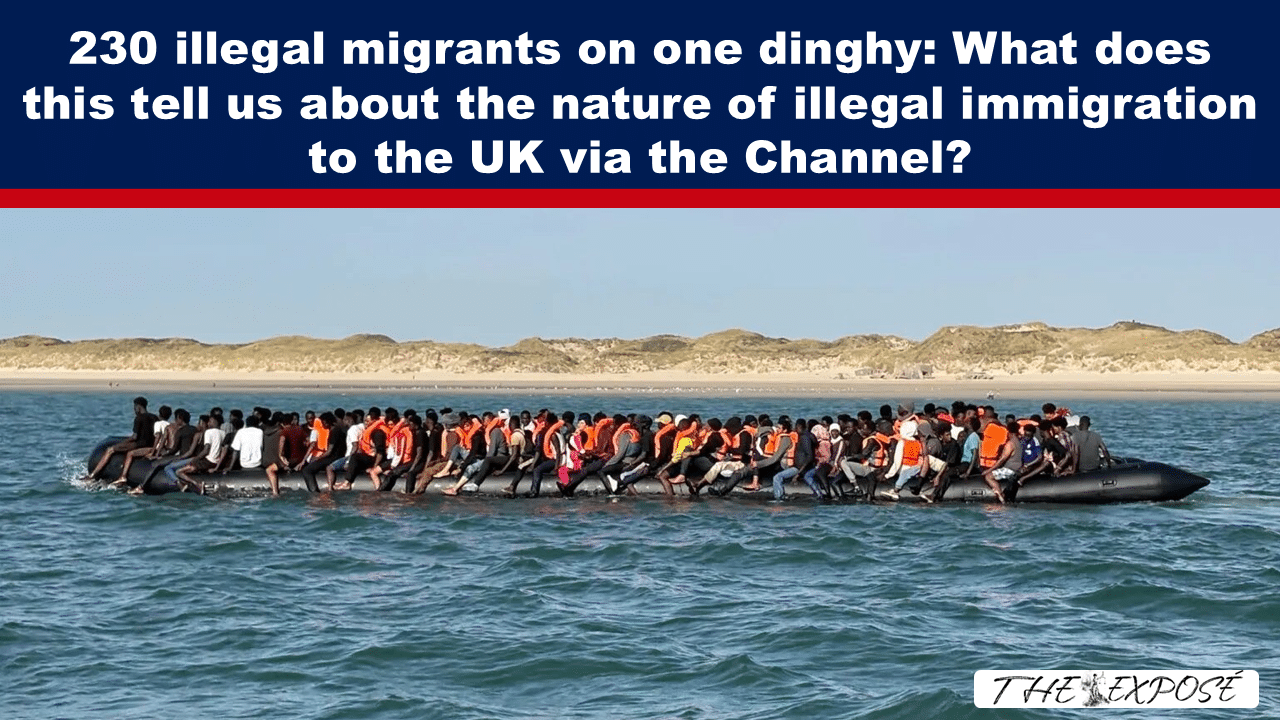
The 230 migrants packed onto a record-breaking mega-dinghy show how radically Channel migration has changed: fewer boats are getting through, but each carry far more people and launch areas now stretch into Belgium.
Behind the crossings is an increasingly professional industry, largely run by Iraqi–Kurdish networks, moving Chinese-made equipment through Türkiye and Germany to northern France.
Let’s not lose touch…Your Government and Big Tech are actively trying to censor the information reported by The Exposé to serve their own needs. Subscribe to our emails now to make sure you receive the latest uncensored news in your inbox…
Mega-Dinghy Carrying 230 Reveals New Channel Migration Model as Industry Adapts
By Joakim Scheffer, as published by the Hungarian Conservative on 12 August 2026
A record 230 migrants crossed the English Channel to Britain in a single inflatable boat on Monday, 10 August, the largest number ever recorded on one small vessel, as human trafficking gangs increasingly turn to heavily overloaded “mega-dinghies” to evade tighter enforcement and patrols on the French coast.
The record came only weeks after boats carrying 128 and 165 people broke the previous ones. Six days earlier, another mega-dinghy carrying 173 people caught fire and capsized, forcing a large-scale rescue operation.
Despite the ever-growing number of illegal migrants one boat carries, the scale of migratory pressure itself has decreased across the Channel. By 10 August, 15,472 people had reached Britain on 229 small boats, 42 per cent down from the previous year. Similarly, July was the quietest July since 2020.
That contradiction is increasingly defining the Channel: fewer people are getting through overall, but the boats that do are becoming much larger.
The average Channel boat carried only seven people when the route emerged in 2018. By 2025, the National Crime Agency put the average at 62, up from 53 a year earlier, even as the number of successful boats fell from 695 to 672.
That doesn’t necessarily mean that the so-called “dinghies” have become more developed or safer through the years. In fact, they remain cheap, flexible inflatables, which are the most cost-effective solution a smuggler can use regarding capacity, portability and disposability. There are, however, significant changes in how they are used.
While boats were launched straight from the coast of Calais in the direction of Dover at the beginning, so-called taxi boats now launch with a small group from a quieter location and then move along the coast, collecting passengers waiting in shallow water. British authorities now list taxi boats alongside simultaneous launches, diversions and deliberate overloading among the principal tactics used to frustrate French police, whose powers have significantly increased regarding both coastal patrols and sea interceptions.
From Just Another Migration Route to an Entire Industry
At its peak, around 2022, the market built around illegal Channel crossings was worth around €150 million, with networks earning as much as around €920,000 per month. That has decreased significantly since then: Belgian authorities reported a roughly €2,000 fare; taken with the 15,472 successful crossings, it could have generated up to €31 million at the upper-end estimate by August. Nevertheless, while the market value has decreased, the industry is far from broken; it has become more specialised and adapted to the operational changes.
Behind the dinghies is now a supply chain extending thousands of miles beyond Calais. The British National Crime Agency’s 2026 strategic assessment says equipment is typically sourced from China, assembled in Türkiye, stored in Germany and then transported to northern France. It also says that alternative supply routes are increasingly emerging to avoid tighter controls at certain borders, most notably the Turkish–Bulgarian border at Lesovo, which was, until now, one of the main gates for smuggling equipment from China flowing into the European Union.
China remains the main manufacturing source, similarly to much of the market for cheap imported plastic goods. The British government says more than half of the engines used by Channel smugglers are made there and signed an agreement with Beijing in January to share intelligence and engage manufacturers before the equipment reaches European networks. In 2025, Britain sanctioned Chinese company Weihai Yamar Outdoors Product Co, accusing it of manufacturing inflatable boats advertised for people smuggling.
“The Channel operation grew from an improvised smuggling route to a highly organised criminal service industry in less than a decade”
The phenomenon is familiar in the EU: in May 2017, during the height of the Mediterranean illegal migration crisis, Commissioner Dimitris Avramopoulos raised the issue of Chinese-made migrant boats in Beijing, asking for help to “track down” the business and “dismantle it.” Nine years later, the problem is still there, although it moved to the Channel in 2018.
A similarly important part of the supply chain is Türkiye, which serves as the hub for this equipment before it passes to Europe, more precisely, into Germany, which is the warehouse and wholesale centre of the network. A Eurojust-led investigation in March found Asian-made equipment brought into Germany from Türkiye by land and sea, then assembled into packages worth more than €10,000 before being sold to smuggling networks in northern France. Searches in Germany and Belgium resulted in four suspected organisers being arrested and 11 boats, weapons, cash and communications equipment being seized.
A separate operation in North Rhine-Westphalia in May found more than 30 boats, more than 20 engines, 360 pumps and more than 9,000 life jackets. Some had already been bundled into “go kits,” consisting of a boat, engine, pump and fuel, ready to be driven to France. The National Crime Agency (“NCA”) said the seized boats could have carried more than 2,000 people.
Turkish national Adem Savas shows how developed the business has become. Investigators say he supplied thousands of boats and engines between 2019 and 2024, including equipment used in about half of all Channel crossings in 2023. He shipped equipment from Türkiye, stored it in Germany and moved it onwards towards northern France.
He was identified through the investigation of Kurdish smuggling boss Hewa Rahimpur, whose Europe-wide network was believed to have moved more than 10,000 people across the Channel. Savas was sentenced in Belgium in January to 11 years in prison and fined €400,000.
The Channel operation grew from an improvised smuggling route to a highly organised criminal service industry in less than a decade. Chinese manufacturers supply much of the equipment; Türkiye and other transit routes move it into Europe; German warehouses store and assemble complete boat packages; and smugglers then transport them towards northern France and Belgium. Kurdish- and Syrian-linked networks connect these suppliers with coastal crews.
Many of the senior organisers remain further upstream, particularly in Iraqi Kurdistan, while local recruiters and online advertising bring in customers and arrange departures. Payments can then move through hawala brokers or businesses in Britain and continental Europe, sometimes being held until a crossing succeeds.
New Model of Channel Migration
Law enforcement has industrialised alongside the smugglers. Britain’s new three-year agreement with France allocates €584 million to strengthen controls in northern France and another €188 million to measures whose funding will depend on results. The personnel, funded by Britain, are due to increase from 907 to 1,392, including special units, surveillance equipment, drones and helicopters.
The disruption rate rose 46 per cent in 2025–2026, with almost 2,000 arrests made in Britain and overseas, while more than 500 pieces of equipment used in small boats were seized in 2025, according to the Border Security Commander. France similarly prevented more than 20,000 attempted crossings.
Evidence of the lasting impact on the gangs’ underlying business models, however, “remains limited” according to the same report. Networks have responded by changing supply routes, launching several boats simultaneously, using taxi boats and overloading those that survive enforcement.
The geography is also changing. A British Home Office report has recently found “moderate evidence” that tighter control has made France a less viable launch point for smugglers. Belgian police had already recorded 17 small-boat departures by early April, compared with no more than two in any year since 2021.
The shift remains small beside departures from France, but Britain has already created a Belgian task force. Its own strategy now treats “France and near neighbours” as a single operational theatre. Launches have also moved farther south along the French coast. The mega-dinghy that caught fire on 4 August departed near Dieppe, well outside the traditional Calais–Dover corridor.
“With the appearance of mega-dinghies, the underlying humanitarian risk of crossing the Channel has increased significantly”
The nature of the problem has also evolved at a fast pace. With the appearance of mega-dinghies, the underlying humanitarian risk of crossing the Channel has increased significantly. Authorities have already warned that overcrowded small boats are ‘too fragile’ for direct intervention once at sea at full capacity, because physically stopping them creates an immediate risk of a mass-casualty event. Once a heavily loaded vessel is offshore, the task can shift rapidly from law enforcement to surveillance and rescue.
French rescuers are also openly warning about the consequences if one of these craft fails catastrophically. Gérard Barron, head of the Boulogne-Sur-Mer branch of the SNSM, said rescuers feared having to pull 200 people from the water at once. Authorities also say there is effectively “no limit” on how many migrants can be crammed into such mega-dinghies.
Smugglers already use simultaneous launches to stretch police resources. Imagine if the same tactic is combined with boats carrying 150 to 230 people; multiple failures could risk overwhelming rescue forces and increase the potential for a large-scale tragedy.
That is the next stage of the Channel problem. The old model is being squeezed: France is harder to launch from, equipment is costlier and major suppliers are being jailed. But the industry has so far answered with fast adaptation. The new model has increasingly stretched launch areas, from southern France to Belgium; alternative supply routes; and unprecedented passenger loads.
About the Author
Joakim Scheffer graduated from the University of Szeged with a Master’s degree in International Relations. Before joining the Hungarian Conservative, he worked as an editor at the foreign policy desk of the Hungarian daily Magyar Nemzet. In addition to his role at Hungarian Conservative, he serves as the editor of Eurasia magazine.
The Expose Urgently Needs Your Help…
Can you please help to keep the lights on with The Expose’s honest, reliable, powerful and truthful journalism?
Your Government & Big Tech organisations
try to silence & shut down The Expose.
So we need your help to ensure
we can continue to bring you the
facts the mainstream refuses to.
The government does not fund us
to publish lies and propaganda on their
behalf like the Mainstream Media.
Instead, we rely solely on your support. So
please support us in our efforts to bring
you honest, reliable, investigative journalism
today. It’s secure, quick and easy.
Please choose your preferred method below to show your support.

Categories: Breaking News, Latest News, World News
What does this tell us about the nature of illegal immigration..?Simple Answer: This tell us about funded & sponsored by United Nation.
Those immigrants are brave enough to enter (infiltrate) any countries because they are promised of protection by hiding behind (wear a mask of) religions & United Nation’s UNHCR program.
This is a simple math of deliberate orchestrated plans by the FIRST CLASS human smuggling organization called United Nation.
Can anyone give me concrete evidence those immigrants are from some country to another country..?
Do not forget of about soulless NPCs (Non-Playable Clones) that pop-up suddenly in large number, This is not science fiction, PEOPLE!.
Cloning technology already existed in ancient time.
Rewind the 19th century, French obstetrician Stéphane Tarnier adapted poultry incubators for human use, leading to the first successful designs. Martin Couney (Con-ey) popularized these incubators in the early 20th century by “SHOWCASING FREAK SHOW” cloned baby in amusement parks at Con-ey Island.
Did anyone notice grumpy, sad & old Trump suddenly changed his hair colour & look better (younger)…?
Just reminding all of you about current deception & lies. Don’t shoot the messenger, please..!
All young men, where are the women and children? Surely they would be brought if there was an real danger🥵
These are the future UN army/soldiers to be deployed against the Europeans.
It’s all obviously very deliberate. I don’t know but I always think George Sore Arse is in there somewhere, possibly contributing to fund it in alignment with his homogenised “open society foundation” and his seeming wish to destroy the Christian-based societies of Europe. It also aligns with the NeoCons “perpetual global warfare” and “forever wars” ideal. I’m reminded of Sun Tzu’s observation that the most powerful weapon in any war is spies. Would be good to try and get into what’s truly motivating all this and deal with it as a “root cause” …..
Do these traffickers use a new boat for every crossing ? No, they don’t have to, because the British Government pays a company (with taxpayer money) to collect the boats, load them onto lorries and return them to France to the traffickers.
Hey stitchywitch, how do you know this, do you have proof of this? if you say things without proof it is considered a lie. you con end up in hot water.
Everything we see these days is a smoke screen for Biodigital convergence revolution, which is happening now.
But no one is asking the right question. Why do they come on boats, a very expensive way to travel to the UK, when they could simply get on a plane, easier and much cheaper? I think we all know the answer, they throw their passports in the channel, their identities. They cannot do this on a airline. So, they are paying a fortune for their anonymity, to hide who they really are. I don’t need to know the details, these liberty takers are the scum of the Earth.
Only a small portion of those immigrants are scum, look at the reasons for comming here, and the reasons they fled their own country. If it was “nice” there they would not need to leave. something about distribution of wealth comes to mind…
Surely, if the government were serious about out ending the crossing it could employ our own special forces to eliminate the traffickers. Or, failing that, rival Iraqui Kurd mercenaries to assassinate the traffickers.
I am making a prediction, we will see a massacre in a village like Piddington. When they impose 1,250 potential Axel Rudikabanas on a village of 400 people with few police officers in the area, it becomes impossible to police.
I predict that a village will see rape, pillage and the slaughter of many of the men, and women and children. It happens in Africa, see what the RSF, Boko Haram and many other groups do.
Import the third world, become the third world.
Blame our govt they have the means, but not the mind, the distruction of our country is in jeppeardy….did i spell that right?
Emmm… Nope! Jeopardy should be correct.
Who cares…. Jab-paddy or jep-peardy still sound good & pronounced the same to me.
I agreed with the Gov have means but no brainer. All people that govern us are those with level of Carrot IQ of money grubber.
They just sit & wait idly for easy monthly huge paychecks. No thinking required. Never about good governance, just selfish desires.
I’m not too troubled by a large scale tragedy at sea because these people are not concerned about the large scale tragedy they wreak on this country. In fact a well publicised large scale tragedy may have the desired effect of discouraging the illegal entry to my country.
If france didnt let them,and uk sent them back the numbers would be better and less of them is more manageble.