














In 1802, a statement was put to the UK House of Commons that vaccination was “entirely safe” and granted “lifelong immunity.” That statement has been revised over time, but it has never been formally retracted.
Roman Bystrianyk has collected evidence and testimonies regarding early smallpox mass vaccination campaigns, beginning in 1799 and spanning more than a century, proving that the “safe and effective” mantra has always been a lie.
Let’s not lose touch…Your Government and Big Tech are actively trying to censor the information reported by The Exposé to serve their own needs. Subscribe to our emails now to make sure you receive the latest uncensored news in your inbox…
Traitors to the Royal Vaccinating State
By Roman Bystrianyk, 21 September 2026
Table of Contents
Introduction
“At one time it was believed and generally understood that after we had once had the disease we were for ever secure against it, but it is now proved that a second and even a third attack is by no means uncommon among persons of a peculiar habit of body, and whose lives are spent in opposition to all sanitary laws. This error led to that blind infatuation of being inoculated for the Small-pox which became so fashionable in the last century, and which, after much controversy, was adopted by the London College of Physicians, who considered it ‘highly beneficial to mankind’.”—William Job Collins, MD, twenty-five years public vaccinator, London, England, 1869[1]
“Millions of vaccinations are made every year, and nobody knows what they are made with. The whole process is a haphazard game with chance. Vaccination was accepted on the simple dictum of Jenner that it would stamp out smallpox. The medical profession of today buys its vaccinal virus of those who make merchandise of it on their simple dictum that it is the right thing to use … I compiled a list of upwards of a thousand instances of persons who had suffered permanent injury, or death [from vaccination] … Of these, nine have been personally known to me.”—George William Winterburn, PhD, MD, author of The Value of Vaccination: A Non-partisan Review of Its History and Results, 1886[2]
“Cow-pox was exceedingly virulent and fatal disease coming to fag end of its career in Jenner’s time. He found it difficult to get lymph from the cow, and therefore he resorted to the heels of horses; and the original lymph we use from the Royal Vaccine Institute has never been vaccine lymph at all; from the day it was introduced into London to the present time – it was derived from the arm of Jane King, who was inoculated from a horse with greasy heels.”—John Le Gay Brereton, Esq., MD, MRCS, LAC, 1881[3]
“This madness – first filtered through the brain of Jenner by the superstitious old women of Berkeley and its neighbourhood, who had long secretly practised vaccination upon children – was, after some few years of hard fighting, transmitted to Sir Gilbert Blane and a few of his class; and as these were the great ‘medicine men,’ whose wisdom excelled all others, the delusion was soon shared by the King. From the King it passed to the Court, from the Court to the Government, from the Government to the profession, and from the profession to all who readily move by example in high places. In this way, not England alone, but every part of the civilised world, more or less, went mad; and humanity is now reaping its reward – not in the extirpation of small-pox, as promised by these fanatics, but in the increase of diseases more frightful in their character, and in their general results more fatal.”— Dr. Skelton, Licentiate in Medicine and Surgery, London and Edinburgh[4]
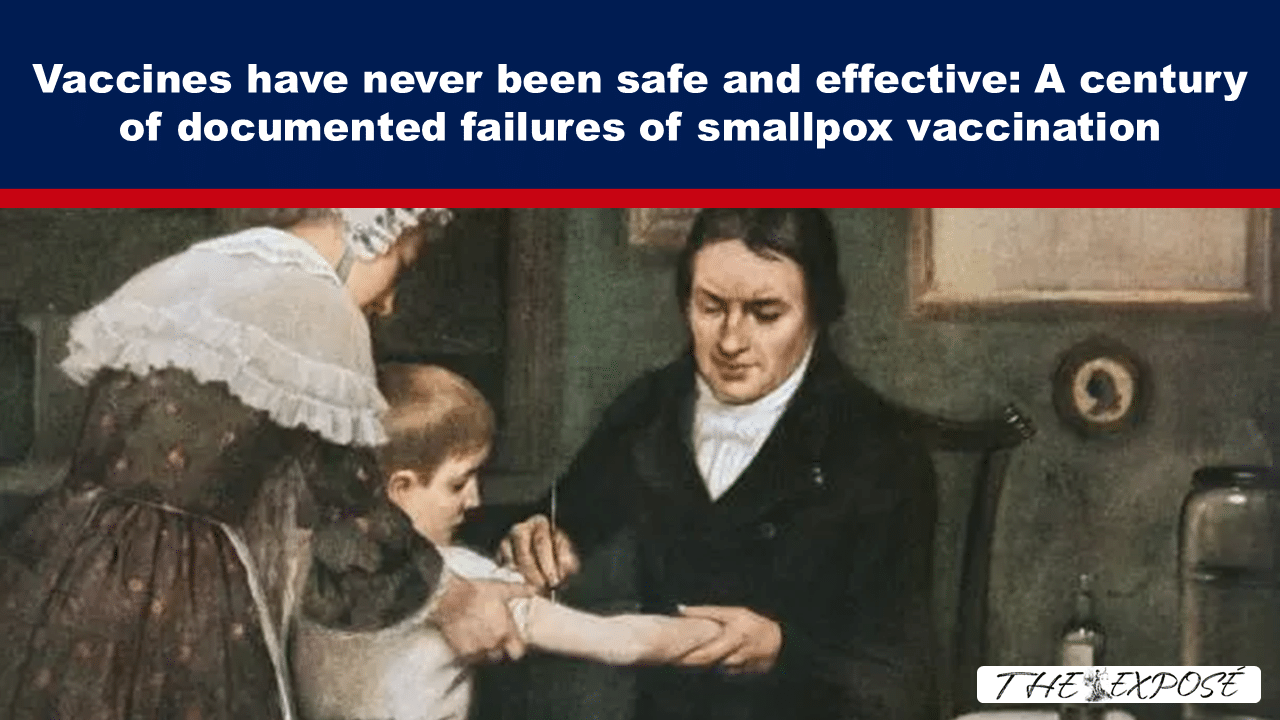
In 1796, Edward Jenner tested a popular belief: that cowpox protected against smallpox. He obtained cowpox material from a milkmaid and used it to inoculate an eight-year-old boy named James Phipps, whom he then deliberately exposed to smallpox. Because the boy did not fall ill, Jenner concluded that the procedure – cowpoxing, later given the more scientific-sounding and mysterious name vaccination (from vacca, Latin for cow) – was effective and conferred lifelong protection. On 17 March 1802, he informed the House of Commons that vaccination was entirely safe, granted lifelong immunity and would rid the world of smallpox.[5]
From the outset, however, many regarded this new notion – built on eighty years of smallpox inoculation – as anything but safe or effective. Yet the idea took hold almost immediately. As Dr. William Rowley, MD, observed in 1805 – less than a decade since vaccination had started – “Whoever had not taken the oaths of supremacy and allegiance to vaccination, or who dared to doubt the infallibility of Cow-pox inoculation even in its infancy, even before any judgment could be formed, were ignominiously treated as traitors to the royal vaccinating state, as rebellious subjects to the Jennerian despotic power.”[6] Decades later, Dr. Charles Creighton likewise noted how firmly this idea had taken root: by 1801, he wrote, professors and others of his class “on the Continent as well as in England were already deeply committed“ and that “anyone who undertakes to answer for Jenner and his theories, must shatter his own reputation for scientific and historical knowledge.”[7]
What follows is not a history of vaccination’s triumphs but a record of its failures – drawn almost entirely from the testimony of physicians who witnessed them firsthand. The timeline that unfolds across the following decades chronicles smallpox vaccination’s inability to shield against the very disease it promised to conquer, together with the injuries and deaths that followed in its trail. The quotations assembled here, spanning 1799 to 1910, call into question the triumphant narrative so widely accepted about this medical intervention.
1799
In 1799, Dr. Drake, a surgeon from Stroud, England, undertook an experiment to assess Jenner’s new preventive measure, using vaccine material obtained directly from Edward Jenner. The children were subsequently challenged with a smallpox inoculation to determine whether the cowpox procedure had conferred protection. The so-called protection failed.
“In three of them, a lad aged seventeen and two of the Colborne children (one four years, the other fifteen months), the cowpox vesicles came to early maturity and were scabbed under the usual time. The lad was inoculated with smallpox on the 20th December, being the eighth day from his vaccination, and the two children on the 21st, being again the eighth day. They all developed smallpox, both the local pustules and the general eruption with fever.”[8]
1801
Dr. Charles Creighton, writing in 1890, described how a professor at Göttingen confronted forty-five cases of smallpox among forty-nine recently vaccinated children – and still refused to abandon the practice (emphasis added):
“In a small town of Brunswick, forty-nine [49] children were vaccinated with lymph “of the clearest and freshest kind,” and with a typically correct result, during the months of June and July, 1801. In the course of August, September, and October, following, forty-five [45] of these same children caught smallpox in the epidemic. [92%] A professor from Göttingen went to inquire, and admitted the facts as I have stated them. “Shall we therefore abandon vaccination?” he asks. His answer was emphatic: Gewiss nicht! [Definitely not!] He made up his mind to “bluff it,” with the help of a little metaphysics; and a Giittingen [sic] professor “bluffing it” is a spectacle for Gods and men. The professor’s “certainly not” was really a non possumus [we cannot], because he and all his class on the Continent as well as in England were already deeply committed. The refusal of the professional leaders to go back upon their mistake, when it was abundantly proved to be a mistake, has become an inherited obligation of hard swearing to successive generations. Things have now come to such a pass that anyone who undertakes to answer for Jenner and his theories, must shatter his own reputation for scientific and historical knowledge. Most of those who have a reputation to lose decline the challenge.”[9]
1804
By 1804, Goldson of Portsea had already published cases of smallpox occurring “within two or three years of vaccination.”[10]
1805
Dr. William Rowley, MD, Physician to Her Majesty’s Lying-in Hospital, published ‘Cow-pox inoculation NO SECURITY against Small-pox infection’, documenting numerous instances in which vaccinated children contracted smallpox despite the confident claims of invulnerability made by those administering the vaccinations.
“As to temporary security by Cow-pox inoculation against Small-pox infection, there exist so many opposing facts to this chimerical idea, from children having had Small-pox from two months to six years after passing through regular vaccination, with the scars on both arms, that this, like the other vaccination extravagances, is perfectly refuted by FACTS … even temporary expectation from Cow-poxing in preventing Small Pox is vain, idle, irrational, and inconclusive, except in the credulous [gullible] minds of vaccinating, disappointed zealots, shifting their ground from one absurdity to another, until they have no ground to stand upon whatever.[11]
“… it is just to infer that millions who have been supposed secure through the imaginary infallibility of Cow-pox inoculation may, and probably will, hereafter become victims to Small Pox and perish by its epidemic malignity, which has actually happened in various parts of the metropolis.[12]
“It is known and must be acknowledged by every penetrating and candid observer, that they have constantly and uniformly opposed, crushed, and never honourably promoted any regular system of fair inquiry. If they met it was to stifle, pervert, virulently, or indecently to abuse every man who wrote or spoke against their attracting interested object. Whoever had not taken the oaths of supremacy and allegiance to vaccination, or who dared to doubt the infallibility of Cow-pox inoculation even in its infancy, even before any judgment could be formed, were ignominiously treated as traitors to the royal vaccinating state, as rebellious subjects to the Jennerian despotic power.”[13] [Emphasis added]
1806
Dr. Squirrel of the Small-pox Hospital, St. Pancras, observed in 1806 that the public had become so alarmed by post-vaccinal smallpox that they rejected both inoculation methods altogether. As he reported (emphasis added):
“The daily occurrence of Small-pox subsequent to vaccination, has so much alarmed and intimidated the public, that they have refused both of the inoculations for as they very justly remarked, if the one be attended with such dreadful consequences as the vaccinators have pointed out, and the other experience tells us affords no security against the small-pox, we will make use of neither, but trust to the will of Divine Providence.”[14]
1809
In 1809, Brown of Musselburgh recorded 48 cases of children who had caught small-pox “within three, four, five, six, seven, eight, nine, and ten years of their vaccination.” Brown was compelled to conclude “that vaccination even in the most perfect form is not only incapable of imparting permanent security against small-pox, but even of retaining the system in that state of impregnation capable of only allowing it to exercise its influence to a safe or trifling extent.”[15]
Also, in 1809 the Medical Observer reported a series of patients demonstrating the failure of natural cowpox or vaccination to protect against smallpox:
1. A Child was vaccinated by Mr. Robinson, surgeon and apothecary, at Rotherham, towards the end of the year 1799. A month later it was inoculated with small-pox matter without effect, and a few months subsequently took confluent small-pox and died.
2. A woman-servant to Mr. Gamble, of Bungay, in Suffolk, had cow-pox in the casual way from milking. Seven years afterwards she became nurse to Yarmouth Hospital, where she caught small-pox, and died.
3 and 4. Elizabeth and John Nicholson, three years of age, were vaccinated at Battersea in the summer of 1804. Both contracted small-pox in May, 1805 and died …
13. The child of Mr. R died of small-pox in October 1805. The patient had been vaccinated, and the parents were assured of its security. The vaccinator’s name was concealed.
14. The child of Mr. Hindsley at Mr. Adam’s office … died of small-pox a year after vaccination.[16]
1810
Charles Maclean, MD, published an extensive work, ‘On the State of Vaccination in 1810’, examining the shortcomings of vaccination. Within its pages, he meticulously presented tables filled with names of people, accompanied by references, which revealed a staggering 535 cases of smallpox emerging after cowpox inoculation. Additionally, the records indicated 150 fatalities resulting from either smallpox or adverse reactions to cowpox after cowpox vaccination.[17]
“Very few deaths from cow-pox appear in the Bills of Mortality, owing to the means which have been used to suppress knowledge of them. Neither were deaths, diseases and failures transmitted in great abundance from the country, not because they did not happen, but because some practitioners were interested in not seeing them, and others who did see them were afraid of announcing what they knew.”[18] [Emphasis added.]
“… the practice of vaccination is absurd, superfluous, and worse than useless. But as, in numerous instances, death has happened from small-pox after cow-pox; and as cow-pox produces other diseases, of which many cases have terminated in death; the practice is directly, positively, and extremely pernicious to society. And, as having been the medium of defrauding the public probably of millions of money, which never has been accounted for, and for which vaccinating adventurers have been scrambling and fighting in the name of philanthropy, I hold it to be an imposture, not simply disgraceful to science, pernicious to health, and dangerous to life; but destructive to the morals of the faculty, and injurious to the purses of the community.”[19] [Emphasis added.]
1817
In 1817, a medical journal acknowledged what practitioners had been reluctant to state publicly – that smallpox was appearing “alarmingly” often in patients who had been vaccinated by “the most skilful practitioners” (emphasis added):
“Variola [smallpox,] above all, continues and spreads a devastating contagion. However painful, yet it is a duty we owe to the public and the profession, to apprise them, that the number of all ranks suffering under Small Pox, who have previously undergone Vaccination by the most skilful practitioners, is at present alarmingly great. This subject is so serious, and so deeply involves the dearest interests of humanity, as well as those of the medical character, that we shall not fail in directing our utmost attention to it.”[20]
1818
In 1818 Dr. Monro of Edinburgh published numerous cases observed by himself and others in which smallpox in its perfect form succeeded to vaccination in its perfect form. Smallpox remained epidemic in Scotland, attacking many hundreds of the vaccinated to varying degrees.[21]
In 1818 Thomas Brown, a surgeon with 30 years of experience in Musselburgh, Scotland, recounted how no one in the medical profession “could outstrip me in zeal for promoting vaccine practice.” But after vaccinating 1,200 people and discovering that many still contracted and even died from smallpox, his conscience could no longer support vaccination.
“Experience has also shewn [shown], that the natural small-pox have made their appearance, when the vaccine puncture had previously existed, surrounded with the areola of the most perfect appearance for more than two days, and not in the least modified, but in the highest degree confluent, and followed by death. Small-pox pustules, too, existed within the very areola of the vaccine puncture … The accounts from all quarters of the world, wherever vaccination has been introduced … the cases of failures are now increased to an alarming proportion; and from a fair and impartial examination appears, where the small-pox contagion has access to operate upon vaccinated cases of upwards of six years standing, and the contagion applied in a concentrated and lasting form, nearly the whole of such cases will yield to the influence of the small-pox contagion.”[22] [Emphasis added.]
1820
Dr. Thomson published a book in 1820 on the varioloid type of the disease. In 1819, nineteen, and in 1825, 147 vaccinated persons were admitted with smallpox into the London Small-Pox Hospital.[23]
By 1820, only two decades after Jenner’s promise of lifelong immunity, a medical journal reported that post-vaccinal smallpox had become so ordinary that it “no longer excited any interest” – including seven vaccinated children in one family, all stricken (emphasis added):
“Cases of small pox after cow pox, are become so common, as no longer to excite any interest. In one family we lately met with seven children laid up with small pox, all of whom had been vaccinated, some eight years, and others four years ago.”[24]
1828
The theory that ascribed to vaccination the reduction of smallpox in the earlier years of the century, in some places to the point of extinction, received a rude shock when in 1828 a severe epidemic broke out at Marseilles and 2,000 vaccinated persons caught the disease.[25]
1829
Writing in The Lancet in 1829, Mr. Fosbroke recalled the epidemic of 1820-1822, which not only reached Dr. Jenner’s own household but “fell upon great numbers” of the vaccinated (emphasis added):
“… during the years 1820, 1, and, 2 [1820–1822] there was a great hubbub about the small-pox. It broke out with the great epidemic to the north … It pressed close to home to Dr. Jenner himself … It attacked many who had had small-pox before, and often severely; almost to death; and of those who had been vaccinated, it left some alone, but fell upon great numbers.”[26]
In 1829 William Cobbett, a farmer, journalist and English pamphleteer, wrote about the failure of vaccination to protect people from smallpox.
“In the midst of all this mad work, to which the doctors, after having found it in vain to resist, had yielded, the real small-pox, in its worst form, broke out in the town of Ringwood, in Hampshire, and carried off, I believe, more than a hundred persons, young and old, every one of whom had had the cow-pox “so nicely!” And what was now said? Was the quackery exploded, and the granters of the twenty thousand pounds ashamed of what they had done? Not at all: the failure was imputed to unskilful operators; to the staleness of the matter; to its not being of genuine quality … what do we know now? Why, that in hundreds of instances, persons cow-poxed by JENNER HIMSELF [Cobbett’s emphasis], have taken the real small-pox afterwards, and have either died from the disorder, or narrowly escaped with their lives!”[27] [Emphasis added.]
1836 to 1851
Mr. Marson records 3,094 cases of post-vaccinal small-pox treated by him at the Highgate Hospital between 1836 and 1851, and a further series of 10,661 such cases between the years 1852 and 1867.[28]
1842
In 1842 Thomas Brown of Musselburgh, Surgeon, published ‘An Investigation of the present Unsatisfactory and Defective State of Vaccination’ (emphasis added):
“…it surely would be unreasonable to expect the public should continue their patronage and confidence, when their safety is positively and confessedly in the greatest danger; and it would be downright madness to imagine they ought, or will continue to adopt vaccination, as a defence against small-pox, when experience has proved that no one who trusts to that practice is protected, or his life safe against the variolous epidemic, but must fly from it for safety; and more especially when even now, seven or eight of every hundred vaccinated cases have, for some years past, fallen a prey to small-pox, which exceeds twenty times the number that died from inoculation with small-pox; and also, as far as present experience goes, much above a half of all who have placed their security in vaccination have undergone an attack of small-pox, and that there is no security for any one who has undergone vaccination, as a protection against the variolous epidemic.”[29]
1843
Dr. Gregory, who gives a table showing the number and mortality from small-pox in the well-vaccinated population of Copenhagen from 1824 to 1835, reports that of 3,839 persons attacked by small-pox, no fewer than 3,093 had been vaccinated. It was these figures that led Dr. Gregory, the physician to the Small-Pox Hospital, in 1843, to declare “that some material error had crept into the views originally entertained regarding the power and capabilities of the vaccine inoculation. If small-pox can invade so large a proportion of a well-vaccinated population, it is obvious that all idea of banishing that disease from the earth is vain and illusory.”[30]
1850
A letter to a newspaper in 1850 asserted there were more admissions to the London Small-Pox Hospital in 1844 than during the smallpox epidemic of 1781 before vaccination began (emphasis added):
“Daily experience now unhappily shows an altered state of things: small pox, in spite of vaccination, is rapidly on the increase … There were more admissions to the London Small-Pox Hospital in 1844 than in the celebrated small-pox epidemic of 1781 before vaccination was introduced. I shall also select the Registrar’s returns of one of the country districts (Bradford) to show how little protection vaccination afforded in the last quarter of that year, 1844: 181 deaths from small-pox were recorded, 60, or nearly one-third, of which had been vaccinated.”[31]
1854
In 1854, The Morning Chronicle reported cases of “small-pox confluent, unmodified” in patients bearing the scars of successful vaccination – and, in the same column, two infant deaths following vaccination:
“…a boy from Somers-town, aged 5 years, “small-pox confluent, unmodified (9 days).” He had been vaccinated at the age of 4 months; one cicatrix… the wife of a labourer, from Lambeth, aged 22 years, “small-pox confluent, unmodified (8 days).” Vaccinated in infancy in Suffolk; two good cicatrices… the son of a mariner, aged 10 weeks, and the son of a sugar baker, aged 13 weeks, died of ‘general erysipelas after vaccination, effusion of the brain.’”[32]
1869
Writing in 1869, as vaccinated children continued to die of smallpox and revaccination was being urged with increasing frequency, Dr. William Job Collins asked how often the “disgusting and unnatural practice” must be repeated – and whether the whole scheme should not be denounced as “a farce and a sham”:
“… we hear daily of children dying of Small-pox who have been vaccinated, I wonder who will be found bold enough (considering that all the schemes hitherto have failed) to say how often this disgusting and unnatural practice is to be performed; whether it is to be every six or twelve months, or every three years, or whether the whole scheme shall not be denounced as a farce and a sham, which would have died a natural death, had it not been for the legislative interference and the vested interests at stake.”[33]
1870 to 1883
Dr. Gayton, during the years 1870 to 1883, treated 8,234 cases of smallpox in vaccinated persons in the hospitals of the Metropolitan Asylums Board.[34]
1879
By 1879, with vaccination enforced by Act of Parliament, Dr. William Hycheman argued that smallpox had increased in both extent and frequency since the law took hold – and, drawing a direct parallel between the two diseases, catalogued the fatal injuries he had found in the bodies of vaccinated children (emphasis added):
“… since blood-poisoning of our children was enforced by Act of Parliament, small-pox has increased both in extent and frequency. Now vaccination by calf-pox, cow-pox, or humanised pox, whatever may be the multiplicity of lymphs, (and “pure vaccine” is only a rhetorical euphemism for horse-grease) is an eruptive disease, setting in with febrile symptoms, followed by papule, vesicle, and pustule, in about eight days. And what else is small-pox?
I have recently dissected more than a dozen children whose deaths were caused by vaccination, and no small-pox, however black, could have left more hideous traces of its malignant sores, foul sloughing, hearts empty or congested with clots, than did some of these little victims. Shame! Indeed, scarcely a day elapses but I am called upon to witness the sufferings of vaccinated children in the form of cerebral and gastric complications, persistent vomiting, bronchitis, diarrhoea, with pustules in the mouth or throat (pharynx), on the eyelids, and ulceration of the cornea, which remains opaque and may lead to blindness.”[35]
1882
Writing in the National Board of Health Bulletin in 1882, a physician warned that vaccine matter distributed by the New England Vaccine Company had produced severe reactions in nearly every person vaccinated (emphasis added):
Our town authorities have employed a physician to vaccinate all persons presenting themselves for the purpose. The “virus” was furnished by the town, and procured from the New England Vaccine Company, Chelsea, Mass., as “bovine matter.” The result has been fearful. Nearly every one vaccinated has suffered severely from erythema or erysipelas, the arm swollen from shoulder to wrist, and the point of puncture presenting the appearance of sloughing ulcer discharging freely sanious pus [a thin, fetid, greenish fluid consisting of serum and pus discharged from a wound]. Many of the cases have been confined to bed, with high fever, from five to ten days, requiring the constant application of poultices to the arm and the free use of morphia for the relief of pain.
It is rumoured that the National Board of Health intends to distribute vaccine matter throughout the country. I deem it my duty to inform you of the results here from the matter used and from whence it came. It came in “cones” said to contain (each cone) enough to vaccinate 100 persons, at a cost of $1 per cone. It “takes” in all cases regardless of previous vaccination, as shown by well-pitted marks, and the inflammation begins frequently on the second day. Those who have tried it tell me they would much prefer to have small-pox.[36]
1887 to 1888
Dr. Gayton at Sheffield in 1887 to 1888: 5,035 vaccinated persons were treated for smallpox.[37]
1888
In 1888, a physician who had avoided vaccination since childhood decided to be revaccinated “to make himself doubly sure against danger” – and died of blood poisoning sixteen days later (emphasis added):
“Dr. Stokes, being in active practice, and thrown constantly into contact with infectious diseases, not having been vaccinated since early childhood, determined to be revaccinated, and thus make himself doubly sure against danger. The operation [vaccination] was performed by Dr. Wallace on Saturday, June 2d. On the Monday following he suffered terribly from nausea and other symptoms of poisoning. He gradually got worse, and on the 9th was taken to the city hospital where he became delirious, and death ended his agonies on June 18th. A post mortem examination revealed the fact that his death was due to blood poisoning.”[38]
1898
In 1898, Dr. Wilder observed that during the 1871–1872 pandemic, the vaccinated often contracted severe smallpox more rapidly than the nonvaccinated (emphasis added):
“Never, however, did the faith in vaccination receive so rude a shock as in the Great Small-Pox Epidemic of 1871 and 1872. Every country in Europe was invaded with a severity greater than had ever been witnessed during the three preceding centuries. In England, the number of deaths from the disease was increased from 2,620 in 1870 to 23,126 in 1871 and 19,064 in 1872, falling again to 2,634 in 1873. Upon the Continent, particularly in France and Germany, the visitation was even more severe. In Bavaria, for example, with a population vaccinated more than any other country of Northern Europe, except Sweden, which experienced the greatest that had ever been known. What was even more significant, many vaccinated persons in almost every place were attacked by small-pox before any unvaccinated persons took the disease.”[39]
1902
In 1902, the Pacific Coast Journal of Homoeopathy reported the case of a five-year-old girl who, though in “thoroughly good health before the vaccination,” died twenty days later of a generalised bullous eruption (emphasis added):
“M. R., a female child of five years, was admitted to the St. Christopher’s Hospital, Philadelphia, on October 19th, 1900. The father stated that his daughter had always enjoyed good health, and her only illness had been measles and whooping-cough. The child had been vaccinated on October 2d by the district vaccine physician; the vaccination took, and with the exception of a considerable degree of swelling and inflammation was in no way abnormal. Ten days after it was performed there occurred upon the shoulder of the arm a number of pea- sized blebs. In a few days lesions of a similar character developed upon the neck, and from this point the eruption gradually spread over the body. On admission to the hospital, the trunk was extensively covered with tense shining blebs, varying in size from a pea to a hickory nut … Heart sounds distant, breathing feeble, eyes sunken; the temperature fluctuated between 101° and 103°; the pulse, which on admission was between 140 and 150, slowed down 110 to 120. The patient developed diarrhoea with green stools, sank rapidly, and died three days after admission to hospital. The clear fluid of recent blebs from our patient was examined for bacteria and was found to contain myriads of micrococci, some extremely minute in size. The child was in thoroughly good health before the vaccination; ten days later it was seized with a generalised bullous outbreak, which ended its life in ten days more.”[40]
1903
In 1903, Professor Robert Alexander Gunn, MD, New York Medical College, New York, testified as follows:
“I have been a careful student of the question of vaccination for the past thirty years and I have found the average physician never investigated the subject for themselves, accepting it because of the general belief in its efficacy. I am firmly convinced (1) that vaccination never protected against smallpox, and never has been relied upon to do so; (2) that smallpox, like other zymotic diseases, has decreased because of our better sanitary and hygiene conditions and the disinfection and isolation practiced when the disease is present; (3) that vaccination, as practised now and at all times since its introduction, has caused untold suffering to countless thousands of helpless victims, and that disease, life-long suffering and death have followed in its trail.”[41]
1910
By 1910, with vaccination required for school attendance despite parental protest, Physical Culture published one reader’s catalogue of the injuries she had witnessed – including a fatal case and a young woman left permanently disfigured (emphasis added):
“I saw in one of our evening papers, not long ago, an article on vaccination, in the schools. In spite of the parents’ protests, it is expected that no child not vaccinated will be allowed to attend school. I should like to tell you of a few cases which have come to my notice.
“Two children in one family came down with smallpox one week after vaccination. A boy had smallpox in his arms as the results of vaccination, the arm swelling and turning black until the doctor, very much frightened told him never to allow anyone to vaccinate him again.
“A girl friend of mine was vaccinated on the leg, it swelled and she was very sick and has never been well since.
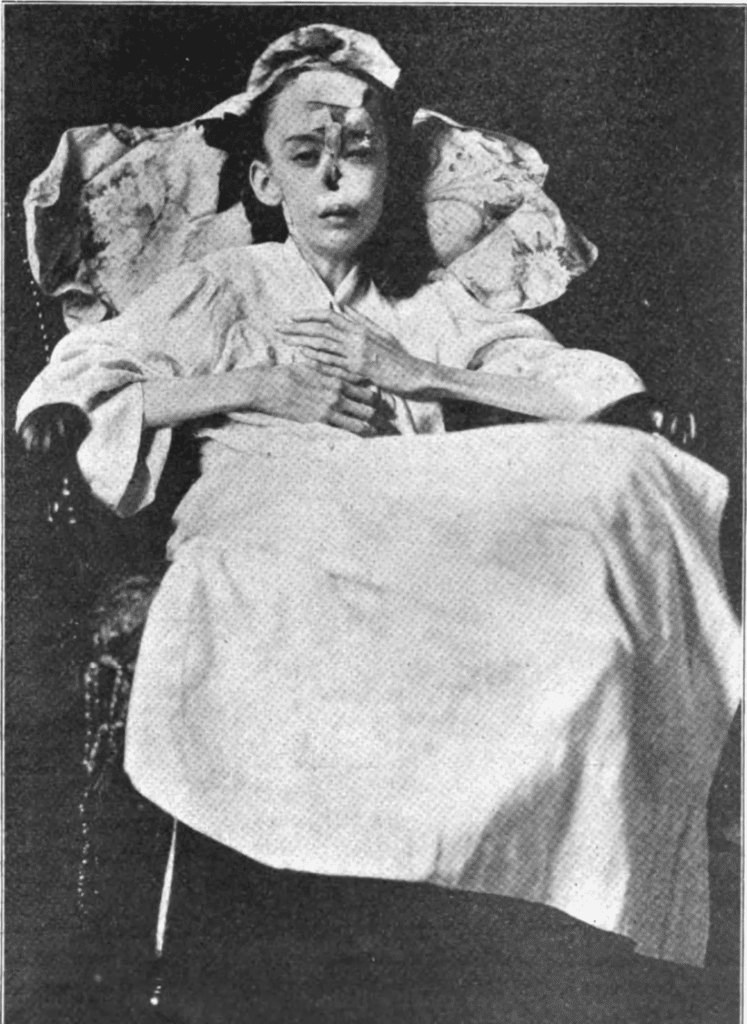
“Another girl after vaccination had boils break out all over her body, the doctors treated her, but she got worse, went into consumption and died. Another case was a young lady in good health and very pretty. She was vaccinated, it poisoned her blood and broke out in eczema on her face, it grew worse steadily. She went to different doctors, they all treated her and from the size of a dollar, it spread all over her face, it has now drawn her lower eye lids down out of shape, eaten the bottom of the nose and the rest of the face looks red and raw and is very painful at times. The once pretty girl. has no hopes of recovery and is forced to cover her face with a heavy veil when she goes out, thanks to the doctors’ treatment.”[42]
Conclusion
The record assembled here spans more than a century, yet its testimony is remarkably consistent. From Dr. Drake’s three children in 1799 to Professor Gunn’s 1903 testimony and the parents’ accounts of 1910, the same pattern recurs: patients vaccinated according to the most approved methods contracted smallpox anyway, often in its most severe and confluent forms, and sometimes died. The same physicians who once championed vaccination – Thomas Brown of Musselburgh, who vaccinated 1,200 people before his conscience turned; Dr. Gregory of the Small-Pox Hospital, who was forced to admit that the “idea of banishing that disease from the earth is vain and illusory” – became its most credible critics precisely because they had once believed.
Equally consistent is the response of the vaccination establishment. Failures were attributed to unskilful operators, stale lymph or spurious matter – never to the theory itself. As Cobbett observed of the Ringwood outbreak, in which more than a hundred vaccinated persons died, “the failure was imputed to unskilful operators; to the staleness of the matter; to its not being of genuine quality.” When the evidence could no longer be explained away, it was suppressed: Maclean noted that “very few deaths from cow-pox appear in the Bills of Mortality, owing to the means which have been used to suppress knowledge of them,” while Rowley described how dissenters were “ignominiously treated as traitors to the royal vaccinating state.” Dr. Stokes, who was revaccinated to “make himself doubly sure against danger,” died of blood poisoning within sixteen days.
By the early twentieth century, the statistical picture was damning. Dr. Gayton treated 8,234 cases of smallpox in vaccinated persons between 1870 and 1883, and another 5,035 at Sheffield in 1887–88. Marson recorded 3,094 post-vaccinal cases at Highgate between 1836 and 1851, and 10,661 more between 1852 and 1867. Gregory found that of 3,839 smallpox patients in well-vaccinated Copenhagen, 3,093 had been vaccinated. These were not isolated failures but the routine experience of the institutions established to treat the disease.
Yet the promise made to the House of Commons in 1802 – that vaccination was “entirely safe,” and granted “lifelong immunity” – was never formally retracted. Instead, it was revised: protection was said to wane, revaccination became necessary, and injuries and deaths went ignored. Dr. William Job Collins saw the revision for what it was, asking in 1869 how often the “disgusting and unnatural practice” must be repeated before the whole scheme was exposed as “a farce and a sham” – one that “would have died a natural death, had it not been for the legislative interference and the vested interests at stake.” The quotations gathered here suggest that this retreat was not a scientific correction but a strategic one – an inherited obligation, as Creighton put it, “of hard swearing to successive generations.”
The timeline ends in 1910, but the debate it records did not. The questions these physicians raised – whether vaccination actually protected, whether it might in fact increase the disease it claimed to prevent, whether its risks outweighed its benefits, and whether its advocates had suppressed evidence to the contrary – would simply fade into the whispers of the past. What remains is the documentary record: a century of medical testimony, largely forgotten, from those who saw the failures with their own eyes – and refused to look away.
Sources and resources
- [1] William Job Collins, MD, Have You Been Vaccinated, and what Protection is it Against the Small Pox? 1869, London, p. 24.
- [2] George William Winterburn, PhD, MD, The Value of Vaccination: A Non-partisan Review of Its History and Results, 1886, pp. 42–43.
- [3] “John Le Gay Bereton, Esq., MD, MRCS, LAC,” New South Wales, Compulsory Vaccination, Presented to the Parliament by Command, September 20, 1881, Sydney: Thomas Richards, Government Printer, pp. 1043–1046.
- [4] Vaccination Tracts. Letters and Opinions of Medical Men, 1892, Province: Snow & Farnham, p. 14.
- [5] John Baron, The Life of Edward Jenner, pp. 490–491.
- [6] William Rowley, MD, Cow-pox inoculation NO SECURITY against Small-pox infection, 1805, London, printed by J. Barfield, sold by J. Harris, pp. 26–27.
- [7] Dr. Charles Creighton, MD, “Vaccination: A Scientific Inquiry,” The Arena, September 1890, vol. 2, no. 4, pp. 436–437.
- [8] Charles Creighton, Jenner and Vaccination, 1889, pp. 95–96.
- [9] Dr. Charles Creighton, MD, “Vaccination: A Scientific Inquiry,” The Arena, September 1890, vol. 2, no. 4, pp. 436–437.
- [10] Final report of the Royal Commission appointed to inquire into the subject of vaccination, London: Printed for Her Majesty’s Stationery Office, by Eyre and Spottiswoode, 1896, p. 171.
- [11] William Rowley, MD, Cow-pox inoculation NO SECURITY against Small-pox infection, 1805, Printed by J. Barfield, sold by J. Harris, London, p. viii.
- [12] William Rowley, MD, Cow-pox inoculation NO SECURITY against Small-pox infection, 1805, Printed by J. Barfield, sold by J. Harris, London, p. 13.
- [13] William Rowley, MD, Cow-pox inoculation NO SECURITY against Small-pox infection, 1805, London, printed by J. Barfield, sold by J. Harris, pp. 26–27.
- [14] William Job Collins, Have You Been Vaccinated And what Protection is it Against the Small Pox? An Essay, 1868, p. 44.
- [15] Final report of the Royal Commission appointed to inquire into the subject of vaccination, London: Printed for Her Majesty’s Stationery Office, by Eyre and Spottiswoode, 1896, p. 171.
- [16] William Scott Tebb, MD, A Century of Vaccination and What It Teaches, 1898, Swan Sonnenschein & Co., London, p. 126.
- [17] Charles Maclean, MD, On the State of Vaccination in 1810, London, Sherwood, Neely, and Jones; [and] C. Birnie, pp. 82–92, 95–97.
- [18] Charles Maclean, MD, On the State of Vaccination in 1810, London, Sherwood, Neely, and Jones; [and] C. Birnie, London, p. 101.
- [19] Charles Maclean, MD, On the State of Vaccination in 1810, Sherwood, Neely, and Jones; [and] C. Birnie, London, p. 103.
- [20] “Observations on Prevailing Diseases,” The London Medical Repository Monthly Journal and Review, vol. VIII, July–December 1817, p. 95.
- [21] Final report of the Royal Commission appointed to inquire into the subject of vaccination, London: Printed for Her Majesty’s Stationery Office, by Eyre and Spottiswoode, 1896, p. 171.
- [22] Thomas Brown, Surgeon Musselburgh, “On the Present State of Vaccination,” The Edinburgh Medical and Surgical Journal, vol. 15, 1819, p. 67.
- [23] Final report of the Royal Commission appointed to inquire into the subject of vaccination, London: Printed for Her Majesty’s Stationery Office, by Eyre and Spottiswoode, 1896, p. 171.
- [24] The Monthly Gazette of Health, vol. V, no. 51, March 1, 1820, p. 439.
- [25] Final report of the Royal Commission appointed to inquire into the subject of vaccination, London: Printed for Her Majesty’s Stationery Office, by Eyre and Spottiswoode, 1896, p. 171.
- [26] “Observations by Mr. Fosbroke,” The Lancet, vol. II, 1829, p. 583.
- [27] William Cobbett, Advice to Young Men and (Incidentally) to Young Women, W Cobbet, London, 1829, pp. 224–225.
- [28] Final report of the Royal Commission appointed to inquire into the subject of vaccination, London: Printed for Her Majesty’s Stationery Office, by Eyre and Spottiswoode, 1896, p. 172.
- [29] Thomas Brown of Musselburgh, Surgeon, An Investigation of the present Unsatisfactory and Defective State of Vaccination, 1842, pp. 136–137.
- [30] Final report of the Royal Commission appointed to inquire into the subject of vaccination, London: Printed for Her Majesty’s Stationery Office, by Eyre and Spottiswoode, 1896, p. 171.
- [31] “Small Pox and Vaccination,” Hampshire Telegraph & Sussex Chronicle, March 2, 1850.
- [32] The Morning Chronicle, April 12, 1854.
- [33] William Job Collins, MD, Have You Been Vaccinated, and what Protection is it Against the Small Pox? 1869, London, p. 32.
- [34] Final report of the Royal Commission appointed to inquire into the subject of vaccination, London: Printed for Her Majesty’s Stationery Office, by Eyre and Spottiswoode, 1896, p. 172.
- [35] William Hycheman, MD, “Small-pox and Vaccination,” The Medical Tribune, February 15, 1879, vol. I, no. 4, pp. 172–175.
- [36] “Spurious Vaccination,” National Board of Health Bulletin, vol. 3, no. 36, March 4, 1882, Washington, D.C., p. 334.
- [37] Final report of the Royal Commission appointed to inquire into the subject of vaccination, London: Printed for Her Majesty’s Stationery Office, by Eyre and Spottiswoode, 1896, p. 172.
- [38] “A Physician Killed by Vaccination,” Journal of Hygeio-therapy, September 1888, vol. II, no. 9, p. 203.
- [39] Alexander Wilder, MD, “The Fallacy of Vaccination,” The Metaphysical Magazine, vol. III, no. 2, May 1898, p. 88.
- [40] “Vaccination Followed by Acute Fatal Pemphigus,” Pacific Coast Journal of Homoeopathy, April 1902, p. 111.
- [41] Order to Show Cause. N. Y. SUPREME COURT, KINGS COUNTY, In the Matter of The Application of Edmund C. Viemeister for a Peremptory Writ of Mandamus, Patrick J. White, President of the Board of Education, and F. H. Meade, Principal of Public School No. 12. Borough of Queens Supreme Court: Appellate Division-Second Department, 1903, pp. 5–10.
- [42] “The Horrible Results of Vaccination,” Physical Culture, vol. XXIII, No. 6, June, 1910, p. 618.
Featured image: Edward Jenner (1749-1823) performing his first vaccination against smallpox on James Phipps, a boy of eight, on 14 May 1796. Source: Getty Images
The Expose Urgently Needs Your Help…
Can you please help to keep the lights on with The Expose’s honest, reliable, powerful and truthful journalism?
Your Government & Big Tech organisations
try to silence & shut down The Expose.
So we need your help to ensure
we can continue to bring you the
facts the mainstream refuses to.
The government does not fund us
to publish lies and propaganda on their
behalf like the Mainstream Media.
Instead, we rely solely on your support. So
please support us in our efforts to bring
you honest, reliable, investigative journalism
today. It’s secure, quick and easy.
Please choose your preferred method below to show your support.

Categories: Breaking News, World News